Personal pension savings are the most reliable means of preparing for a secure retirement while enjoying substantial tax deductions during the annual year-end tax settlement. So-yeon, an office worker, has been consistently saving a portion of her monthly salary, but she still feels a lingering anxiety when thinking about her post-retirement life. It is common for people to feel confused about which account to prioritize when they receive recommendations for Individual Retirement Pensions (IRP) or various tax-saving products. In particular, financial asset allocation strategies must differ completely depending on income levels and lifestyles, whether for young professionals or middle-aged and older individuals. In this article, we will clearly explain the basic concepts of personal pension savings, strategies to maximize tax deduction limits, and how to link these with other tax-saving accounts.
=
The Ultimate Guide to Comparing Personal Pension Savings Tax Deduction Limits and IRP
1. What is Personal Pension Savings?
Personal pension savings are a representative financial product that individuals voluntarily join to prepare for retirement, offering significant tax benefits on annual contributions. In the past, these were primarily simple bank fixed deposits, but they have recently evolved to include investments in various funds and Exchange-Traded Funds (ETFs) through securities firms. This pension account is one of the most beneficial items during the year-end tax settlement, which many office workers call their “13th-month salary.” Indeed, it is easy to find many office workers scrambling to make additional contributions at the end of the year to claim tax refunds. As retirement approaches, it becomes increasingly difficult to cover living expenses with public pensions alone, making personal preparation essential. The government provides strong tax incentives to encourage long-term savings and prevent post-retirement poverty among citizens. In addition to simply saving money, this product offers a tax deferral benefit, meaning taxes on investment returns are not deducted immediately but are postponed until the pension is received. This allows the principal and returns to benefit from compound interest, growing the asset size much faster. If you look around, you can even find news or community posts about people who started diligently filling their pension accounts in their 40s or 50s and achieved impressive returns. The time to think it is “too late” is actually the best time to start, so it is important to understand the structure and open an account now.
Personal pension savings are an essential tax-saving account that allows you to secure retirement funds and enjoy year-end tax deductions simultaneously.
2. Clear Differences Between Pension Savings and IRP

Many people confuse personal pension savings with Individual Retirement Pension (IRP) accounts, but the two products have clear differences in eligibility and management methods. While anyone can join a personal pension savings account regardless of income, IRP accounts can only be opened by workers or business owners with income. There are also differences in the proportion of assets that can be invested; personal pension savings allow up to 100% investment in equity assets. However, IRP accounts must hold at least 30% in safe assets, which may feel restrictive for those with an aggressive investment style. There are also differences in fees; personal pension savings accounts opened online often have management fees waived. The two accounts also differ in terms of fund flexibility, affecting how they handle sudden large cash needs. If you terminate a personal pension savings account midway or withdraw funds, miscellaneous income tax is applied, though partial withdrawals may be subject to specific conditions depending on the situation. For IRP accounts, early withdrawal is nearly impossible unless specific legal grounds exist, such as purchasing a home (for non-homeowners) or bankruptcy. Therefore, when office workers are saving for retirement, they need the wisdom to allocate funds between the two accounts in a ratio that suits them by combining their limits. To maximize both returns and tax-saving effects, you must accurately understand the characteristics of both accounts and combine them according to your investment style.
Personal pension savings offer freedom in equity investment ratios, while IRP accounts have strict safe asset ratio requirements and fee regulations.
3. Tax Deduction Limits and Maximization Strategies
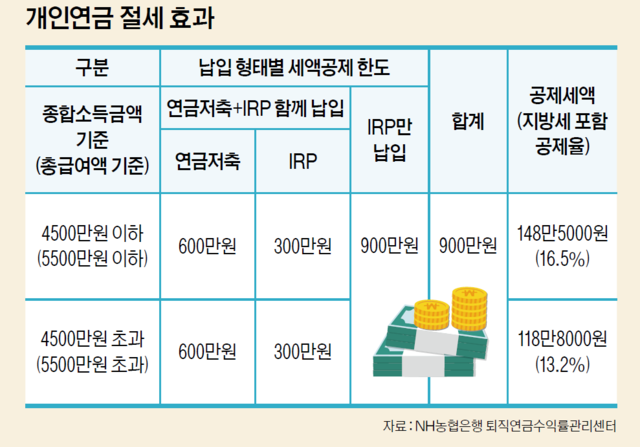
If you join personal pension savings alone, you can receive a tax deduction on annual contributions of up to 6 million KRW. However, if you utilize an IRP account in addition to this, the total deduction limit increases significantly to 9 million KRW per year. Workers with a total annual income of 50 million KRW or less can enjoy a high deduction rate of 16.5%, resulting in a maximum tax refund of 1.485 million KRW. Even office workers with incomes exceeding 50 million KRW can benefit from a 13.2% deduction rate, making this an essential wealth management tool for employees. Setting up automatic monthly transfers of a fixed amount allows you to naturally fill the limit without the stress of gathering a large sum at year-end. For dual-income couples, it is much more advantageous for both partners to open personal pension savings accounts in their own names to receive deduction benefits. Rather than concentrating contributions on one side, filling the limits for both partners considering their income brackets is the shortest way to reduce the household’s overall tax burden. Looking at the household budget of So-yeon, a mother of multiple children, you can see that while her living expenses and loan interest are tight, she strives to make consistent, even if small, contributions to her pension savings. Although immediate cash flow may be tight, once you experience the joy of receiving tax refunds from a long-term perspective, the habit of saving develops naturally. If you want to feel the thrill of receiving a refund while your colleagues are paying taxes during the year-end settlement season, you should check your contribution amount immediately.
Filling the maximum 9 million KRW limit by combining pension savings and IRP maximizes your year-end tax refund.
4. Utilizing Comprehensive Asset Management Account (CMA) Maturity Funds
One method frequently used by investment experts is transferring the maturity funds from a Comprehensive Asset Management Account (CMA) directly into pension savings. If you terminate a CMA after fulfilling the mandatory 3-year subscription period and transfer the principal and returns to a pension account, you receive additional tax deduction benefits. Since the tax deduction limit is increased by 10% of the transferred amount (up to a maximum of 3 million KRW), this is a valuable tip that should never be missed. For example, if you have already filled your existing pension limit and add the CMA maturity funds, the scope of tax benefits you can receive in a single year expands significantly. This linkage strategy also serves as a powerful weapon for asset accumulation for middle-aged and older individuals or single people in their prime earning years. There are also increasing attempts to organically link pension accounts with various government support funds and policy financial products for the youth. Accounts like the Youth Tomorrow Savings Account or the Housing Dream Subscription Account serve as a bridge to accumulate seed money and convert it into long-term retirement assets. This structure allows those who manage their immediate living expenses while securing savings capacity and creating an initial lump sum to naturally flow into the pension market. The financial industry is also trending toward offering various customized strategies and composite products tailored to these changes in the customer life cycle. Focusing on accumulating a lump sum when young and transferring assets to pension accounts with significant tax benefits after middle age is close to the correct approach.
Transferring CMA maturity funds to pension savings allows you to enjoy additional tax deduction benefits as a bonus.
5. Risks of Early Termination and Countermeasures
Personal pension savings are products designed to lock in money for a very long period to prepare for retirement, so breaking the contract midway results in significant losses. If you terminate the contract due to unavoidable circumstances, you must not only return all the tax deduction benefits received to date but also pay miscellaneous income tax. You can often see people around you who regretted terminating their accounts when they urgently needed money, only to be hit with a “tax bomb” after being happy about their tax savings. Therefore, it is most important to accurately assess your monthly income and fixed expenses and set contributions only to an amount you can afford. You must absolutely avoid the vicious cycle of forcing most of your salary into savings, lacking living expenses, and then breaking the fixed deposit to cover the shortfall. If you face significant economic difficulties during the contribution period, it is wiser to utilize systems for temporarily suspending or reducing contributions rather than terminating the account unconditionally. Contacting your financial institution to apply for a contribution suspension allows you to keep the account alive while taking a breather, which is a much smarter response. Establish the iron rule of not touching the funds before age 55 (retirement age) and manage your emergency fund separately in a completely distinct account. The essence of long-term investment is time, so the patience to endure without wavering in the middle is what creates the best returns. Balanced financial planning is essential to ensure that savings for a prosperous retirement do not become a shackle that squeezes your current life.
Since you must return all tax benefits upon early termination, the key is to maintain consistent contributions within an affordable amount.
6. Pension Investment Outlook for a Successful Retirement
In the coming era of an aging society, it will be difficult to maintain a comfortable life with only the pensions paid by the state, making the importance of personal pension savings even greater. As post-retirement life becomes longer, only assets prepared step by step from a young age can serve as a sturdy shield for retirement. We recommend that you check your financial goals and income level now and start with automatic transfers of an amount you can realistically practice monthly. Imagine receiving a larger refund than others during the year-end settlement season and enjoying the leisure of a warm cup of coffee after retirement. Small changes in habits will bring a miracle that completely transforms your bank balance and quality of life 10 or 20 years from now. Financial market trends are also rapidly shifting from short-term capital gains to long-term tax savings and stable cash flow generation. This is also why more smart young people are opening their eyes to pension accounts from their early career days, in addition to middle-aged and older individuals approaching retirement. While referring to expert advice, you need the attitude to periodically check your fund portfolio considering your investment style and risk tolerance. Based on what you have learned today, try opening a pension account suitable for you by logging into your main bank or securities firm app starting tomorrow. You will surely find yourself smiling a few years from now, looking at a substantial refund and grown assets instead of a tax bomb.
A consistent attitude of managing pension savings from a long-term perspective completes a prosperous life after retirement.
Frequently Asked Questions
=