Receiving your retirement pension is not simply about getting a deposit into your bank account when you quit your job; it is a critical juncture where the choice of account and method determines whether you can avoid a tax bomb and protect your retirement funds. Last year, Manager Kim, who left a large corporation, received his severance pay as a lump sum and regretted it greatly after paying much higher taxes than expected. In contrast, his colleague transferred the funds to an Individual Retirement Pension (IRP) account and received them as a pension, significantly reducing his tax burden. In this article, we will thoroughly examine everything from the concepts of Defined Benefit (DB), Defined Contribution (DC), and Individual Retirement Pensions (IRP) to the specific procedures for receiving the funds. Checking where your severance pay is currently held is the first step toward wise retirement preparation. From here, we will break down complex financial terms to guide you on how to protect your valuable assets.
=
Complete Guide to Receiving Your Retirement Pension: IRP Accounts and Tax-Saving Tips
1. Identifying Your Retirement Pension Type
To receive your retirement pension correctly, you must first accurately determine whether your company’s plan is a Defined Benefit (DB) plan, a Defined Contribution (DC) plan, or an Individual Retirement Pension (IRP). Many employees know that their company contributes to a retirement pension every month, but they often do not know specifically which type of plan they are enrolled in. A Defined Benefit plan is a method where the company directly manages the funds and pays a predetermined amount upon retirement, resulting in less management burden for the employee. On the other hand, a Defined Contribution plan is structured so that the employee directly selects and manages investment products, and the final amount received varies based on the investment results. If you are a self-employed individual or are managing severance pay received from a previous employer separately, you likely already have an IRP account. Since the management entity and responsibility differ for each system, there are subtle differences in the receiving methods and application procedures. Checking your current enrolled products through your company’s HR department or the financial institution’s application is a very simple process. Knowing your exact status allows you to smoothly plan the next steps, such as opening an account and formulating a receiving strategy.
Before receiving your retirement pension, you must verify whether your plan is a Defined Benefit or Defined Contribution type.
2. Opening an IRP Account and Essential Conditions
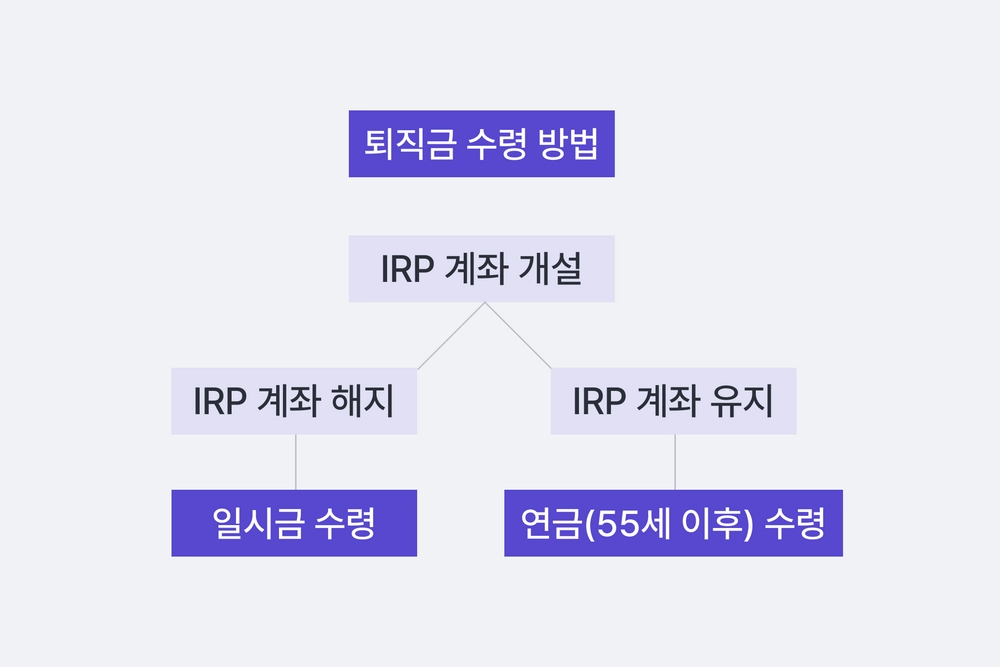
To receive your severance pay as a pension or a lump sum, you must open an Individual Retirement Pension (IRP) account in your own name. You can easily open an account non-face-to-face through various financial institutions such as banks, securities firms, and insurance companies, and it is advisable to compare fee conditions. For example, Mr. Park, an office worker, opened an IRP account in just 5 minutes using his main bank’s mobile app and provided the account number to his company’s representative. The company is legally obligated to deposit the full amount of severance pay into this IRP account within a specified period from the date of resignation. A crucial point in this process is that, except for legally defined exceptions, severance pay must be transferred to an IRP account. In cases of short tenure or small amounts, it may be possible to receive the funds directly into a regular bank account as an exception, but for most cases, transfer to an IRP account is mandatory. Carefully reviewing fee waiver benefits and promotional conditions offered by financial institutions when opening the account can be a significant long-term advantage. Once the account is successfully opened and the company completes the deposit, you are ready to formally apply for the receipt of funds.
Opening an Individual Retirement Pension (IRP) account in your own name is essential for receiving severance pay.
3. Differences Between Lump-Sum and Pension Receipt

Deciding whether to receive your severance pay as a lump sum or as a monthly pension is a crucial choice that determines the longevity of your retirement funds. Receiving a lump sum has the advantage of providing a large amount of cash at once, which can be immediately utilized for purposes such as purchasing a home or business capital. However, having a large sum of money can lead to increased spending or risky investments, significantly increasing the risk of losing assets. On the other hand, receiving it as a pension ensures a stable cash flow for at least 10 years, greatly alleviating concerns about living expenses in retirement. From a tax perspective, receiving a pension is overwhelmingly advantageous because it allows for substantial tax reductions when calculating retirement income tax. In fact, receiving 100 million won as a pension over 10 years can reduce taxes by up to 70% compared to receiving it as a lump sum. By adjusting the annual pension receipt amount to stay within a certain limit, you can minimize the tax burden while safely growing your assets. Therefore, unless you urgently need a large sum of money, you should seriously consider the pension receipt method for your retirement.
Receiving funds as a pension saves significantly more in taxes compared to a lump sum and secures stable retirement living expenses.
4. Pension Receipt Requirements and Payment Schedule
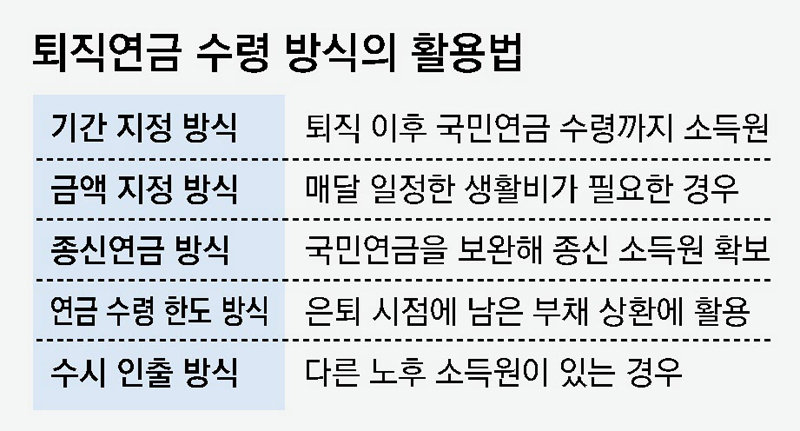
To receive your retirement pension in the form of a pension, you must meet several legally stipulated requirements. The most basic requirements are that the subscriber must be at least 55 years old and must have held the retirement pension account for more than 5 years. Mrs. Lee, a housewife, tried to withdraw her funds before turning 55 after early retirement, but because she did not meet the requirements, she could only proceed with a general termination. If you must use the funds before turning 55, it will be processed as an early withdrawal or general account termination rather than pension receipt, meaning you will not receive tax benefits. Additionally, pension payment schedules may vary slightly depending on the financial institution and the type of product managed, so it is safe to check in advance. For example, principal-and-interest guaranteed products and performance-linked funds have different cash-out speeds, so the date the money actually arrives in your account may differ after application. During periods overlapping with holidays or long weekends, financial institutions’ processing times may be delayed, so you should plan your finances with some buffer. Knowing the exact payment schedule allows you to handle important schedules such as utility bill payments and loan repayments without issues.
You must be at least 55 years old and have a membership period of more than 5 years to receive a regular pension.
5. Tax Calculation for Retirement Pension Receipt
The taxes incurred when receiving a retirement pension must be carefully examined and divided into retirement income tax and pension income tax based on the nature of the income. The retirement income tax imposed when receiving funds accumulated by the company has a structure where the deduction benefit increases with longer employment periods, thereby reducing the tax burden. In addition, the amounts you personally contributed to the IRP account to receive tax deductions, along with their investment returns, are subject to pension income tax when received as a pension. The pension income tax rate varies depending on the recipient’s age, with the rate gradually decreasing as one gets older, and the lowest rate applying after age 70. Retiree Mr. Choi initially found it very difficult to understand how taxes were differently imposed on retirement income versus additional contributions. However, through a bank consultation, he learned that the severance pay itself is subject to a lower retirement income tax rate, while pension receipts are subject to tax rates applied based on the period. To avoid paying unnecessary high taxes, you need the wisdom to meticulously manage your pension receipt amount to stay within the annual limit. Accurate knowledge of taxes becomes the most powerful weapon for protecting your valuable assets, down to the last won, after retirement.
Retirement income tax and pension income tax are applied differently depending on the receipt method and age, so prior study is necessary.
6. Pension Management Strategies for a Successful Retirement
Retirement pension does not end with simply receiving the funds; the level of prosperity in your retirement varies completely depending on how you manage the funds during the receipt process. If you tie up all your funds in safe cash assets just because you have retired, your real asset value may decrease as it fails to keep up with inflation. Therefore, you must continue to manage your pension account by appropriately allocating stable principal-and-interest guaranteed products and some investment products that seek returns. Financial experts recommend a strategy of keeping a portion of total assets in steadily growing assets because the pension receipt period is long. It is important to maintain a flexible attitude to adjust your pension portfolio by periodically reviewing changes in the economic situation and tax law revision trends. Starting this autumn, various financial companies are introducing customer-tailored asset management tools, so actively utilizing these is also a good method. Life after retirement is longer than you might think, so only thorough planning and consistent interest can guarantee a comfortable and leisurely retirement. Please start with the small action of opening your pension account today to check which products your money is invested in.
You must continuously manage and allocate pension assets even after retirement to cope with inflation.
Frequently Asked Questions
=