
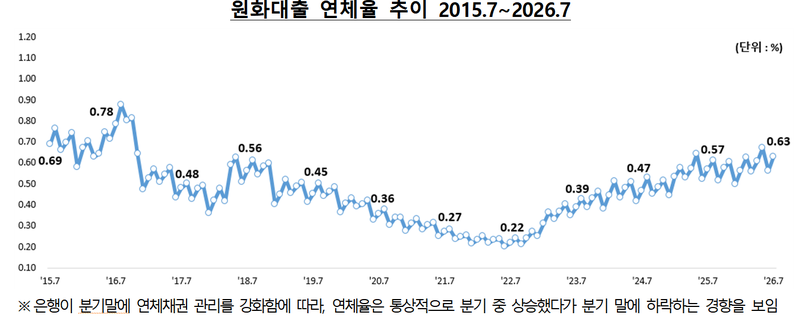
The successive workouts and commencement of rehabilitation procedures for Central Group affiliates pushed the delinquency rate for large corporate loans in July to its highest level in five years. According to the Financial Supervisory Service’s report on the status of won loan delinquency rates, the overall delinquency rate rose by 0.07 percentage points from the previous month to 0.63 percent. In particular, the delinquency rate for large corporate loans increased by 0.14 percentage points from the previous month to 0.36 percent, marking the highest figure since July 2021. Meanwhile, the household loan delinquency rate also rose slightly but remained slightly lower than the same month of the previous year. The FSS pointed to rising market interest rates and the restructuring of Central Group as the main causes. This article will examine the background of these figures, changes in specific items, and future implications in order.
=
Aftermath of Central Group’s Restructuring and Workout… July Corporate Loan Delinquency Rate Hits 5-Year High

1. Overview of Central Group’s Workout and Rehabilitation Procedures
Central Group has seen multiple affiliates enter workouts simultaneously since last June, with the process expanding to court-supervised rehabilitation in July. A workout is a procedure aimed at debt repayment deferrals and restructuring, while rehabilitation is a system that allows businesses to continue operations under court supervision while adjusting debts. The procedures undertaken this time were primarily intended to resolve liquidity crises that arose in the real estate development and construction sectors. Since financial institutions held large-scale loans to these affiliates, the risk of delinquency increased immediately after the workout announcement. In fact, new delinquencies in July amounted to 3.2 trillion won, an increase of 600 billion won from the previous month. This was driven by new delinquent claims worth several hundred billion won arising from Central Group affiliates. The FSS explained that these new delinquencies led to the rise in the overall corporate loan delinquency rate.
The workout and rehabilitation procedures for Central Group affiliates triggered large-scale new delinquencies, pushing up the delinquency rate for large corporate loans.
2. Trends in Overall Won Loan Delinquency Rates

According to the Financial Supervisory Service, the delinquency rate for won loans at domestic banks at the end of July was recorded at 0.63 percent. This represents an increase of 0.07 percentage points from 0.56 percent in the previous month and is 0.06 percentage points higher than the same month last year. The rise in the overall delinquency rate is the result of simultaneous impacts on both corporate and household loans. The corporate loan delinquency rate rose by 0.10 percentage points from the previous month to 0.78 percent. This indicates a trend of rising again after a decline in June from 0.84 percent in May. The household loan delinquency rate increased by 0.02 percentage points from the previous month to 0.42 percent, but was 0.01 percentage points lower than the same month last year. The delinquency rate for mortgage loans rose by 0.01 percentage points from the previous month to 0.29 percent. The delinquency rate for other household loans, excluding credit loans, increased by 0.07 percentage points from the previous month to 0.84 percent.
The overall won loan delinquency rate recorded 0.63 percent, showing a clear upward trend compared to the previous month due to simultaneous increases in both the corporate and household sectors.
3. Detailed Analysis of Large Corporate Loan Delinquency Rates
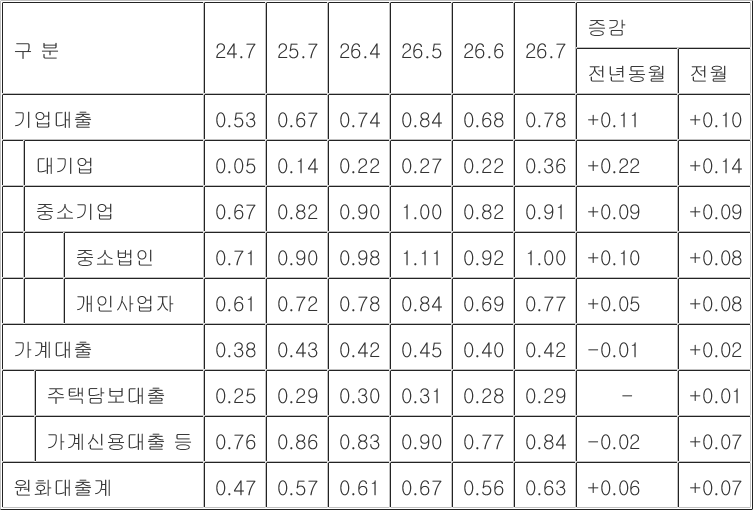
The delinquency rate for large corporate loans rose by 0.14 percentage points from the previous month to 0.36 percent, which is 0.22 percentage points higher than the same month last year. This figure is the highest level in five years, surpassing the 0.37 percent recorded in July 2021. The FSS identified the workout and rehabilitation procedures for Central Group affiliates as the main cause of the increase in the large corporate loan delinquency rate. In particular, banks that had directly lent to Central Group faced difficulties in recovering large-scale claims, leading to an increase in the scale of delinquencies. The portion of new delinquencies in July related to large corporations is estimated at approximately 1.8 trillion won. This accounts for more than half of all new delinquencies. Additionally, the scale of delinquent claim resolution for large corporate loans decreased compared to the previous month, meaning new inflows outpaced resolutions. This structural imbalance acted as a factor sustaining the rise in the delinquency rate.
The delinquency rate for large corporate loans rose to 0.36 percent due to the impact of Central Group, recording a five-year high.
4. Trends in SME and Individual Business Owner Loans
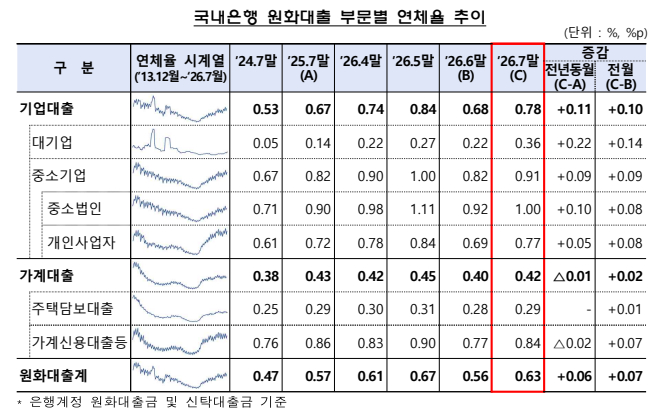
The delinquency rate for SME loans rose by 0.09 percentage points from the previous month to 0.91 percent. Among these, the delinquency rate for small and medium-sized corporate loans increased by 0.08 percentage points from the previous month to 1.00 percent. The delinquency rate for individual business owner loans rose by 0.08 percentage points to 0.77 percent. While the SME sector has more diverse funding channels than large corporations, the burden of debt repayment has increased due to the overall economic slowdown and rising interest rates. In particular, delinquency cases have increased in the small-scale manufacturing and retail sectors. The FSS stated that it is strengthening monitoring of vulnerable SME groups and considering expanding guarantee support if necessary. Additionally, regarding individual business owner loans, income volatility is a factor contributing to the rise in delinquency rates.
The delinquency rates for SME and individual business owner loans rose by 0.09 and 0.08 percentage points, respectively, indicating a general deterioration in the soundness of the corporate sector.
5. Changes in Household Loan Items
The household loan delinquency rate rose by 0.02 percentage points from the previous month to 0.42 percent, but decreased by 0.01 percentage points compared to the same month last year. The delinquency rate for mortgage loans increased by 0.01 percentage points from the previous month to 0.29 percent. This is due to a slight increase in the burden of principal and interest repayments alongside the weakness in the real estate market. The delinquency rate for other household loans, excluding credit loans, rose by 0.07 percentage points from the previous month to 0.84 percent. This category includes card loans and overdraft accounts, with the increased interest burden due to rising interest rates acting as a major cause. As the delinquency rate for consumer credit overall rises, there are concerns that household consumption capacity may be squeezed. The FSS announced that it will expand debt restructuring programs for vulnerable groups and strengthen financial education to prevent delinquencies. Overall, while the increase in household loans is smaller than that of corporate loans, sustained interest rate pressure could act as a risk factor in the future.
The household loan delinquency rate rose slightly, but showed mixed signals regarding overall soundness as mortgage loans and other loan items exhibited different movements.
6. Outlook and Recommendations for Readers

The FSS predicted that pressure on delinquency rates to rise could continue if the trend of rising market interest rates persists for the time being. In particular, if the resolution of claims related to Central Group is delayed, there is a possibility that the delinquency rate for large corporate loans could rise further. Therefore, banks should expand the scale of allowance for loan losses and actively promote the sale of non-performing loans. Companies should proactively manage cash flow and restructure their debt to enhance financial soundness. For households, it is advisable to convert variable-rate loans to fixed-rate loans or to refrain from excessive consumption. Readers should review their loan conditions and formulate strategies to minimize risk by utilizing financial counseling centers if necessary. It is important to proactively respond at both the individual and corporate levels while keeping a close eye on future economic trends and the policy direction of financial authorities.
If the effects of rising interest rates and restructuring persist, there is a risk of further increases in delinquency rates, and proactive soundness management is needed for banks, corporations, and households alike.
Frequently Asked Questions
=