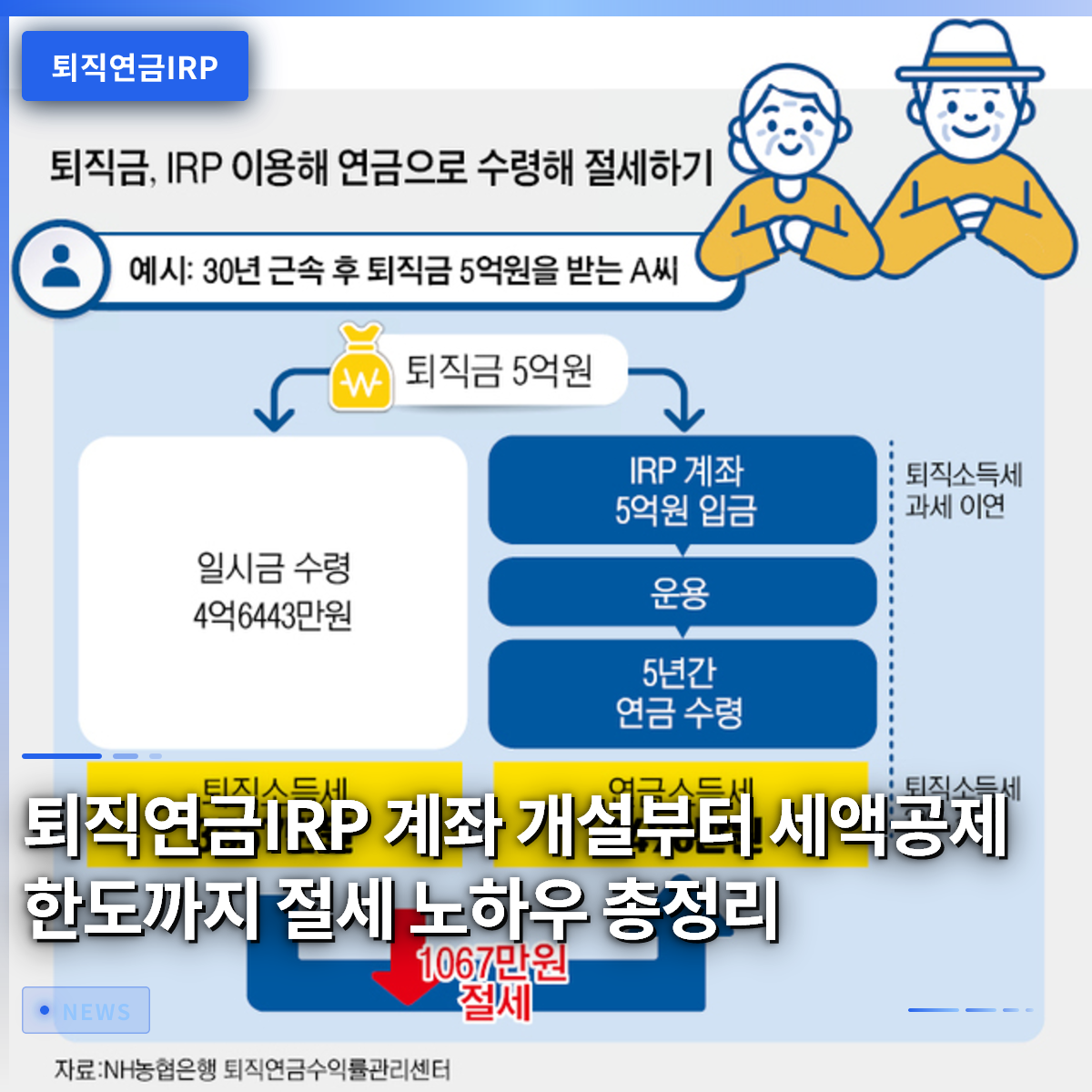
The Retirement Pension IRP (Individual Retirement Pension) account is the ultimate tax-saving tool that not only provides a solid foundation for your post-retirement life but also delivers significant tax refunds during the year-end tax settlement. Mr. Kim, an office worker, maxed out his contribution limits for both pension savings and the Retirement Pension IRP last year. As a result, he was pleasantly surprised by the substantial refund he received during this year’s year-end tax settlement. Many people overlook the importance of this account when receiving their severance pay or voluntarily saving for old age. However, by properly understanding and utilizing the system, you can avoid a tax burden and grow your assets efficiently. In this article, we will explain the core structure of the Retirement Pension IRP, year-end tax settlement benefits, and effective asset management methods in an easy-to-understand manner.
=
A Complete Guide to Tax Savings: From Opening a Retirement Pension IRP Account to Maximizing Tax Deduction Limits
1. Basic Concepts and Eligibility for Retirement Pension IRP

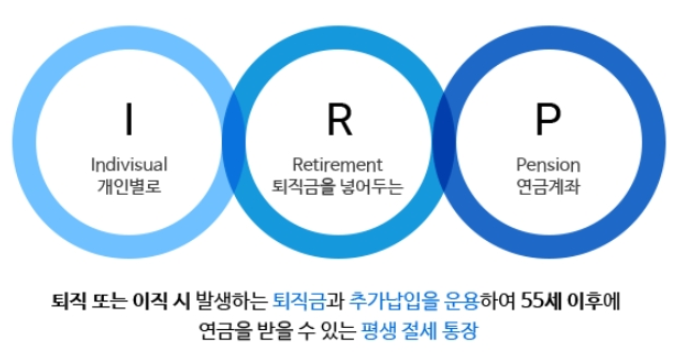
The Retirement Pension IRP is a personal retirement pension that allows employees to accumulate their severance pay in an account in their own name and continue investing it until retirement. You can join at any time while employed and make additional contributions from your discretionary funds. Self-employed individuals with income, civil servants, and others can also join freely. While it was once considered exclusive to office workers, it has now become a universal retirement preparation tool accessible to almost all economically active individuals. It can be easily opened through various financial institutions such as banks, securities firms, and insurance companies, and one person can hold multiple accounts. However, when considering tax benefits and asset management efficiency, it is wise to carefully compare and decide based on your primary financial institution or those with lower fees.
The ability to manage your account according to your income type and retirement timing goals is paramount. In particular, if you simply receive your severance pay in a regular bank account when changing jobs, you will immediately incur severance income tax. To enjoy the full benefit of compound interest until retirement, you must transfer your severance pay to a Retirement Pension IRP account to benefit from tax deferral. I often see cases where people lose a portion of their valuable severance pay to taxes because they are unfamiliar with this system. Therefore, if you are planning to change jobs or retire, the first step is to consult with the accounting department or a financial institution representative to safely transfer funds to the account.
The Retirement Pension IRP is an essential account that anyone can join to accumulate retirement funds and save on taxes.
2. Year-End Tax Settlement Deduction Limits and Strategies to Maximize Benefits
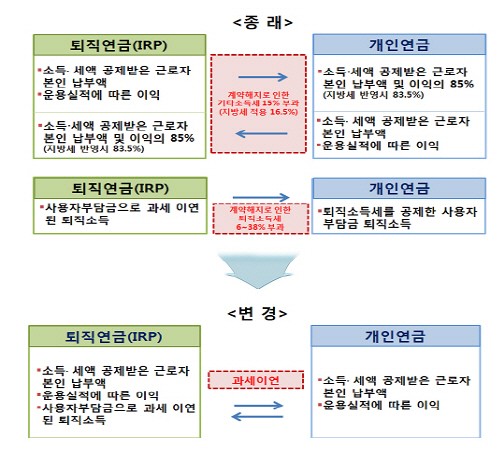
As the year-end tax settlement season approaches, the biggest concern for office workers is undoubtedly how much tax deduction benefit they can receive. Combining pension savings and the Retirement Pension IRP allows you to receive a certain percentage of tax refund within the annual maximum contribution limit, making it an essential wealth management tool for employees. Employees with total income below a certain level are eligible for a higher deduction rate, so it is advantageous to max out the contribution limit. For example, if you consistently contribute monthly to fill the annual contribution amount, you can enjoy the joy of receiving a refund of several hundred thousand to over one million won during the year-end tax settlement. However, amounts exceeding the annual contribution limit can be carried over to the following year for deduction, so you can adjust flexibly according to your financial situation.
To maximize tax savings, you must first accurately understand your annual income and the tax deduction criteria. Occasionally, people scramble to gather cash to make contributions, only to face penalties or have to withdraw early when they urgently need money. Since you will pay a lower pension income tax when receiving the amount as a pension in the future based on the deducted amount, you should approach this from a long-term perspective rather than chasing short-term tax savings. Instead of rushing to join right before the year-end tax settlement season, making consistent monthly contributions starting from the beginning of the year is a good way to reduce financial burden. By effectively utilizing various events and mobile gift card benefits offered by financial institutions, you can complete a frugal tax-saving plan while also securing small additional income.
By combining pension savings and the Retirement Pension IRP to fill the tax deduction limit, you can significantly increase your year-end tax settlement refund.
3. The Tax Deferral Effect When Transferring Severance Pay to an IRP
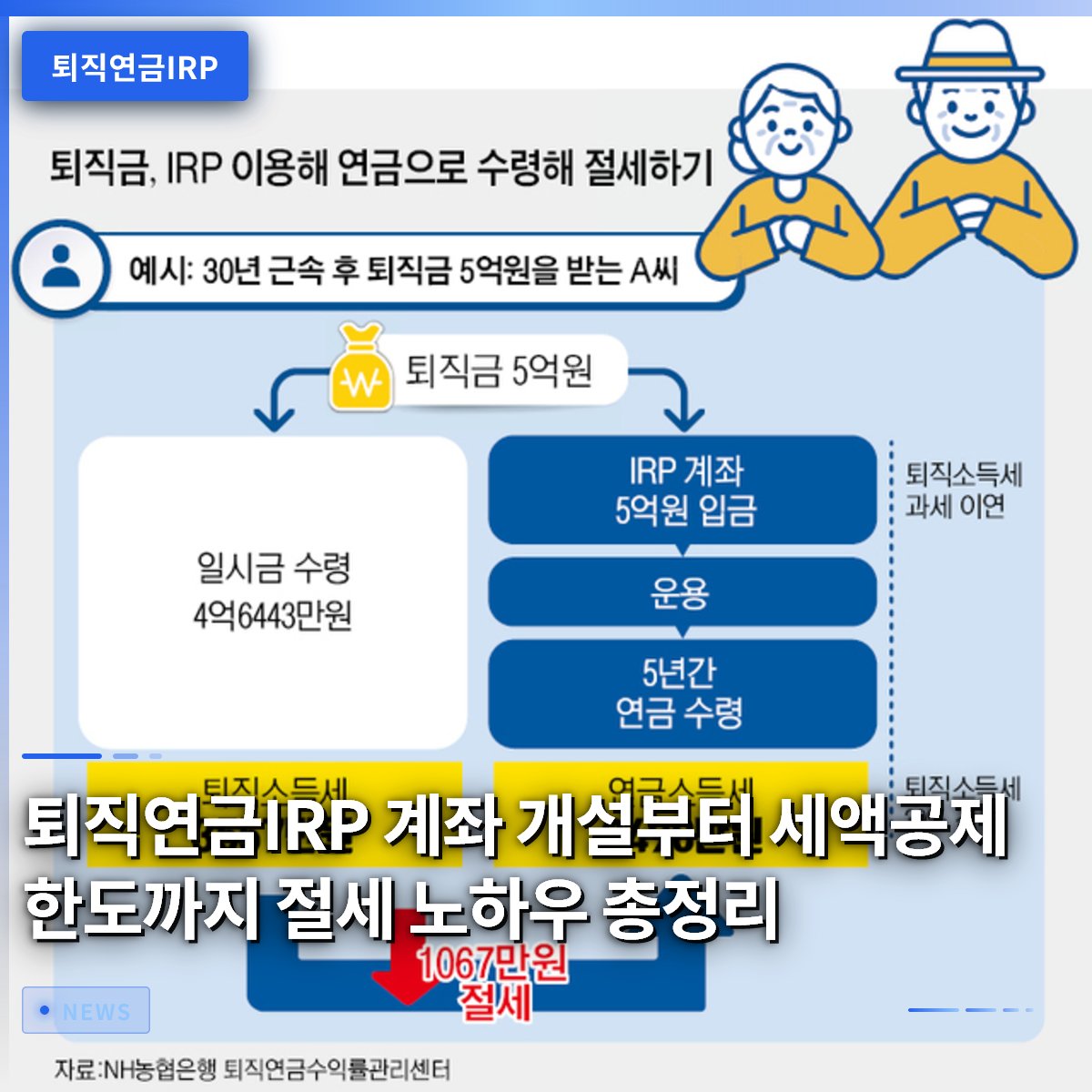
If you receive your severance pay in a regular bank account when leaving your job, severance income tax is immediately withheld, significantly reducing the lump sum. However, if you transfer your severance pay directly to a Retirement Pension IRP account, the tax deferral benefit applies, meaning you do not pay taxes immediately but defer them until you receive the pension. Since the money that would have gone to taxes remains in the account to continue generating investment returns, the asset growth effect becomes enormous over time. For example, whether you invest the full 100 million won severance pay or only the amount remaining after tax deduction creates a massive asset gap 10 or 20 years later. This tax deferral system serves as the most powerful weapon in preserving and growing the size of your retirement funds.
Tax-deferred severance pay, when received as a pension in installments after age 55, is subject to a pension income tax rate much lower than the original severance income tax. Since the tax burden is reduced by more than 30%, it is overwhelmingly more advantageous for tax purposes than receiving it as a lump sum. Mr. Park, an office worker nearing retirement, initially planned to receive his severance pay in a lump sum to start a business but changed his mind to deposit it into an IRP and receive it over 15 years on the advice of those around him. He is satisfied, saying his anxiety about old age melted away as he saw a stable monthly amount deposited into his account. As such, the process of designing a pension rather than using a lump sum all at once becomes a decisive turning point that determines the quality of life after retirement.
Transferring severance pay to an IRP allows you to grow your assets further through the tax deferral effect, where taxes are paid later.
4. Pension Receiving Timing and the Secret of the 15 Million Won Annual Limit
When receiving Retirement Pension IRP assets as a pension after age 55, you must be careful not to exceed a certain annual amount to avoid a tax bomb. According to relevant tax laws, if the annual pension receipt exceeds 15 million won, you may face disadvantages when choosing to pay comprehensive income tax by combining it with other income or opting for separate taxation. Many people think that receiving more is always better, but if you inadvertently trigger a higher tax bracket, you could actually incur a loss, so wisdom in adjusting the receiving period is necessary. The core technique for tax savings is to design the receiving period, such as 10 or 15 years, so that you can receive up to 15 million won annually. Retirement planning experts unanimously advise that adhering to this limit is a hidden decisive factor in managing old-age assets.
By calculating the monthly receipt amount to ensure it does not exceed the 15 million won annual benchmark, you can get a sense of how much money will come into your account each month. For example, if you have 100 million won in retirement pension assets and receive them evenly over 10 months, you can create a stable cash flow while minimizing the tax burden. To prevent a situation where you unknowingly try to withdraw a large amount of pension quickly and end up paying a huge amount in taxes due to a lack of knowledge about the system, you must plan your receipt schedule in advance. It is essential to simulate the expected receipt amount and taxes through the consultation desk of a bank or securities firm. Wise retirees cleverly navigate around this tax bracket to create the optimal receiving schedule that is most advantageous to them.
You should adjust your annual pension receipt to within 15 million won to reduce the tax burden and increase actual income.
5. Investment Product Management Methods and Mandatory Safe Asset Ratios
It does not end with just opening a Retirement Pension IRP account; the final rate of return varies significantly depending on which products you invest in within it. Laws mandate maintaining a certain level of investment ratio between safe and risky assets, which helps defend against the risk of principal loss. You can invest up to 70% of the total accumulated funds in risky assets such as equity funds or exchange-traded funds (ETFs), and the remainder must be filled with safe assets such as deposits or bonds. Mr. Jeong, an office worker, initially kept his funds only in deposits but realized they were not keeping up with inflation. He then appropriately mixed high-quality bond funds and equity products within the safe asset limit. As a result, he smiled as he achieved a return rate much higher than regular bank deposit rates while maintaining stability.
Financial institutions are introducing AI-based fund management systems and automatic diagnostic programs to help customers easily check their portfolios. You must monitor how your assets are performing in real-time via mobile apps when market conditions change rapidly and periodically execute rebalancing by switching products as needed. A strategy of appropriately maintaining a high proportion of equity assets to aim for compound interest is advantageous when there is a long time until retirement, while funds should be preserved primarily in safe assets as the retirement date approaches. Money left unmanaged will inevitably lose value against inflation, so you must find the optimal product combination that suits your investment style. By actively utilizing asset management solutions provided by various financial institutions, even beginners can manage their return rates without much difficulty.
You must actively manage your portfolio within the Retirement Pension IRP while adhering to the ratio of safe and risky assets to increase your return rate.
6. Early Withdrawal Conditions and How to Handle Unavoidable Situations
The most significant feature of the Retirement Pension IRP is that, as it is fundamentally for post-retirement life, early withdrawal is generally impossible before age 55. However, early withdrawal is permitted in exceptional situations defined by law, such as when purchasing a house, securing a deposit for a rental, or when you or a family member suffers from a disease requiring long-term treatment. Even in extreme crisis situations such as bankruptcy or personal rehabilitation proceedings, a path is opened to utilize part of the funds through exception clauses. Many people find themselves in a panic when they suddenly need a large amount of money because they do not recall this system, so it is good to familiarize yourself with the early withdrawal requirements in advance. However, since early withdrawal can render previous tax benefits void or result in other income tax, it should only be considered as a last resort.
When you need urgent cash before retirement, it is much wiser to first explore the possibility of contract loans or loans secured by other assets rather than unconditionally closing the account. Once you break the retirement funds you have carefully accumulated, it is very difficult to restore them, so maintaining the account is beneficial in the long run. Since financial market trends and related tax laws are updated slightly every year, you need to have the attitude of frequently reviewing the terms of the products you have joined. As the aging population accelerates, the role of the Retirement Pension IRP will become even more significant, and the government is expected to ease regulations to help citizens prepare for retirement. Even if it seems a bit cumbersome now, the effort to carefully manage and maintain your account is the most certain key to determining a prosperous life in the future.
The conditions for early withdrawal from a Retirement Pension IRP are very strict, so you should avoid closing it and maintain it until retirement.
Frequently Asked Questions
=