
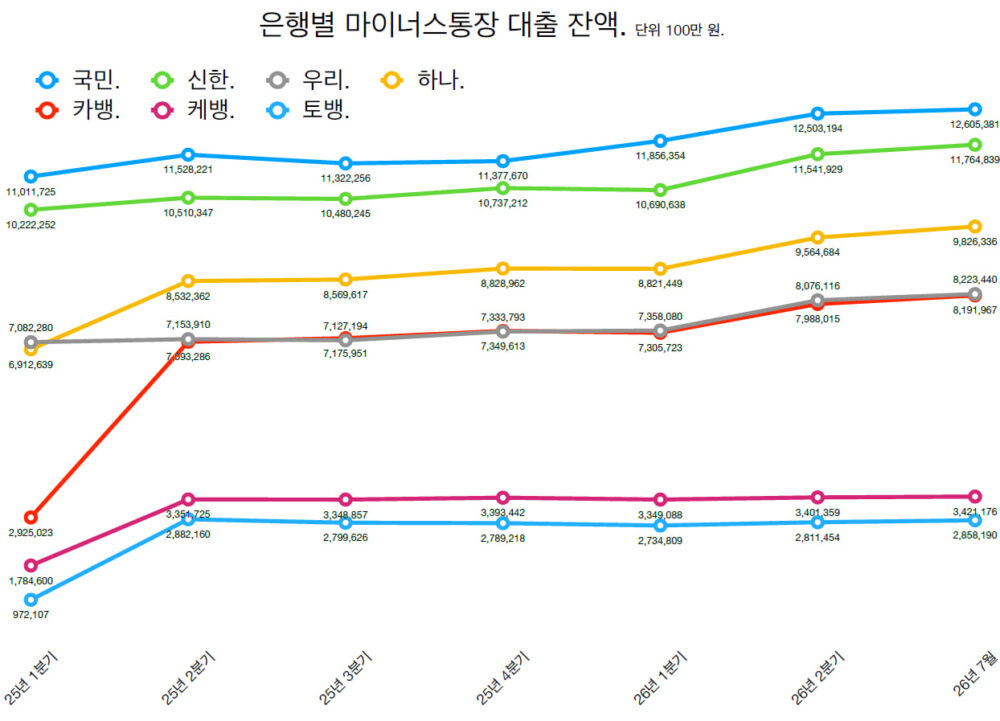
The outstanding loan balance for overdraft accounts at domestic banks has surged by over 6 trillion won since the beginning of the year, reaching the brink of 70 trillion won by the end of July. According to data submitted by the Financial Supervisory Service to Rep. Park Sung-hoon of the People Power Party, a member of the National Assembly’s Committee on Finance, the total overdraft loan balance at commercial banks has ballooned from the 63 trillion won range at the end of last year to 69.7283 trillion won recently. This figure does not simply represent the credit limits extended by banks; it signifies the actual size of debt that ordinary citizens and office workers have drawn and spent. Despite the number of accounts remaining nearly unchanged compared to the end of last year, the amount borrowed has skyrocketed by nearly 10 percent. This starkly reveals the plight of households pushed to the brink of financial limits to cover living expenses amid soaring inflation and an economic downturn. In this article, we will examine in detail the specific figures and background behind the explosive growth in overdraft balances.
=
Bank Overdraft Balances Approach 70 Trillion Won: Why Loan Balances Are Surging

1. The Shocking Reality of Overdraft Balances Nearing 70 Trillion Won

As of the end of July this year, the overdraft balance at domestic banks reached 69.7283 trillion won, bringing the era of 70 trillion won within sight. Compared to the end of last year, this means an additional 6.0874 trillion won in loans was executed in just a few months. In percentage terms, this represents a steep increase of approximately 9.6%, giving a glimpse into how depleted household cash flows have become. What was once used lightly as an emergency fund or for small expenses like grocery shopping has now become a primary source of funding. The number of people resorting to debt because their monthly salaries are no longer enough to cover soaring food and utility bills has surged. It is said that among colleagues and neighbors, it is rare to find anyone who has not maxed out their overdraft limit. As more people seek additional loans through bank counters or mobile apps, the entire financial sector is on edge. Experts predict that at this pace, overdraft balances will easily surpass 70 trillion won soon.
Bank overdraft balances have increased by nearly 7 trillion won this year, bringing them to the verge of surpassing 70 trillion won.
2. The Anomaly of Rising Debt Despite Stable Account Numbers

The most noteworthy aspect of this statistical data is the huge gap between the change in the total number of overdraft accounts and the rate of increase in loan balances. The number of overdraft accounts, which was approximately 4.86 million at the end of last year, reached about 4.89 million by the end of July this year, an increase of only about 24,000 accounts. In percentage terms, this is a negligible increase of less than 0.5%, indicating that the number of new accounts has essentially stagnated. This does not mean there has been an explosive increase in new debtors; rather, it means that existing account holders have drawn money up to the limit. In fact, when calculated based on valid, non-closed accounts, the average loan balance per account jumped from 13.07 million won at the end of last year to 14.25 million won by the end of July this year. This means that an average of over 1 million won in additional debt has accumulated per account in just a few months. This serves as evidence that people have exhausted their emergency credit limits to cover living expenses or pay credit card bills. The phenomenon where the number of accounts remains stable while the accounts themselves become empty is a warning sign that household disposable income has hit rock bottom.
While new account openings were minimal, the amount borrowed from existing accounts increased, pushing the average debt per account over 14 million won.
3. Why People Are Forced to Increase Debt Despite Unchanged Salaries
The main reason ordinary citizens and office workers are heavily relying on overdraft accounts is the endless rise in prices and the stagnation of real income. The prices of fruits, vegetables, and meat at local supermarkets and large marts have soared to levels that make people afraid to open their wallets. Even a single meal out is expensive, with the average lunch for office workers exceeding 10,000 won, causing bank accounts to empty quickly after payday. On top of this, rent, management fees, public transportation fares, and utility bills have all risen, causing household fixed expenses to snowball. Regular salaries fail to keep up with rising prices, creating a significant hole in cash flow. Consequently, people are forced to reach for overdraft accounts, the easiest way to borrow money, to cover their living expenses. Self-employed acquaintances report opening overdraft accounts to pay rent immediately as customer traffic dries up, while office workers complain of maxing out their limits to cover urgent hospital bills for their parents.
Loans for living expenses have surged as people struggle to cope with increased fixed expenses amid soaring inflation and stagnant income.
4. Why People Cannot Stop Borrowing Despite Heavy Interest Burdens

The problem is that the interest costs associated with overdraft loans are by no means negligible compared to the past. Although expectations for a base rate cut are fluctuating, the actual loan interest rates applied by commercial banks remain at high levels. Overdraft accounts often carry higher interest rates than general credit loans, leading to potential interest bombs. The interest automatically deducted from accounts each month can reach several hundred thousand won, further tightening household finances. Nevertheless, people are forced to maintain high-interest loans to pay for credit card bills, utility bills, and children’s tuition fees that are due immediately. There are countless ordinary citizens around us trapped in a vicious cycle of seeking new loans to pay off interest on existing ones. As this precarious balancing act of paying off debt with debt continues, concerns are growing about when the household debt bomb might explode.
Despite still high loan interest rates, people are burdened with high-interest debt to maintain their livelihoods and cover immediate payments.
5. Emergency Signals for Household Debt Management and Future Economic Outlook

With bank overdraft balances approaching 70 trillion won, financial regulators and economic experts are sounding the alarm. When the scale of household debt becomes disproportionately large relative to the overall economy, it becomes a primary factor reducing the nation’s overall consumption capacity. As citizens close their wallets because they have no money left after repaying debts, sales for self-employed individuals and small and medium-sized enterprises also decline, plunging the economy into a recession. While the government and financial institutions are reviewing various regulatory measures to curb the rise in household loans, they are in a difficult position as they cannot simply block livelihood loans for ordinary citizens. As long as employment remains unstable and there are no signs of income improvement, overdraft balances are likely to remain high or increase further rather than decrease in the near future. For individuals, it is crucial to be cautious about indiscriminate credit loan extensions and to exercise the wisdom to drastically cut unnecessary expenses.
The surge in overdraft accounts signals a red light for both the national economy and household financial health, highlighting the urgent need for thorough management.
6. Wise Fund Management and Future Countermeasures

Overdraft accounts can be as tempting as a drug due to the convenience of being able to withdraw money whenever needed. However, if one only pays interest without repaying the principal, they may find themselves crushed under a growing pile of debt, pushed to the brink of household financial ruin. First, one must carefully review their income and expenses and drastically cut unnecessary subscription services and dining out costs. It is necessary to gradually reduce overdraft limits or repay the principal whenever surplus funds are available to lower the interest burden. One should also consistently check economic news and information on policy support loans to avoid missing opportunities to refinance high-interest debt with lower-interest options. In difficult economic times like now, making thorough budget plans and avoiding excessive borrowing is the only way to protect one’s assets. It is strongly recommended that you start today by calmly assessing your account balances and loan status and formulating an emergency plan.
You must reduce unnecessary expenses, gradually repay the principal of overdraft accounts, and thoroughly manage household debt risks.
Frequently Asked Questions
=