To manage your retirement pension efficiently, you must accurately understand and select the asset management account that suits your employment type, whether it is a Defined Contribution (DC) plan or an Individual Retirement Pension (IRP) account. For decades, many employees have carefully reviewed the retirement benefit systems funded monthly by their companies to prepare for life after retirement. However, when changing jobs or approaching retirement, many find themselves at a loss, unsure of how to best manage their funds. For example, Mr. Kim, a man in his 30s working in Seoul, once left his company’s monthly contributions untouched and was shocked to realize the difference in returns later on. In this article, we will clearly explain the differences between DC and IRP accounts, as well as the depositor protection limits for safe fund management. Let’s take a step-by-step look at what you need to check right now to build a solid foundation for your retirement.
=
A Complete Guide to Choosing a DC-Plan IRP Account and Understanding Depositor Protection Limits
1. What is the Retirement Pension System?
The retirement pension is a system where companies accumulate funds to ensure employees can enjoy a stable life after retirement. In the past, the primary method was receiving a lump sum upon leaving the company. However, recent regulations mandate that funds be deposited with financial institutions to grow over time. Employers are legally required to contribute a certain amount at specified intervals, and failure to do so can result in legal penalties or other disadvantages. Mr. Park, who works at a small and medium-sized enterprise, experienced significant anxiety when his boss failed to make timely contributions to his retirement benefits. However, by researching the relevant regulations, he was able to confidently assert his rights. This system, established to protect workers’ valuable retirement assets, serves as a crucial financial safety net for both companies and employees. Although the monthly contributions may seem small, they can grow into substantial assets over time, so it is essential to stay informed.
The retirement pension is an essential asset management system where companies accumulate funds with financial institutions for employees’ retirement.
2. Differences Between Defined Contribution (DC) and Defined Benefit (DB) Plans
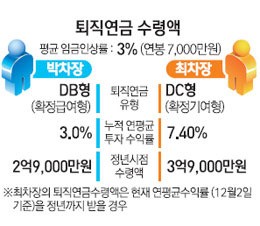
Company retirement asset management methods are broadly divided into Defined Benefit (DB) and Defined Contribution (DC) plans, each with distinct pros and cons. In a DB plan, the company directly manages the funds and determines the final payout amount in advance, bearing the risk of investment losses. In contrast, in a DC plan, the company deposits a fixed amount into the employee’s account each month, and the employee directly selects and manages various financial products such as stocks, bonds, and deposits. Mr. Lee, who was preparing to change jobs after turning 40, recently learned that his company’s plan was a DC plan and began actively changing his investment products. If you are confident in managing your own assets, a DC plan can offer the potential for higher returns, but it also carries the risk of losses. Therefore, it is wise to carefully consider your investment style and the time remaining until retirement, and consult with your company to choose the appropriate method.
A DC plan is a retirement asset management system where employees directly choose their investment methods to potentially increase returns.
3. How to Utilize an Individual Retirement Pension (IRP) Account
The Individual Retirement Pension (IRP) account is a useful tool for employees who have left their jobs or wish to add extra funds to their savings. This account allows you to consolidate retirement benefits received upon changing jobs and continue investing, while also enabling voluntary additional contributions to enjoy tax deduction benefits. Mr. Jung, an office worker, consistently deposits money into this account to receive tax refunds during his annual tax settlement, continuing his prudent financial management. Additionally, it offers the advantage of holding various products such as funds and Exchange-Traded Funds (ETFs), providing a wide range of asset growth opportunities. However, withdrawing funds before retirement is strictly limited to specific reasons, so careful consideration is needed if you require emergency funds. For modern office workers who want to enjoy both retirement preparation and tax benefits, this account has become an essential rather than an optional tool.
An IRP account is an essential tool for consolidating funds upon job changes while simultaneously securing tax deductions and investment opportunities.
4. Depositor Protection Limits and Diversification Tips
The first safety measure to check when entrusting money to a financial institution is the separate protection limit under the Depositor Protection Act. According to the relevant enforcement decree, general deposits, retirement pensions, pension savings, and insurance products each have a separate protection limit of 100 million won, ensuring safe protection. For example, if you have 100 million won in general deposits at one bank and another 100 million won in a retirement pension product, each is protected separately. Mrs. Choi, a housewife, used to worry constantly about the possibility of her bank going bankrupt, but since learning about these diversification criteria, she has been able to manage her assets with much greater peace of mind. Therefore, rather than concentrating large retirement funds in a single financial institution, it is a wise investment strategy to distribute them across multiple institutions. To protect your retirement funds safely, you must accurately understand the system’s protection limits and regularly check where your assets are held.
Retirement pensions are protected separately from general deposits up to 100 million won, making diversification advantageous.
5. Boosting Returns Through Diverse Financial Products
Simply keeping retirement assets in bank deposits may not keep up with inflation, potentially reducing the real value of your assets. Recently, the number of people investing in Exchange-Traded Funds (ETFs) that track domestic and global stock indices or high-quality bond products through securities firms or banks is rapidly increasing. For instance, many office workers include products containing semiconductor companies or global innovative firms in their pension accounts to achieve high long-term returns. Mr. Han, an office worker with a keen interest in financial management, recorded significantly higher returns than others by selecting excellent products with low total expense ratios to manage his retirement assets. Of course, since equity products have high price volatility, a strategy of increasing the proportion of safe assets like deposits or bonds is needed as retirement approaches. Adjusting the balance between risky and safe assets according to your investment age is the key to successful retirement preparation.
Diversifying investments in various ETFs and bonds within a pension account can yield returns that outpace inflation.
6. Information Protection and the Future of Safe Asset Management
When choosing a financial institution to entrust your valuable money to, you must carefully consider the stability of its computer systems and its information protection capabilities. Recently, major financial institutions have obtained rigorous information security management certifications, making every effort to safely protect customers’ financial information and assets. Mr. Kang, an office worker, recently compared the security levels of financial companies online and was able to change his retirement asset management institution with peace of mind. In the future retirement market, the criterion for choice will extend beyond simply pursuing high returns to how safely an institution protects and manages your information. In a changing financial environment, building your own knowledge and consistently reviewing your account will determine your post-retirement prosperity. Start by opening your retirement asset account now and checking which products your money is invested in.
A financial institution’s thorough information protection capabilities and secure systems are essential conditions for trustworthy retirement asset management.
Frequently Asked Questions
=