Many people find themselves sighing deeply every time they check their bank statements and see the rising premiums for their expense reimbursement insurance (실손보험). Friends often insist that the products they signed up for years ago are the best and advise them to hold onto them, while others argue that since they rarely use hospital services, they should switch to cheaper, newer products, adding to the confusion. For instance, Mr. Kim, an office worker who hasn’t visited a hospital in years, has considered canceling his policy simply because he feels the monthly premiums are a waste of money. However, there are many cases where people who switched policies without proper consideration later ended up facing a massive medical bill “bomb” after falling seriously ill, only to regret their decision. In this article, we will carefully compare which generation of insurance suits you best and thoroughly explore how to wisely reduce your expenses. To protect both your wallet and your health, you must clearly understand the pros and cons of each generational structure right now.
=
Comparing Expense Insurance: Generational Differences and Tips for Making the Best Choice
1. The History and Evolution of Expense Insurance from Generation 1 to 4
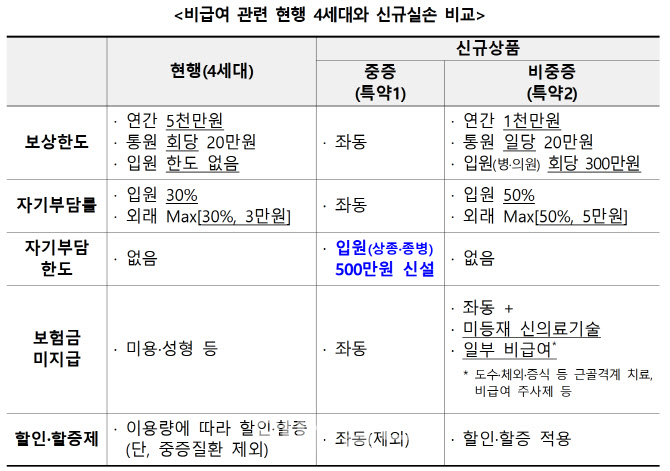
Generation 1 and 2 products, which were signed up for in the past, effectively reimbursed almost the entire cost of hospital bills, making them seem like a “golden goose” to policyholders. At the time, there were constant criticisms regarding moral hazard, and this became a major cause for insurance companies’ loss ratios to snowball. To correct this, the government and the industry implemented reforms by gradually increasing out-of-pocket costs and rationally adjusting coverage ranges. Generation 3 and the current Generation 4 products were born from these efforts, focusing on preventing over-treatment and lowering premiums for the majority of honest policyholders.
However, people accustomed to past benefits often believe that the changed system is inherently disadvantageous and are extremely reluctant to switch. They find it difficult to bear the soaring premiums at each annual renewal, yet they cling to their old policies simply because they are “old products.” In this process, most people rely on vague anxiety without considering their actual frequency of hospital visits or health status. You must properly understand the evolutionary process of each generation to prevent unnecessary insurance expenses and make the right decisions in the future.
You must understand the evolutionary process of each generation and changes in out-of-pocket costs to make the right product choice.
2. Realistic Differences in Non-National Health Insurance Coverage and Out-of-Pocket Costs

The most significant feature of recently launched products is that the personal burden ratio for non-national health insurance (non-NHI) treatment costs has increased considerably compared to the past. For example, if you frequently use non-critical non-NHI items such as physical therapy or vitamin injections, older products may be more advantageous. Conversely, if you rarely visit the hospital and only go for minor issues like a cold, the latest products with non-NHI discount benefits are much more economical.
Mrs. Lee, a housewife, was fully benefiting from her old product by receiving physical therapy twice a week for back pain. However, as the annual renewal increases became unbearable, she eventually faced a situation where her monthly payment skyrocketed to the level of an office worker’s rent. If you do not objectively reflect on your hospital usage habits, unnecessary expenses will continue to pile up. Carefully comparing the coverage limits and out-of-pocket costs for non-NHI items is the key to defending your spending.
The conditions of the advantageous product change completely depending on the frequency of non-NHI treatment usage.
3. The Secret Behind Premium Increase Rates and Renewal Cycles
The biggest pain point for people holding older products is the outrageous premium increase rate that arrives every year. As loss ratios spike, insurance companies are not hesitant to apply double-digit increase rates aligned with the renewal points of existing policyholders. Even if you signed up cheaply when you were young, you may find it impossible to maintain the policy if you hit a premium “bomb” when your income decreases with age.
On the other hand, recently launched products have relatively stable renewal cycles or structures where premiums are discounted or surcharged based on non-NHI usage volume. If you are a model policyholder who rarely visits the hospital, switching to the latest product can drastically lower your monthly fixed costs. Of course, it is easy to be scared just by looking at the immediate coverage details, but you must consider the total payment amount from a long-term perspective. If you consider your financial situation after retirement, insisting on keeping the old product is not always the best strategy.
To reduce long-term payment burdens, you must carefully examine the characteristics of renewal cycles and increase rates.
4. Essential Checks When Remodeling Your Existing Insurance
Before canceling your existing product or switching to another, you must first check your current health status and past medical history. If you have suffered from a major illness in the last few years or are undergoing continuous medication, an aggressive switch could be extremely harmful. This is because you might be rejected during the underwriting process for a new product or fail to secure the desired conditions, leading to a disadvantageous situation.
Every year, tens of thousands of consumers regret changing their contracts after blindly trusting recommendations from acquaintances or home shopping broadcasts. Your top priority should be to accurately identify gaps in your current coverage and compare what coverage you will need in the future. If there is a history of major illness in your family or if your immunity is weak, you must approach this cautiously without compromising the continuity of your coverage. Getting an objective diagnosis from an expert is also a good way to prevent unnecessary losses.
You must check your health status and existing medical history before proceeding with remodeling to prevent losses.
5. Convenience of Claiming Insurance Benefits and Hidden Pitfalls
When trying to claim expense reimbursement insurance directly, you may find yourself wanting to give up midway due to the cumbersome procedures. There is more than one document to prepare, from medical receipts to detailed itemized statements, which is a heavy burden for busy office workers. Although paperless and simple claiming methods are gradually increasing, integration with small local clinics and pharmacies is still slow.
Many people also lose money when they suddenly use a hospital during overseas travel or when flights are delayed, simply because they do not know the specific coverage details. According to news reports, there were cases where people did not receive a single won in compensation because they did not properly understand the special clause conditions, even though their flights were delayed by several hours. If you take claiming methods or specific policy clauses lightly, you may suffer the injustice of not receiving help when you actually need it. You must remember that a single minor document or one line in the policy can make a difference of hundreds of thousands of won later on.
You must familiarize yourself with the cumbersome claiming procedures and specific special clause conditions in advance to prevent coverage gaps.
6. Final Selection Guide for Wise Consumers
In conclusion, there is no “perfect” product that fits everyone; there is only the choice that suits your situation. If you are confident in your health and rarely visit the hospital, the latest product with slightly adjusted coverage but lower premiums is the right answer. Conversely, if you have chronic illnesses or require regular physical therapy and injections, it is wise to maintain your existing product as much as possible.
Since medical technology will continue to advance and the system will keep changing, periodic checks are not optional but essential. Do not be swayed by what others say is good or by advertisements; you must honestly lay out your hospital usage records from the past year and do the math. Through this time today, please exercise the wisdom to correct unnecessarily leaking insurance premiums and protect both your health and your wallet.
Selecting the most advantageous product based on your health status and hospital usage patterns is the top priority.
Frequently Asked Questions
=