Before you rush to switch to a cheaper plan just because your monthly medical expense insurance premiums are becoming a burden, you must carefully review the coverage scope and out-of-pocket costs of your current contract. If you impulsively cancel your policy simply because you hear stories about rising premiums from people around you, you risk finding yourself in a dire situation where you receive no support for necessary medical costs if you fall seriously ill later on. Since the nature of medical cost coverage has changed significantly in recent years due to shifts in the medical environment and regulations, indiscriminate switching is strictly discouraged. In particular, if you frequently use non-covered treatments for minor, non-critical conditions, it may actually be more advantageous to keep your older plan. Today, we will specifically look at how to make the best choice that suits your financial situation and health status by comparing medical expense insurance across different generations. I will explain the complex insurance system in an easy-to-understand way, so please take your time and read through to the end.
=
Comparing Medical Expense Insurance by Generation: A Guide to Finding the Right Plan for You
1. The History and Evolution of Medical Expense Insurance by Generation

Medical expense insurance was introduced to supplement high out-of-pocket costs and has been categorized into several generations based on the time of enrollment. The first-generation products, which were the first to be released, allowed policyholders to recover almost all medical expenses, but this caused insurance companies’ loss ratios to skyrocket. Subsequently, to prevent over-treatment and stabilize the system, changes such as the introduction of out-of-pocket costs and adjustments to coverage limits were made. From the third-generation products to the fourth generation, which currently dominates the market, the out-of-pocket percentage has gradually increased, while premiums have become more rationalized. As generations have evolved, new items that did not exist before have emerged, and items such as physical therapy and non-covered injections have been separated into special riders. Therefore, accurately knowing which generation your enrolled product belongs to is the starting point for all insurance management.
In the past, it was common to see elderly people who regretted enrolling based solely on the promise of full hospital bill coverage, only to face a “renewal bomb” later on. For example, Mr. Kim, who has maintained the same product for over 10 years, has recently reached a point where he can no longer afford the rising monthly premiums. On the other hand, Mrs. Park, who received full reimbursement for a major surgery thanks to an old product she enrolled in during her youth, insists that she will never cancel this plan. As seen here, the value of past products varies completely depending on one’s health status and hospital usage habits, so simple comparisons are prohibited. Understanding the evolution by generation allows you to grasp at a glance how your family’s medical cost shield is structured.
Medical expense insurance varies significantly in coverage scope and out-of-pocket costs depending on the enrollment period, so you must first identify the generation of your current contract.
2. Characteristics and Pros/Cons of 1st and 2nd Generation Medical Expense Insurance
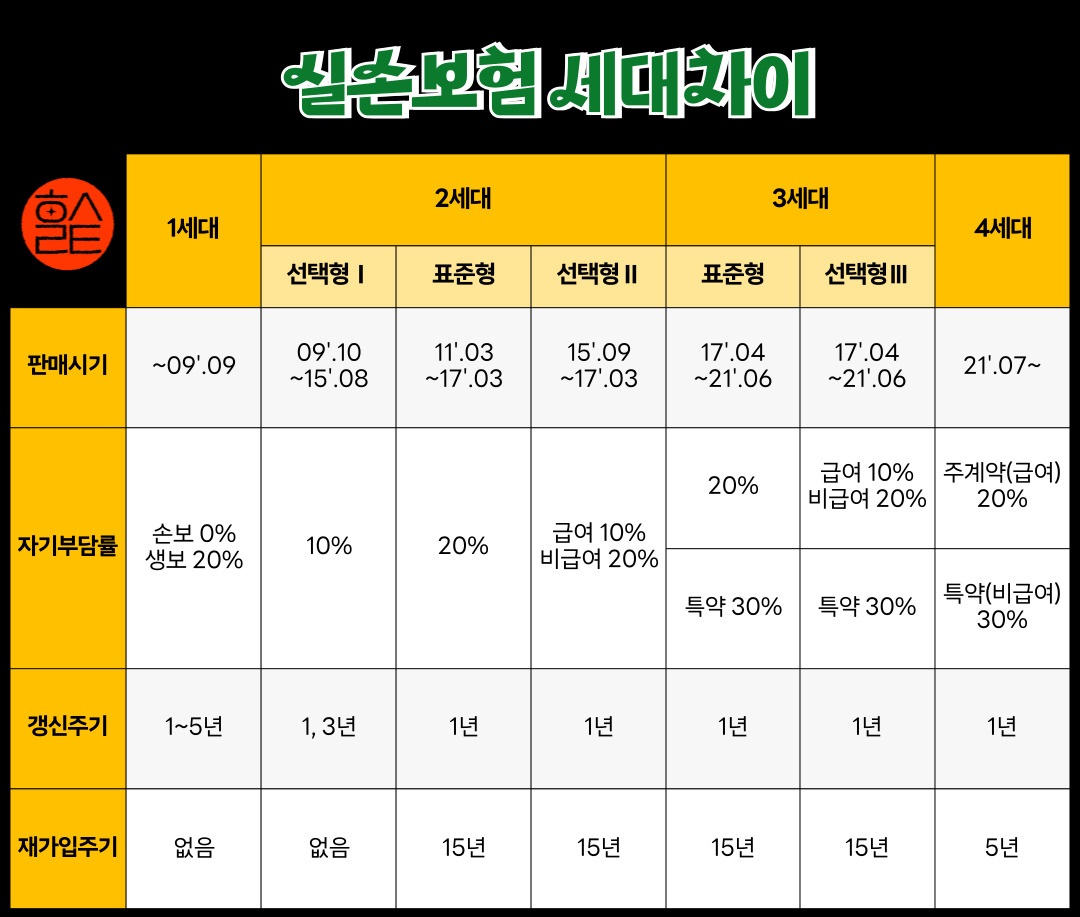
1st and 2nd generation medical expense insurance plans have little to no out-of-pocket costs, making them a golden coverage for those who frequently visit hospitals. Even if you catch a cold and visit a local clinic, you could recover most of the consultation fees and medication costs, so patients felt almost no financial burden. However, due to this high level of coverage, the financial soundness of insurance companies deteriorated, ultimately leading to the side effect of renewal premiums skyrocketing every year for all policyholders. It was only in the latter half of the 2nd generation that standardization efforts began, establishing a standard contract framework. Nevertheless, control over non-covered items remains loose, leading to continuous dissatisfaction among long-term policyholders.
There are many people who believe as a rule that they must always keep their old insurance policies. Mr. Lee, an office worker, often boasts that he did not worry about hospital bills during his back surgery thanks to the old medical expense insurance his parents bought for him. However, there are also many young office workers who rarely visit hospitals and feel it is a waste of money to pay hundreds of thousands of won in premiums every month. Like this, past products are a double-edged sword: they offer robust coverage but come with sharply rising premiums at each renewal. Therefore, it is wise to calmly weigh your age group and anticipated disease risk before deciding whether to keep the policy.
1st and 2nd generation medical expense insurance offers thick hospital bill coverage but carries a high risk of a “renewal bomb,” so you should consider your medical expense spending patterns.
3. Structural Differences Between 3rd and 4th Generation Medical Expense Insurance
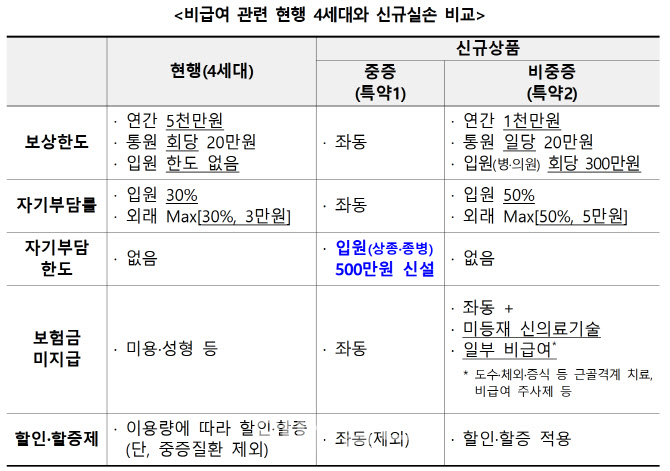
3rd generation medical expense insurance began to curb over-treatment by separating covered and non-covered items and introducing special riders for non-covered treatments. The 4th generation medical expense insurance, currently on sale, has abruptly introduced a system where premiums are discounted or surcharged based on the volume of non-covered medical usage. While 4th generation products have the advantage of lower base premiums compared to previous generations, premiums can jump several times if you receive a lot of non-covered treatment. For example, if you frequently receive physical therapy or nutritional injections, switching to the 4th generation could actually increase your monthly fixed costs. Conversely, healthy young people who rarely visit hospitals can save significantly on premiums by choosing 4th generation products.
Mr. Kim, a manager who exercises diligently and stays away from hospitals, expresses great satisfaction after switching to the 4th generation, as he receives annual premium discounts. On the other hand, Mr. Choi, a department head who visits a traditional Korean medicine hospital or orthopedics clinic once a week due to chronic pain, says he hit a “non-covered surcharge bomb” after switching to the 4th generation and now desperately wishes he had kept his old plan. As such, 4th generation medical expense insurance focuses on preventing moral hazard among users and encouraging voluntary health management. Therefore, unless you carefully consider your usual frequency of hospital visits and the nature of the treatments you receive, you are likely to end up in a difficult situation.
4th generation medical expense insurance premiums vary based on non-covered usage volume, so your usual frequency of hospital visits is the key criterion for judgment.
4. Essential Checkpoints When Comparing Medical Expense Insurance
More people than you might think regret impulsively switching to a new product just because the premium is cheap. When canceling an existing contract, you must first check if you are currently being treated for any diseases or if you have any scheduled surgeries or hospitalizations. New products may not cover diseases or injuries that were previously rejected, so maintaining your existing contract could be more advantageous. Also, remember that the out-of-pocket percentage may be higher than before, meaning the cash amount you need to pay when you receive a hospital receipt could increase. Coverage limits also differ by generation, so you should carefully check if the maximum amount you can receive in case of a serious illness has decreased.
Mrs. Park, a housewife who was worried about her mother’s diabetes treatment costs, saw an ad for a cheap product online and impulsively proceeded with a policy remodel. However, upon completing the enrollment, she found that some of the medication benefits she previously received were missing from the new product, resulting in a loss. As seen here, finding the hidden coverage gaps behind the visible immediate premium savings is the core of true insurance management. Rather than blindly switching based solely on the insurance agent’s words, you need the prudence to compare coverage contents yourself and consult with your family. The habit of carefully examining even the fine print in the terms and conditions becomes the most reliable shield to protect your savings.
To avoid losses, you must comprehensively compare factors such as out-of-pocket percentages, coverage limits, and current health status, in addition to premiums.
5. Convenient Medical Expense Insurance Claim Methods Without Documents
The era of issuing paper receipts and detailed statements to mail in for insurance claims is now a thing of the past. Recently, with the rapid introduction of simple claim systems directly connected to hospital computer networks, you can finish the process with just a few touches on a smartphone app. After finishing your consultation, you no longer need to separately collect prescriptions and receipts at the payment counter; you simply press the insurance claim menu on the screen. However, while large general hospitals have relatively early established these computer linkages, many small local clinics and pharmacies are still in the preparation stage. Therefore, checking in advance whether your hospital supports simple claims can save you valuable time in your busy daily life.
Mr. Kang, an office worker, suddenly had a stomachache just before the recent Chuseok holiday and visited the emergency room. He was in a rush to gather documents while processing his discharge procedures. In the old days, he would have wasted over 30 minutes standing in line at the counter to get documents issued, but now he completed the claim directly in the hospital lobby through a smartphone-linked service. He felt the world has truly improved when he saw the claim completion notification text message from the insurance company arrive while he was on the bus home. By actively utilizing this convenient claim system, you can receive even small insurance claims that you had been putting off. The small hospital bills of a few tens of thousands of won that you gave up on out of laziness can add up to a considerable amount, so you should develop the habit of claiming actively.
Using the simple claim system via smartphone allows you to easily receive small insurance claims without the hassle of preparing documents.
6. Realistic Insurance Remodeling and Future Outlook
The future medical environment is expected to make the role of insurance even more important due to aging populations and the emergence of new treatment methods. Rather than obsessing solely over reducing premiums, you need the wisdom to coldly assess what coverage is truly necessary for your body. Objectively comparing the pros and cons of your current situation before organizing old insurance determines the success or failure of a remodel. Do not be swayed by hearsay from people around you; instead, you should create a customized portfolio that fits your age group, income level, and health status. Although countless new products are being released even now, only policyholders who adhere to principles can prevent unnecessary expenditures.
Mr. Jung, a 50-year-old office worker approaching retirement, recently organized all his insurance with an expert to avoid a hospital bill bomb in his old age. By boldly reducing overlapping coverage and restructuring his policies to focus on essential medical expense insurance and critical illness diagnosis benefits, his monthly fixed costs decreased noticeably. Mr. Jung says he feels much lighter knowing he prepared in advance and recommends that his friends check their contract status before it is too late. As such, wise comparison and inspection serve as a sturdy pillar protecting our peaceful retirement. The small action of opening your policy documents today to check your coverage status determines your financial stability tomorrow.
Through thorough pre-comparison and realistic remodeling, you should reduce unnecessary expenditures while maintaining robust medical coverage.
Frequently Asked Questions
=