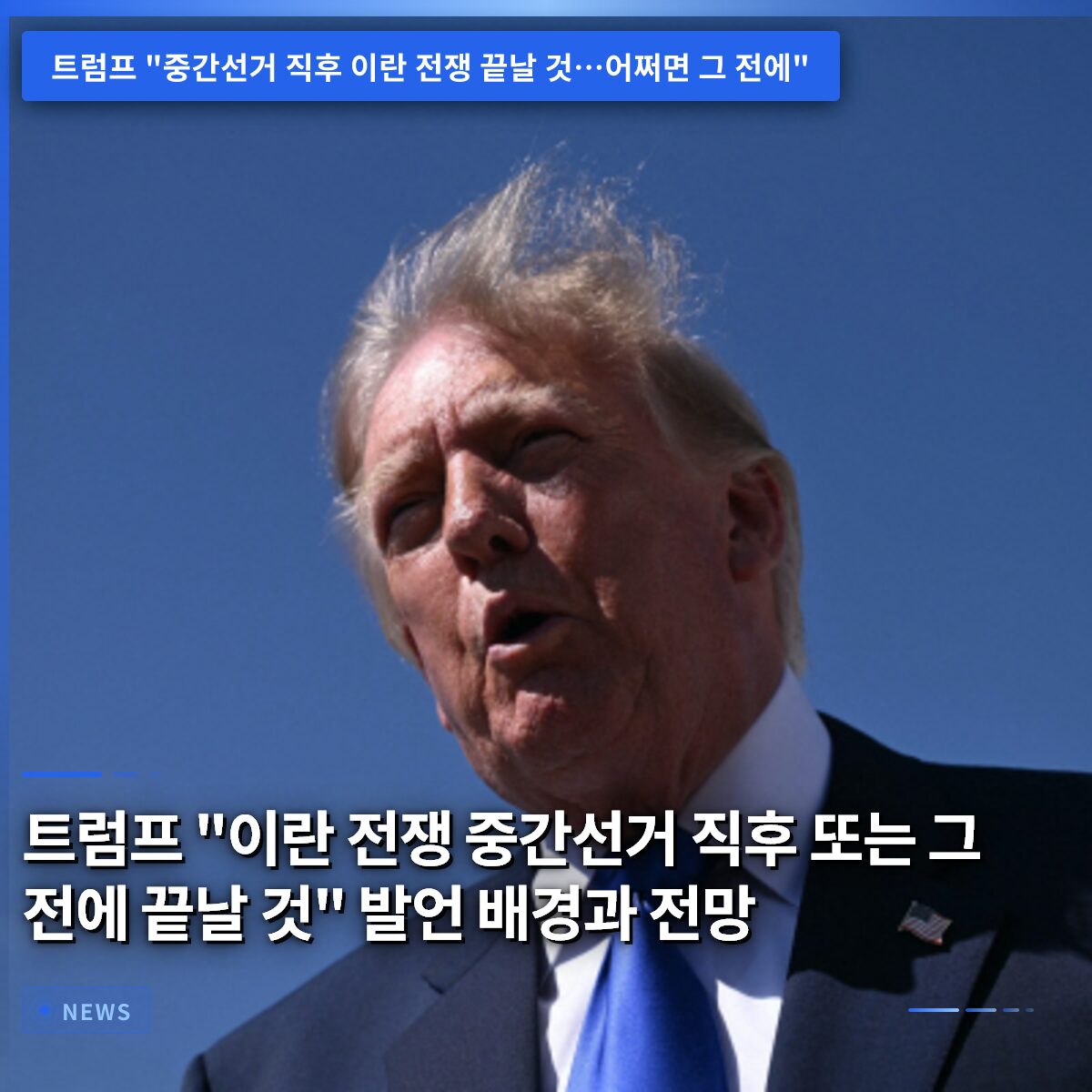
During his visit to Ireland, U.S. President Donald Trump strongly implied to reporters at a local golf course that the war with Iran will end shortly after the upcoming midterm elections, or perhaps even sooner. The international community is currently on high alert, closely watching how this abrupt prediction of an end to the war will impact the geopolitical landscape in the Middle East. The President’s remarks, stating that Iran has been urgently requesting dialogue and making multiple contact attempts, indicate that behind-the-scenes negotiations between the two nations are accelerating. However, he also made it clear that unless the U.S. decides to remain directly to secure resources, similar to the case of Venezuela, it will ultimately withdraw its forces. This article explores the actual significance of President Trump’s recent statements, as well as their potential impact on the upcoming U.S.-China summit and interest rate policies. Readers will gain a tangible understanding of how shifts in the international situation affect our daily lives and the economy. We will examine in detail the exit strategy the U.S. administration is formulating amidst complex diplomatic interests.
=
Context and Outlook on Trump’s Remark: “The Iran War Will End Right After or Before the Midterms”
1. Subheading
The Timeline for Ending the Iran War and Negotiation Trends. U.S. President Donald Trump met with reporters at his golf course in Ireland, repeatedly emphasizing that the armed conflict with Iran will conclude shortly after the midterm elections, or possibly much sooner. He candidly described the on-site atmosphere, stating that the Iranian government is under severe pressure, desperately wants to negotiate, and is calling continuously day after day. The President took a firm stance, declaring he would never agree to a sham deal with no real benefit, and insisted that any agreement would only be reached under correct and just conditions. He also hinted at a specific position: unless a special policy is decided to stay directly and manage oil resources, as in Venezuela, military forces will ultimately be withdrawn. Regarding the plan for Iran and Gulf states to hold a strategy meeting in Oman to resolve the Strait of Hormuz transit issue, he showed little significance, stating it is up to the parties involved to decide. These diplomatic maneuvers are seen as a prime example indicating that back-channel communications are actively operating in the field, rather than mere bluffs. The President’s remark that Iran is clinging to the demand for dialogue like a beggar expresses a strong will to firmly grasp the initiative in negotiations. It is analyzed that, unlike past attritional conflicts in the Middle East, there is a strategic calculation to secure definite tangible benefits and withdraw quickly this time.
President Trump forecast that the war would end around the midterm elections, stating that Iran is desperately demanding dialogue.
2. Subheading
Summit with Chinese President Xi Jinping and Diagnosis of Bilateral Relations. Regarding the possibility of the U.S.-China summit, scheduled for the 24th with Chinese President Xi Jinping’s visit to the U.S., being canceled, President Trump clearly drew a line, stating he has no worries at all. He repeatedly emphasized that the relationship between the two leaders remains excellent and that the Chinese leadership also wishes for a smooth relationship that benefits both countries. He criticized that while China has treated the U.S. very fairly during his administration, previous administrations saw China unfairly seize enormous economic gains. These remarks are interpreted as a display of diplomatic superiority while revealing confidence in the ability to flexibly coordinate friction with the counterpart. It also appears to be an intention to fundamentally block any speculation and anxiety that may arise ahead of the summit schedule. In reality, a meeting between the leaders of two major powers on the international diplomatic stage is a critical issue that significantly impacts the global economy and security. The President’s attitude and criticism can be seen as a sophisticated diplomatic rhetoric aimed at not losing the upper hand in setting the tone with the counterpart while demonstrating stable national governance.
He dismissed concerns about the cancellation of the summit with President Xi, stating that they maintain an excellent relationship.
3. Subheading
Pressure on the Federal Reserve and the Argument for the World’s Lowest Interest Rates. Ahead of the upcoming meeting of the Federal Reserve, the U.S. central bank, President Trump argued that the U.S. economy should be granted the lowest interest rates in the world, based on its inherent resilience. He maintained the position that, regardless of the existing formulas or procedures upheld by the Fed, interest rates should be significantly lowered given the current robust state of the U.S. economy. He self-assessed that the U.S. credit rating boasts an unparalleled top level in the world and plays a crucial role in making other nations wealthy. He did not hide his strong confidence that, if necessary, he could instantly correct this abnormal economic structure in just a few minutes. The President’s actions, which apply direct and indirect pressure on monetary policy even within the traditional norm of respecting central bank independence, are causing significant ripples in the market. His public preference for interest rate cuts contains a strong political intention to steer economic indicators favorably ahead of the upcoming elections. Both investors and the general public are reacting sensitively to these interest rate-related remarks, actively gauging the future direction of asset markets.
He strongly demanded the application of the world’s lowest interest rates, citing the strength of the U.S. economy, regardless of the Fed’s official criteria.
4. Subheading
The Feasibility of the $5,000 Dividend Promise, a Midterm Election Pledge. Attention is focused on whether congressional approval will be smoothly obtained for the pledge to pay a $5,000 dividend per American, announced at the Republican midterm convention. President Trump stated that while he cannot say exactly how the congressional approval process will proceed, if the Republicans win the election, all procedures will become very easy. He expressed confidence that since the current U.S. economy is generating enormous revenue, it can easily afford to return dividends to the people. Emphasizing his philosophy that he always keeps his promises, he repeatedly asserted that this cash dividend pledge is not merely an electoral slogan. Such a radical fiscal policy, which directly stimulates voters’ hearts, acts as a powerful weapon that can shake up the entire electoral landscape. Despite voices of concern regarding fiscal soundness from his surroundings, the President takes a stance of confronting this head-on, citing his massive profit-generating capacity. In fact, this pledge, which directly touches the pockets of the people, is eliciting explosive reactions from middle-class and lower-income voters, heating up the election atmosphere.
He emphasized that if the Republicans win the midterms, congressional approval for the per-capita dividend pledge will be easier and fully affordable.
5. Subheading
The Impact of Middle East Stability on the Global Economy and Oil Market. As the possibility of an early end to the armed conflict with Iran grows, the global oil market and supply chains are taking a breather. Instability in the Middle East has always been the biggest cause of sharp fluctuations in international oil prices, so news of an end to the war is directly related to economic stability. The voluntary efforts of countries surrounding the Strait of Hormuz to resolve the issue, combined with U.S. pressure, can lead to a downward stabilization of logistics costs and energy prices. Both businesses and consumers will experience relief from soaring price pressures, which will positively impact the recovery of overall consumer sentiment. Each time diplomatic conflicts move toward resolution, global stock and foreign exchange markets react agilely, seeking a new equilibrium. This is why government-led foreign policies do not stop at mere political achievements but are directly linked to the prices in the average citizen’s shopping basket. As the settlement of peace in the Middle East becomes more tangible, governments and central banks in various countries will have the leeway to implement more flexible monetary policies.
The possibility of an early end to the Iran war is expected to play a decisive role in stabilizing international oil prices and recovering global supply chains.
6. Subheading
Changes in the U.S. Political Landscape and Outlook for Future Governance. The upcoming midterm elections will undoubtedly be the most critical watershed in determining the momentum of the current Trump administration’s remaining term. The early end of the Iran war and the radical economic dividend pledge are acting as core drivers that send a strong message to voters and consolidate support. A will to produce definitive results is seen even amidst fierce debates with the opposition, which will significantly impact whether the administration secures control of the legislature. If the strategy to secure both diplomatic achievements and economic benefits succeeds, the administration’s power is expected to become more solid. Readers should also cultivate the discernment to carefully examine the true economic substance hidden behind media headlines during these moments of political upheaval. Accurately grasping the intersection of rapidly changing international situations and domestic political interests is a shortcut to making wise economic decisions. We recommend continuously monitoring the upcoming election results and the realization of policies to wisely adapt to the changing trends.
This midterm election will be an important test for evaluating the administration’s performance and will determine the direction of future governance.
Frequently Asked Questions
=