Foreign investors net bought over 340 billion won in domestic stocks last month, marking a shift to a net buying position for the first time in eight months. According to recent securities investment trends data released by the Financial Services Commission, foreigners purchased 344 billion won worth of listed stocks last month, putting an end to a prolonged selling streak. Like Mr. Kim, an office worker who worries about portfolio adjustments around this time of year, many investors are keenly watching whether this rebound is a temporary phenomenon or the start of a full-fledged trend reversal. While large-scale funds flowed into the KOSPI market, some volume flowed out of the KOSDAQ market, showing a clear temperature difference between the two markets. In this article, we will carefully examine the details of foreign capital flows, investment tendencies by country, and movements in the bond market. To formulate a wise investment strategy that protects your assets, you must read the direction in which the market’s big players are moving.
=
Foreign Investors Net Buy KRW 340 Billion in Domestic Stocks in August, Switching to Buying for First Time in 8 Months
1. Rebound After 8 Months: Shift to Net Buying of Stocks
Foreign investors broke their long silence in the domestic stock market last month by hitting the buy button. According to statistics released by financial authorities, the net purchase of listed stocks last month totaled 344 billion won. Foreigners, who had been continuously selling stocks since the beginning of the year, joined the buying ranks for a rare occasion. Expectations are growing among individual investors watching the stock market that the atmosphere is finally reversing. Many experts interpret this as a sign that the frozen investment sentiment, which has persisted since last winter, is gradually thawing.
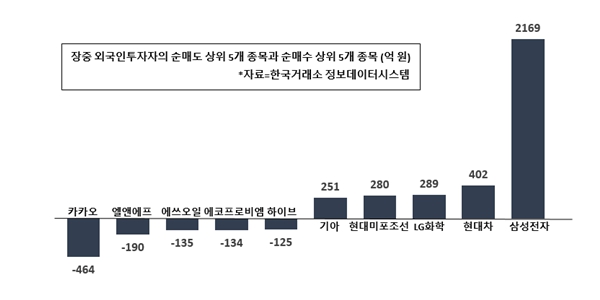
However, it is important to note that money did not flow evenly into all sectors and markets. While nearly 2 trillion won was swept up in the KOSPI market, over 1 trillion won worth of selling volume emerged in the KOSDAQ market. This means that while definite buying pressure flowed into large-cap blue-chip stocks centered on major companies, small and mid-cap individual stocks experienced a differentiated market environment. This phenomenon clearly reflects the foreign investors’ investment habit of preferring stable stocks centered on large corporations. This is why it is crucial to meticulously analyze where supply and demand are heading, rather than just looking at overall market indicators.
Foreigners net bought 344 billion won in domestic stocks last month, returning to a buying position for the first time in 8 months, but a clear temperature difference remained between the KOSPI and KOSDAQ.
2. Market Contrasts: The Temperature Gap Between Large-Cap Stocks and KOSDAQ
Looking closely at the KOSPI market’s performance, it is easy to see how intensively foreigners bought large-cap stocks. Last month, they net bought 1.888 trillion won worth of stocks in the KOSPI market alone, providing a solid support for the index floor. In contrast, they sold 1.545 trillion won worth of stocks in the KOSDAQ market, showing a completely different trend. Researcher Park, who works in the securities district in Yeouido, Seoul, advises that the separation of supply and demand between large-cap and small/mid-cap stocks may continue for some time.
From the perspective of individual investors, the continued selling by foreigners in the KOSDAQ market may feel somewhat unsettling. Investors who had been trading centered on biotech or thematic stocks also experienced frustration as stock price recovery slowed due to foreign outflows. Nevertheless, the total foreign holdings of listed stocks remain at a massive capital scale exceeding 2610 trillion won. It is worth evaluating positively that a rebound centered on large-cap stocks emerged while the market’s overall resilience had not completely collapsed. Voices are gaining traction that an approach centered on KOSPI blue-chip stocks, rather than the KOSDAQ, may be advantageous in upcoming market conditions.
While large-scale net buying occurred in the KOSPI market, selling dominance persisted in the KOSDAQ market, resulting in stock-specific differentiation.
3. Country-Specific Capital Flows: US Buying, Europe Selling
Examining the tendencies of foreign investors by nationality reveals that the movements of the US and Europe were completely divergent. US-based investors net bought a massive 13.4 trillion won worth of stocks over the past month, demonstrating the most aggressive buying pressure. In contrast, European investors net sold 10.7 trillion won, and investors from Asia and the Middle East also recorded selling dominance. US-based funds effectively served as a pillar of support for the domestic stock market.
As a result, US investors’ share of the total foreign holdings reached 999.7 trillion won, accounting for 43.8%, maintaining an overwhelming first place. European funds followed with 676.9 trillion won, recording 29.7% of the total. The shares for Asia and the Middle East remained at relatively modest levels. The strong inflow of US funds was driven by a combination of expectations for changes in global monetary policy and improved earnings outlooks for domestic large corporations. In the midst of the massive flow of global capital, tracking the movements of US-based big players is the shortcut to successful investing.
While US investors led the domestic stock market with over 13 trillion won in net buying, European and Asian investors showed selling dominance.
4. Bond Market Reversal: Record of Net Redemption After 4 Months
Unlike the vibrancy in the stock market, a completely different atmosphere unfolded in the bond market. Foreign investors net sold 3.935 trillion won in the listed bond market last month and redeemed 801 billion won, resulting in a total net redemption of 4.736 trillion won. This outflow of bond investment funds is the first time in four months. It is interpreted that foreign funds, which had been targeting stable interest income, temporarily reduced their bond allocation and moved to cash.
As a result, foreign bond holdings as of the end of last month decreased by 580 billion won from the previous month to 330.3 trillion won. This may be surprising news for conservative investors who manage their assets primarily through bank deposits or safe assets. It is the result of a combination of movements to realize capital gains from bond trading coinciding with interest rate cuts and strategies to respond to exchange rate volatility. A seesaw market emerged where money flowed into stocks while funds flowed out of bonds. This is precisely why it is necessary to analyze changes in macroeconomic indicators covering both bonds and stocks in a three-dimensional manner.
Foreigners redeemed over 4 trillion won in the bond market, returning to net redemption for the first time in 4 months, and their holdings also decreased.
5. Complex Impact of Exchange Rates and Global Economic Environment
Behind the volatility of foreign funds lies a complex global economic environment. Everything from subtle movements in the won-dollar exchange rate to interest rate policies of major central banks determines whether foreign investors open or close their wallets. For foreign investors seeking exchange rate gains, the exchange rate is as important a criterion for investment decisions as stock price returns. The massive inflow of US-based funds amidst last month’s exchange rate fluctuations was due to the interplay between this exchange rate merit and confidence in corporate fundamentals.
Many acquaintances are torn between whether to buy export stocks when the exchange rate rises or to stay safe in deposits. The perspective of foreigners looking at the Korean market is not much different. As risk appetite across global stock markets revived, Korea’s representative companies were once again added to investment baskets. Going forward, the direction of the exchange rate and the improvement of global economic indicators will be the key factors determining whether foreigners continue to buy. It is a time when understanding the big picture of the macroeconomy and maintaining a flexible posture to ride the market waves is necessary.
Exchange rate fluctuations and policy changes by global central banks directly impacted foreign investors’ domestic stock and bond portfolios.
6. Future Stock Market Outlook and Response Strategies for Wise Investors
The shift to foreign net buying after 8 months is certainly welcome news for the domestic capital market. However, unstable factors such as outflows from bonds and weakness in the KOSDAQ market still coexist. Individual investors should be wary of chasing buys simply because they see headlines about foreigners buying. They should acknowledge the phenomenon of supply and demand concentrating on large-cap blue-chip stocks and use it as an opportunity to check the health of their own portfolios.
The greater the market volatility, the more investment principles faithful to the basics shine. Wisdom is needed to select companies backed by solid performance and manage risk through diversification. One must cultivate the discernment to calmly observe whether foreign buying pressure will extend beyond a one-off event to the entire autumn market. Those who step back one step when others rush in to analyze the flow of supply and demand ultimately become the winners in the market. Based on the foreign securities investment trends summarized today, we hope you will formulate a successful asset management plan.
While the shift to foreign net buying is positive, a cautious and balanced investment strategy should be formulated considering market-specific differentiation and bond outflows.
Frequently Asked Questions
=