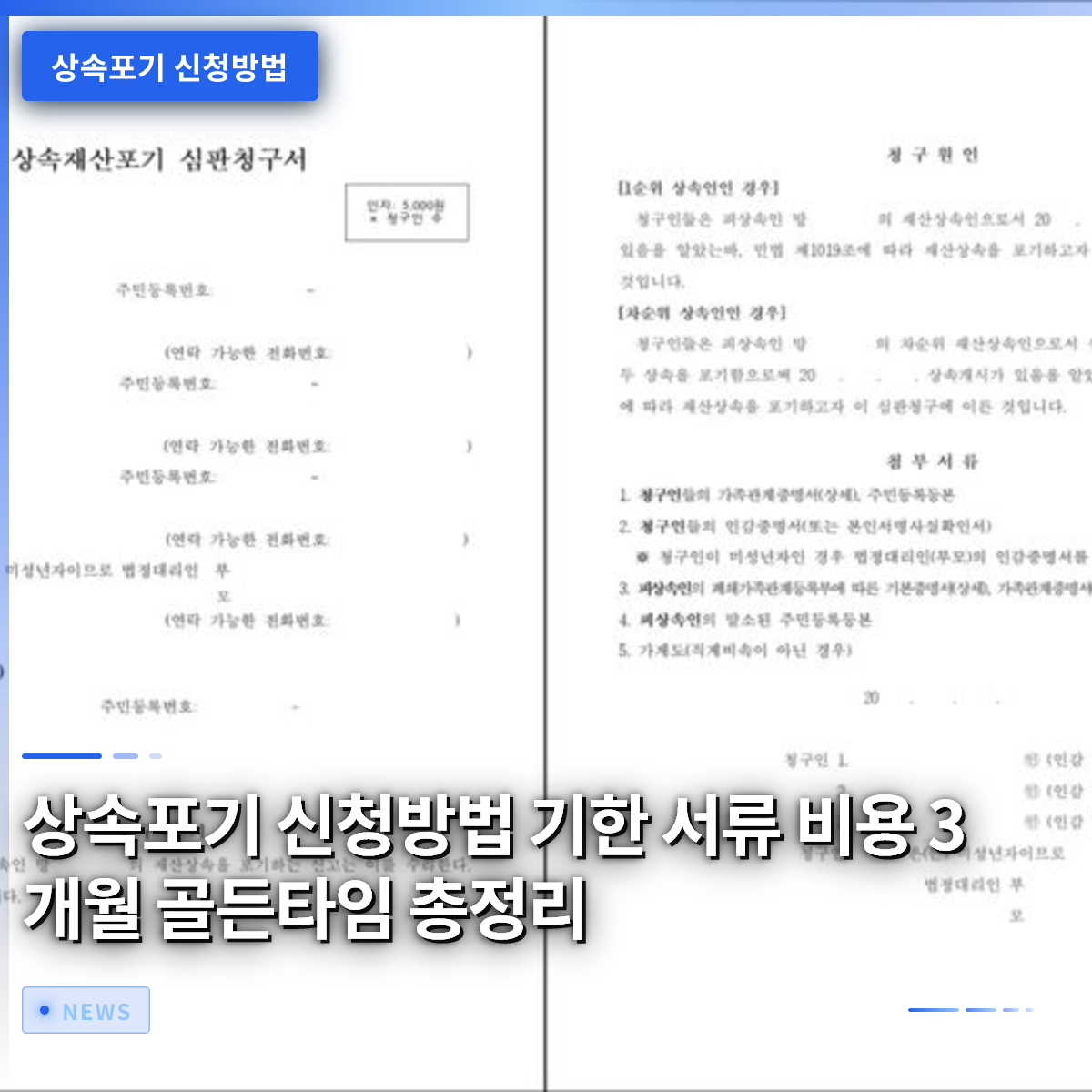
Renouncing inheritance is a legal procedure that must be filed with the Family Court within three months of learning about the decedent’s death. Many people are shocked to discover massive debts only after receiving dunning letters from financial institutions following the sudden loss of a parent or family member. While facing such debts without time to grieve can be overwhelming, you can resolve the financial burden cleanly by following the correct procedures within the specified deadline. It is crucial to start by carefully reviewing the decedent’s past assets and debts and preparing all related documents without omission. In this article, we will detail the common mistakes made during the inheritance renunciation process and the specific application steps from start to finish.
=
How to Renounce Inheritance: Deadline, Documents, Costs, and the 3-Month Golden Period
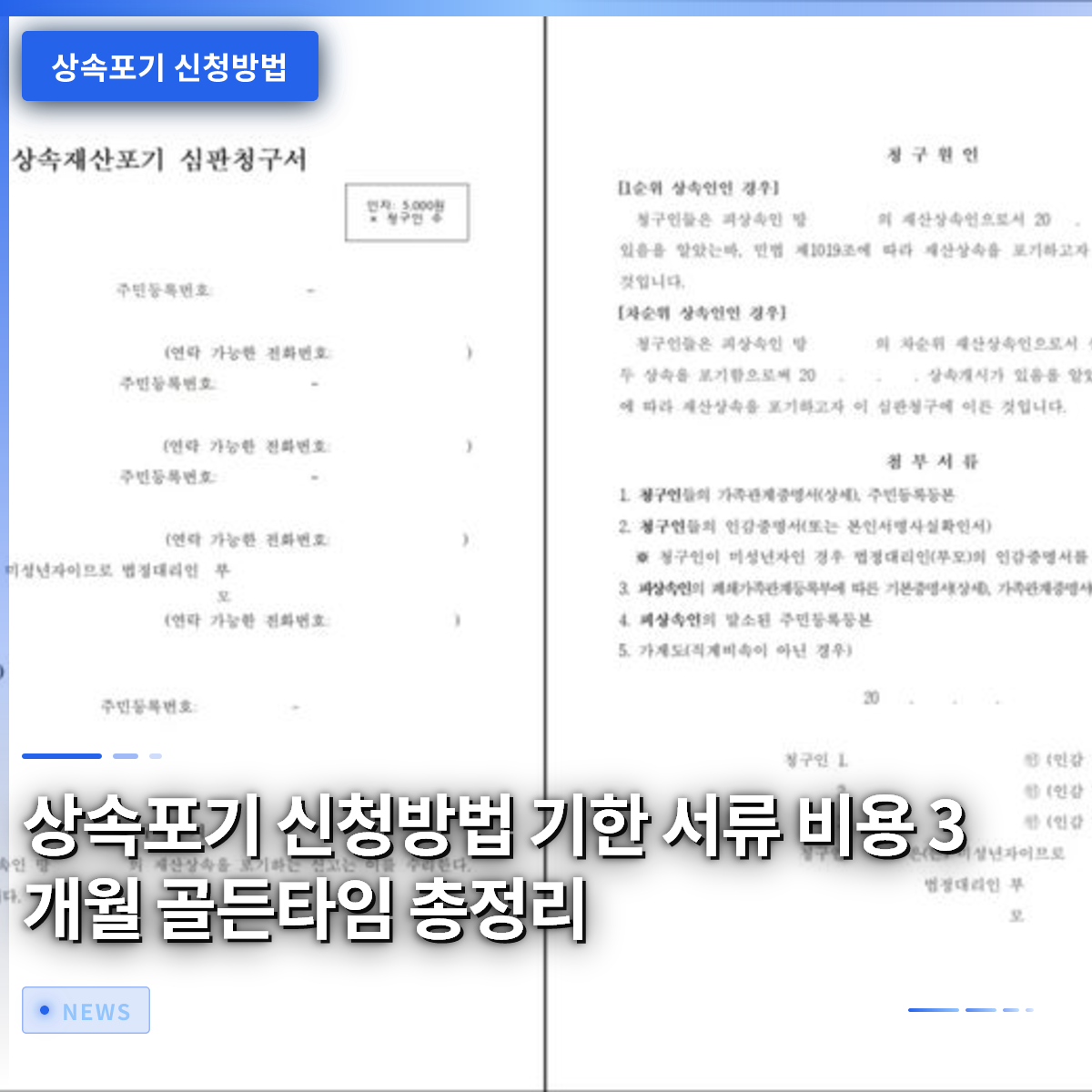
1. Inheritance Renunciation Deadline and Golden Period

If you have decided to renounce inheritance, you must complete the application within exactly three months of the date you learned of the inheritance’s commencement, i.e., the date you became aware of the decedent’s death, in accordance with Article 1041 of the Civil Act. Missing this golden period by even a single day results in the legal presumption of simple acceptance, meaning you would be forced to assume all debts left by the deceased. For instance, Mr. Kim, an office worker in Seoul, missed the three-month deadline because he was overwhelmed with funeral arrangements after his father’s passing. Months later, he was shocked to receive a dunning letter for his father’s hidden credit card debt. To prevent such misfortunes, it is wise to actively utilize the various support systems provided by local government offices immediately after reporting the death. In particular, applying for integrated processing during the death report allows you to grasp the status of financial assets and debts at a glance, which is very helpful. Since time passes faster than expected, you need the initiative to start asset investigations immediately upon receiving the death certificate.
The three-month deadline for inheritance renunciation is applied very strictly by law, so you should not rely on even a day’s leeway. If you reside overseas or failed to apply within the deadline for special reasons, you must look into special relief procedures; therefore, the best course of action is to strictly adhere to the deadline from the start.
Inheritance renunciation must be filed with the Family Court within three months of learning of the death; missing the deadline means you will inherit the debts.
2. Preparing Required Documents

To proceed smoothly with an inheritance renunciation application, you must carefully issue all documents to be submitted to the Family Court without omission. Basically, you need the decedent’s basic certificate, family relationship certificate, and certified copy of the resident registration cancellation. You must also prepare your own family relationship certificate, resident registration certificate, and seal certificate. When obtaining these documents from a community center or through the government’s computer network, you must request detailed certificates that disclose the entire resident registration number, including the last digits, to avoid the hassle of rejection. If even one document is missing or contains incorrect information, the court may issue a correction order, potentially delaying the process by more than a month. Mrs. Lee, a housewife in Gwacheon, Gyeonggi-do, shared a scary memory of having to turn back just before submission because she forgot to bring her seal while preparing documents. It is safest to carefully read the guidebooks issued by local governments or the preliminary instructions from relevant civil affairs offices and create a checklist to verify the required documents.
When issuing documents, you must double-check that the resident registration number is not omitted and that the certified copy of the resident registration cancellation accurately reflects the decedent’s date of death. Also, note that documents are typically valid only if issued within the last three months, so be careful not to issue them too early and have them become invalid.
Essential documents such as the decedent’s certified copy of resident registration cancellation and basic certificate must be issued accurately in the detailed version showing the full resident registration number.
3. In-Person Application and Online Filing Methods
Methods for applying for inheritance renunciation are broadly divided into visiting the competent Family Court directly and filing online through the computer system. When visiting in person, you go to the Family Court with jurisdiction over the decedent’s last address, fill out the application form according to the provided template, and submit it along with the prepared documents for review by the assigned judge. Nowadays, the number of people who conveniently scan all documents on their home computers and file them online via the Supreme Court’s e-Litigation website, without visiting the court, has surged. When proceeding online, login with a public certificate or common authentication is mandatory, and since there are many items to enter, you must calmly follow the on-screen instructions to ensure there are no typos. Mr. Park, an office worker in Dongjak-gu, Seoul, chose online filing because it was difficult to take annual leave to visit the court. He reported that he could comfortably upload documents and pay fees from home at night, saving significant time and money. Regardless of the method chosen, you must keep the receipt or case number safe to track and verify the progress in real-time.
In-person applications at the court have the advantage of allowing you to ask staff directly about any questions, while online filing offers the strength of being able to prepare leisurely on weekends or at night without time constraints. Choose the method that suits your lifestyle and convenience, but if the filing deadline is approaching, we strongly recommend in-person visit to ensure same-day processing.
You must complete the process within the deadline by choosing either a direct visit to the competent Family Court or online filing via the Supreme Court’s e-Litigation website.
4. Calculating Costs and Fees
The cost of applying for inheritance renunciation at the court is not as high as you might think, but knowing the exact amount in advance and preparing cash or a card will prevent panic. Basically, stamp duty and service fees are incurred. Since the calculation of service fees varies slightly depending on the number of applicants and the number of decedents, it is good to check in advance. Generally, the basic stamp duty is a few thousand won, and the service fee is set around tens of thousands of won considering postal costs, so there is no significant financial burden. However, if you entrust the preparation and filing of documents to a legal representative such as a legal scrivener or lawyer, additional fees or appointment costs will be incurred, so you should check your budget beforehand. A citizen who received legal consultation in the Seongbuk area of Gyeonggi-do said they were worried about making mistakes while preparing documents alone, so they sought expert help. They were very satisfied as they could reduce their stress at a reasonable cost. After accurately paying the stamp duty and service fees through banks or unmanned payment machines within the court premises, you must attach the receipt to the application form to complete the filing properly.
If you lose the receipt or payment confirmation when paying the fees, the filing may be delayed, so you must develop the habit of taking photos or keeping them separately. Do not forget that the accuracy of the documents and adherence to the filing deadline are far more important core elements than the cost itself.
Court costs for inheritance renunciation are mainly stamp duty and service fees, totaling around tens of thousands of won; additional fees apply if you use an agent.
5. Common Mistakes and Countermeasures
The most common mistake people make during the inheritance renunciation process is disposing of or using part of the decedent’s assets or debts before proceeding with the renunciation. Under the Civil Act, if an heir disposes of or conceals the decedent’s assets, it is legally presumed to be simple acceptance, making renunciation impossible, so you must be extremely careful. For example, if you withdrew a small deposit from the decedent’s bank account to pay for funeral expenses or temporarily changed the name on the decedent’s car, it becomes a major problem. Mr. Kim, residing in Jung-gu, Incheon, withdrew 300,000 won from his father’s account to pay for food for mourners while sorting through his father’s belongings. He encountered significant difficulties during the inheritance renunciation process and ultimately had to abruptly switch to limited acceptance. Another common mistake is thinking that if the first-priority heir renounces, it is over. If the first priority renounces, the right automatically passes to the second priority (lineal ascendants) or third priority (siblings), so you must inform relatives in advance.
To prevent such mistakes, it is a priority to freeze financial institution accounts and fully grasp the debt status before touching the assets after the decedent’s death. If you have already touched some of the assets, looking into the limited acceptance system quickly before it becomes simple acceptance may be the only way out.
Withdrawing deposits or disposing of the decedent’s assets is presumed to be simple acceptance, which can invalidate inheritance renunciation, so you must never touch them.
6. Advice for Successful Inheritance Settlement
Properly understanding how to renounce inheritance and acting within the deadline is the wisest first step for remaining family members to start a new life. Even amidst sudden grief and the pressure of debt, if you maintain composure and follow the legally prescribed procedures step by step, you can overcome the crisis. In the future, various civil affairs follow-up guidance services and integrated inquiry systems provided by local governments are expected to become more advanced, so the information gap and confusion experienced by general citizens are expected to decrease gradually. If there are people around you who are losing sleep over similar concerns, please share the information discussed today generously and encourage them not to miss the deadline. If you are currently sighing over overwhelming mail, we recommend immediately opening the website of the Family Court with jurisdiction over your residence and carefully checking the document list. Thorough preparation and swift action are the only answers to escaping the shackles of unexpected debt.
Even after all legal procedures are completed, it is advisable to keep the original decision document in a safe place for a long time in preparation for potential contact from subsequent creditors. We sincerely hope that through sufficient communication with your family, you can fundamentally block the inheritance of debt and regain a peaceful daily life.
Through thorough prior preparation and adherence to the 3-month deadline, you can prevent the inheritance of debt and regain a peaceful daily life.
Frequently Asked Questions
=