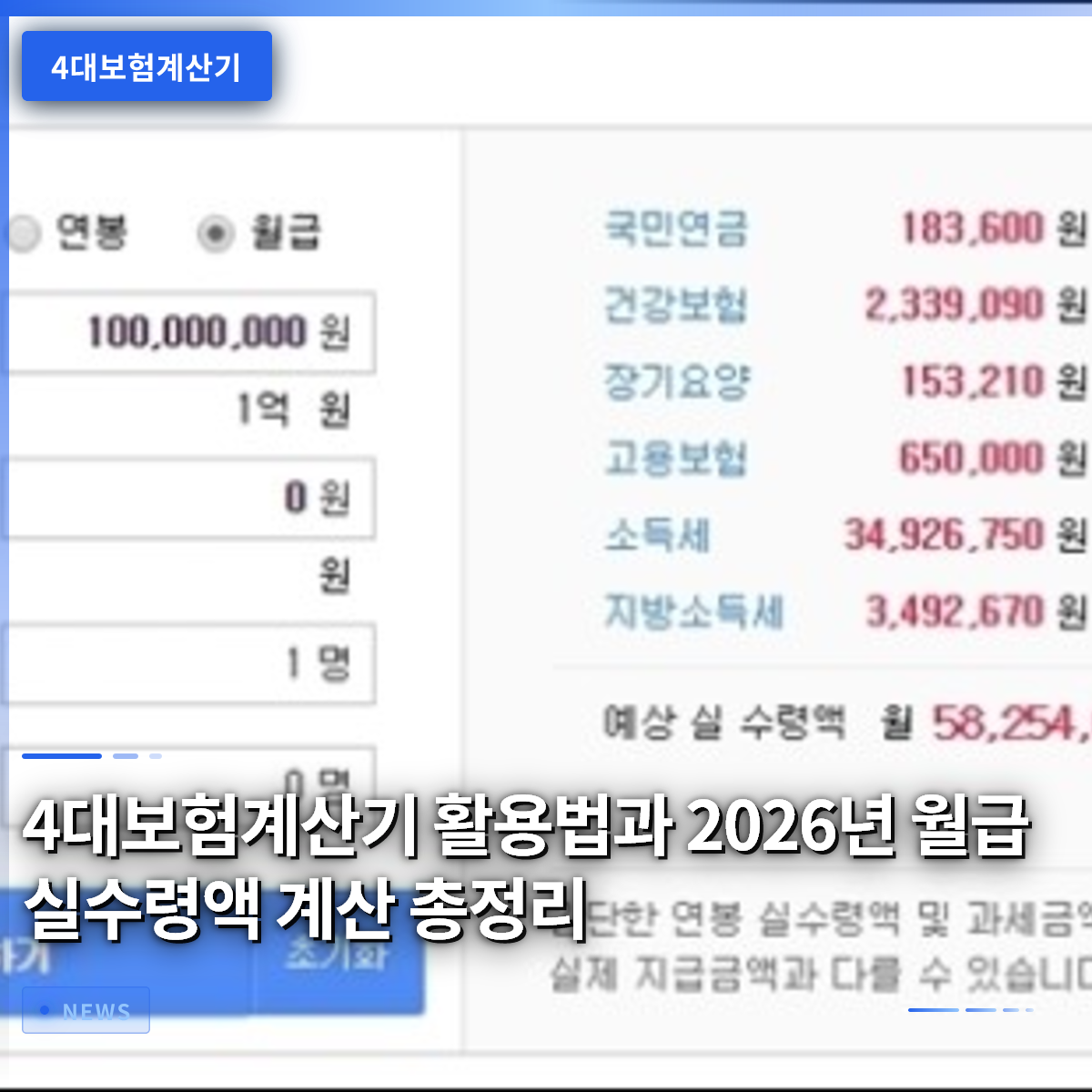
Everyone has likely experienced the shock of seeing their monthly salary deposit differ from the pre-tax amount. As of 2026, with changes in social insurance rates such as the National Pension and Health Insurance, it has become crucial to understand the exact deductions in advance. A pre-tax salary of 3 million won does not mean that entire amount lands in your pocket. As an employee, it is essential to carefully examine the flow of taxes and social insurance premiums deducted from your salary each month. In this article, we will look in detail at how to use calculators based on the latest standards and tips for accurately predicting your actual take-home pay. By reading this article to the end, you will clearly understand the secrets behind your complex pay stub.
=
How to Use the Four Major Insurance Calculator and a Complete Guide to Calculating Your 2026 Net Salary
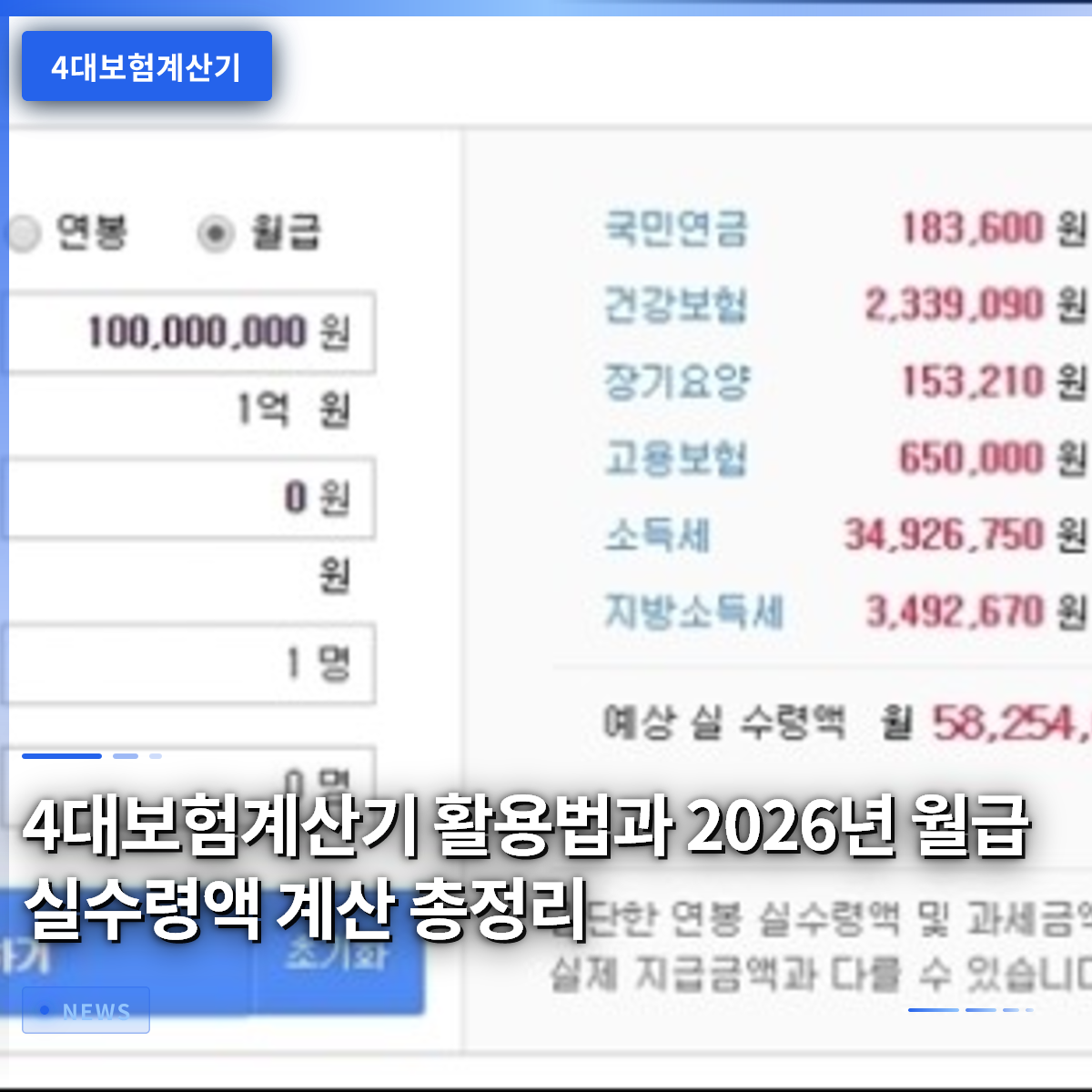
1. Why the Four Major Insurance Calculator is Essential
When starting a new job or changing careers, the first thing you check is usually the annual salary contract. However, there is often a significant gap between the amount stated in the contract and the amount actually deposited into your bank account. The main culprit behind this difference is social insurance, which consists of the National Pension, Health Insurance, Employment Insurance, and Industrial Accident Insurance. Since these are withheld at a set rate each month, knowing exactly which items are deducted from your salary and in what amounts is essential for financial management. Many people vaguely assume that only about 10% is deducted after taxes, but the actual deductions can be larger. In particular, because relevant laws and rates are revised slightly every year, calculating based on past memories or simple estimates can lead to errors. In such cases, online calculators are the perfect tools to assist with accurate calculations. Simply enter your exact income level, and taxes and social insurance premiums are calculated automatically, making it very convenient.
To accurately understand the difference between your pre-tax annual salary and the actual amount received in your bank account, it is essential to use a calculator that reflects the latest standards.
2. Changes in the 2026 National Pension Rate

With changes to the National Pension contribution rate this year, there has been a slight adjustment to the fixed monthly expenses of office workers. While the National Pension is the most basic social safety net for retirement, it is natural to feel a sense of loss when seeing the amount deducted from your monthly salary. For example, for an employee earning 3 million won per month, applying the revised rate results in a slight difference in the deduction amount compared to before. This change is not just a difference of a few tens of won; when accumulated over a year, it can make a noticeable impact on your household budget, acting like a “diet” for your finances. As the importance of retirement preparation grows, more people are becoming interested in the estimated pension amount they will receive in the future. By using smartphone inquiry features, you can easily check the premiums you have paid so far and the estimated amount you will receive in the future. It is wise to check in advance how the pension assets you have consistently built up since your youth will protect you in the future. Reflecting on the meaning of the amount deducted each month through a calculator can make you feel more secure about preparing for your retirement.
You must use a calculator that accurately reflects the revised National Pension rate to confirm the exact amount deducted each month.
3. Understanding the Structure of Health Insurance and Long-Term Care Insurance

When you receive your monthly pay stub, the items that stand out after the National Pension are Health Insurance and Long-Term Care Insurance premiums. These items play a crucial role in providing actual medical expense coverage when we visit hospitals or suffer from serious illnesses. Health insurance premiums are calculated at a certain rate based on your total compensation, while Long-Term Care Insurance premiums are calculated as a certain percentage of the Health Insurance premium. Therefore, if Health Insurance premiums increase, Long-Term Care Insurance premiums naturally rise in tandem. You can easily see colleagues sighing that more money was suddenly deducted when the Health Insurance settlement season arrives. This is due to the Health Insurance settlement, which is similar in concept to the year-end tax settlement that occurs when your previous year’s compensation increased or you received a large performance bonus. To prevent such additional expenses, it is helpful to develop the habit of frequently inputting your salary changes into a calculator. It is the most reliable preventive measure against unexpected expenditures creating holes in your household budget.
Since Health Insurance premiums may require additional settlement due to changes in compensation, it is safer to check the estimated amount in advance using a calculator.
4. The Secrets of Employment Insurance and Income Tax Deductions
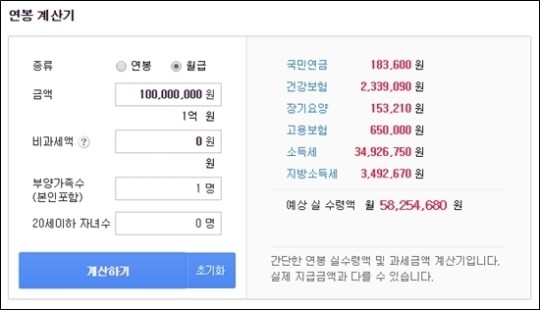
Another deduction item that office workers often overlook is Employment Insurance premiums, as well as income tax and local income tax. Employment Insurance is a cost deducted to provide livelihood support and help with re-employment in case of unemployment, shared equally between the employee and the company. Regarding taxes, small amounts are prepaid each month according to the simplified tax table; this serves as a temporary payment to allow for accurate settlement at the end of the year. Many people skip understanding tax calculations because they seem complex, but in reality, they follow a consistent formula. In fact, calculating the actual take-home pay for an employee with an annual salary of 36 million won yields interesting results. After deducting all four major insurance premiums and various taxes, many early-career employees are disappointed to find that less money remains in their bank account than expected. However, these deductions include potential benefits such as the right to receive unemployment benefits in the future, health coverage, and year-end tax refunds. Rather than thinking of it as money being taken away, you need the mental flexibility to view it as forced savings for yourself and a social insurance premium.
Although Employment Insurance and taxes are forcibly withheld each month, they form the basis for various social safety net benefits and year-end tax refunds in the future.
5. Accurately Calculating Net Salary with Online Calculators
If you type “salary calculator” or “social insurance calculator” into an internet search bar, numerous free tools appear on the screen. However, the results can vary slightly depending on which calculator you use, which can confuse users. This is because some platforms may not have updated their rates to the latest standards in a timely manner, or there may be differences in the order of deductions. Therefore, it is most important to select and use the latest version of a tool provided by a reliable platform. The actual usage is very simple, allowing even non-experts to get the desired results with just a few clicks. You simply enter your pre-tax monthly salary or annual salary and fill in basic information such as the number of dependents or the number of children under 20. Then, the National Pension, Health Insurance, and even income tax are calculated automatically, and the pure net salary is displayed on the screen immediately. This process can be used as very useful basic data when negotiating a job change or considering next year’s salary raise rate.
To know the error-free net salary, you must use a reliable calculator that applies the latest standards and accurately input details such as the number of dependents.
6. The Attitude of an Employee for Wise Financial Planning
The taxes and social insurance premiums deducted from your salary each month may feel like a loss, but they are a sturdy fence supporting our economic lives. Accurately grasping the flow of these fixed expenses can be called the first step toward successful asset management and savings planning. As various rates and systems will continue to be revised in response to changes in the economic environment, we must always pay attention. I hope you become a wise employee who accurately calculates your own income value in line with changing trends. To ensure financial stability in the coming future, start with the small practice of comparing your pay stub with a calculator right now.
Understanding the structure of social insurance premiums and taxes, and developing the habit of regularly using calculators, completes a solid financial plan.
Frequently Asked Questions
=