Hyundai Motor’s stock price has fallen to less than half of its peak, deepening the sighs of countless shareholders. As of the closing price on the 15th, it recorded 367,000 won, failing to break free from a three-trading-day consecutive decline. It is painful to wonder why a stock price that seemed destined to rise endlessly, hovering above 780,000 won just a few months ago, has reached this state. Hearing the desperate sighs of an acquaintance who bought the stock at the 750,000 won peak makes it feel like a personal matter. In this article, we will thoroughly examine the real reasons behind Hyundai Motor’s steep plunge and the key points we should watch out for going forward.
=
Hyundai Motor Stock Plunges to the 360,000 Won Range: The Real Reason It Has Halved from Its Peak and Future Outlook
1. Current Status of Hyundai Motor Stock Halved from Its Peak
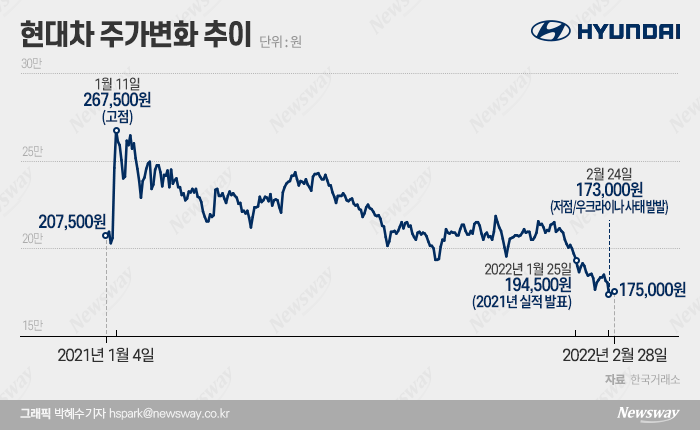
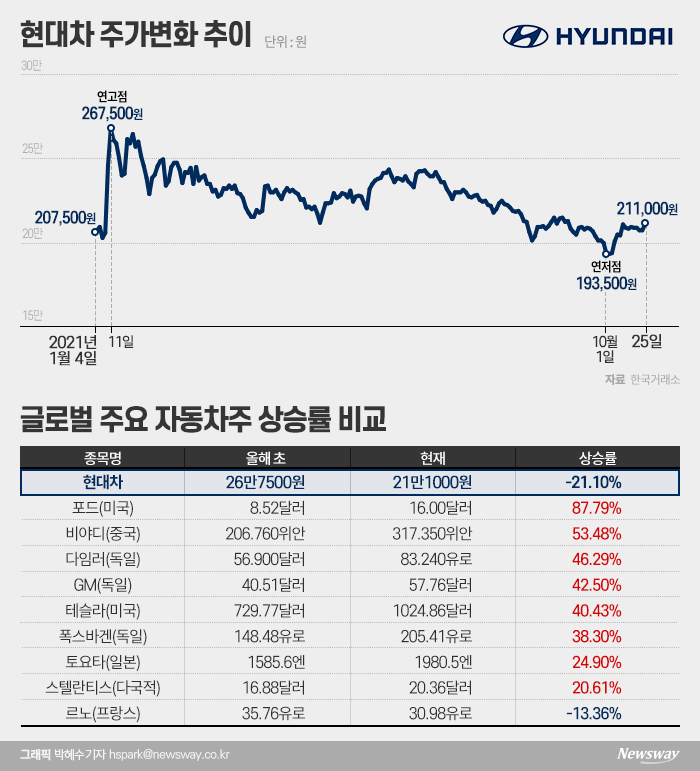
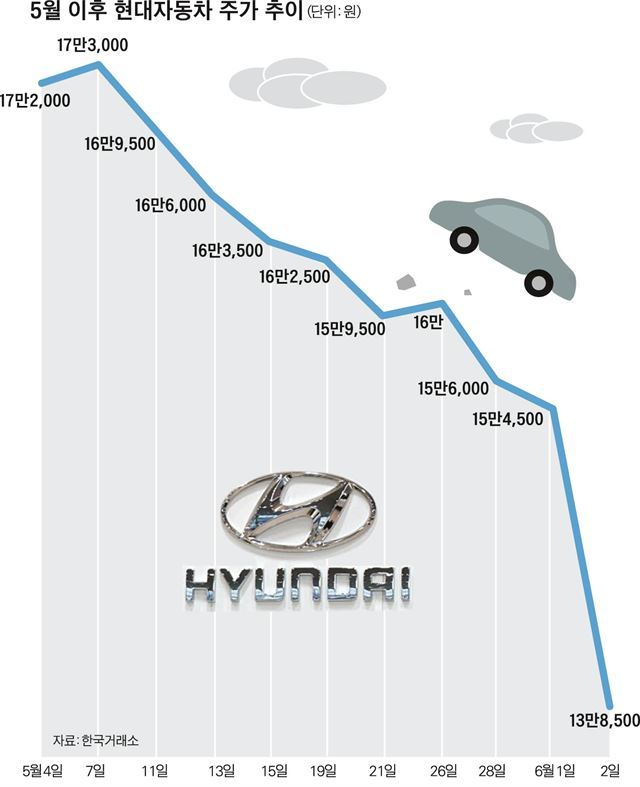
Hyundai Motor’s stock price, which hit 780,000 won intraday as recently as this summer, has plummeted to the 360,000 won range by mid-September. This means that more than half of the asset value has vanished in just three months, causing significant shock to the market. On the 15th alone, the price dropped by 4,500 won, closing down 1.21%. The downward trend that began on the 11th has continued without interruption, pushing investor anxiety to its peak. Those who bought 100 shares at the peak are now bearing losses of tens of millions of won. At this point, many shareholders are so exhausted from being angry that they have simply stopped checking their accounts.
The collapse of the stock price is not just due to a general market correction but reflects the specific weight of this individual stock. Individual investors who rode the upward trend that began at the start of the year are seeing their losses widen without understanding why. As voices calling for lower target prices emerge in the securities industry, investor sentiment has frozen further. This is why more and more people are sighing every time they open their accounts each morning. The market conditions remain unpredictable, making it difficult to gauge how far this decline will continue.
Hyundai Motor’s stock price has halved in three months, falling from its June peak of 780,000 won to the 360,000 won range in September.
2. The Identity of the Vanished 420,000 Won: The Robot Premium
The driving force behind the past stock price surge was not the core business of car sales, but expectations for future growth engines. In particular, the robotics business, including Boston Dynamics, and autonomous driving technology created a massive bubble in the stock price. The market valued Hyundai not as a simple manufacturer but as an advanced technology company, giving it high marks. Every time a humanoid robot like Atlas was showcased, the stock price soared at an unimaginable speed. However, when these expectations were not immediately proven by results, the bubble began to deflate instantly.
It has become clear that the 420,000 won price tag, inflated solely by expectations, was indeed a bubble. The premium, which was not supported by actual profit-generating capabilities, crumbled like a castle of sand as soon as the market mood changed. Investor disappointment grew each time news emerged that the robotics business roadmap had been slightly delayed. While the company argues that the future remains, it has been insufficient to satisfy the immediate financial needs of shareholders. Ultimately, the stock price, which grew on dreams, is returning to reality after hitting the wall of current circumstances.
A significant portion of the price increase from the peak was a bubble driven by the uncertain robot premium.
3. Q3 Earnings and the Approaching Real Bill
The factor making shareholders tremble with fear is none other than the upcoming Q3 earnings release. Tension is rising as the time approaches to reveal the true report card of the core business, which had been hidden until now. Concerns are mounting about how the sales volume competition with Tesla and the slowdown in electric vehicle demand will impact earnings. Macroeconomic indicators such as exchange rate effects and global interest rate hikes are also negatively affecting car sales margins. With U.S. Treasury yields breaking the 5% mark, capital markets are tightening, increasing interest burdens for companies.
In fact, examining the financial structures of major groups reveals that capital pressure is more serious than expected. Hyundai Motor is also in a position where it cannot be completely free from the effects of prolonged high interest rates. If Q3 earnings fall short of market expectations, the stock price could undergo another major shakeup. It is dangerous to hastily judge that the bottom has been reached just because the stock price has already fallen significantly. This is why we must coldly observe how the market reacts after the real bill arrives.
The upcoming Q3 earnings will be a true test of the core business’s competitiveness.
4. Differentiated Market Conditions and Investors’ Dilemma
Currently, as the KOSPI index fluctuates, the fortunes of individual stocks are sharply diverging. While some stocks are rising steeply, large-cap stocks, including Hyundai Motor, are struggling to escape weakness. Investor attention is not focused on one side but is being divided based on each company’s earnings and fundamentals. In such a phase, blindly following others to buy is a very risky strategy. If you hold on without knowing the exact reason why the stocks in your account are falling, you are likely to suffer significant losses.
Some voices are emerging suggesting that now is an opportunity for low-price buying and recommending averaging down. However, injecting additional funds into a stock that has already halved requires immense courage. This is because it is uncertain whether the stock price is in the process of bottoming out or heading to even deeper lows. Compared to financial stocks or other large-cap stocks, Hyundai Motor’s recent slump is particularly painful and conspicuous. Investors are at a crossroads, wondering whether they should sell now or grit their teeth and endure longer.
In a market with differentiated stock performance, verifying earnings is more important than reckless additional buying.
5. Conditions and Outlook for Future Stock Price Recovery
For Hyundai Motor to regain its past glory and recover the 400,000 and 600,000 won levels, clear conditions are necessary. First, it must establish a solid foundation for a comeback in the electric vehicle market share battle with Tesla. It must show concrete indicators of increased sales volume and improved profitability, rather than just presenting a long-term vision. Additionally, it must prove that visible achievements in autonomous driving and robotics are translating into revenue. It is urgent to present definitive management results so that shareholders are no longer subjected to false hope.
It is expected that it will take a considerable amount of time to regain market trust. From a policy investment perspective, new purchases should be observed cautiously, while existing holders must verify core business earnings to the end. The comprehensive investment scores assigned by experts are not as high as before. The current position, evaluated at around 7 out of 10 points, signifies a significant level of risk. Nevertheless, Hyundai Motor’s solid position in the global finished car market remains a powerful weapon.
Substantial earnings improvement and proof of technology commercialization are essential to recover the 400,000 and 600,000 won levels.
6. Advice for Shareholders Passing Through the Dark Tunnel
When stock prices are sluggish for a long period, as they are now, the action to be most wary of is making hasty stop-loss sales driven by emotion. It is necessary to calmly review the original investment idea of why you bought this stock. While the deflation of the robot premium bubble is painful, the fundamental nature of the core automotive business has become much stronger compared to the past. Rather than reacting emotionally to short-term stock price fluctuations, patience is needed to observe the company’s long-term structural improvement. Only those who maintain composure while others panic and sell will be able to smile later.
You must carefully monitor the upcoming Q3 earnings and global sales volumes to adjust your response strategy. Taking on excessive debt for investment is strictly forbidden, and a long-term perspective should be maintained based on spare funds. Although the end of the dark tunnel is not yet clearly visible, if the essence of the company has not been damaged, opportunities will return. It is time to engrave the truth that those who survive in the stock market ultimately become the winners. Once this painful period passes, a new opportunity for a stock price rebound will certainly be created.
Refrain from emotional responses, believe in the fundamental nature of the core business, and observe the market with a long-term perspective.
Frequently Asked Questions
=