Individual Retirement Pension (IRP) accounts are essential financial products that allow you to accumulate retirement funds while enjoying significant tax benefits during your annual year-end tax settlement. Many employees inadvertently leave their severance pay or surplus funds unmanaged, only to join the program later. However, the size of your assets at retirement can vary by tens of millions of won depending on how you manage the account. Recently, with the ability to directly trade individual investment bonds and various exchange-traded funds (ETFs) within the account, more investors are finding ways to balance profitability and stability. However, since terminating the account before age 55 requires returning the benefits received and early withdrawal conditions are very strict, thorough prior understanding is necessary. This article will meticulously cover how to utilize tax deduction limits, asset allocation strategies for different situations, and the pitfalls of early withdrawals to avoid.
=
IRP Pension: A Complete Guide from Tax Deduction Limits to Early Withdrawal Cautions
1. Subheading
Concept of IRP Accounts and Eligibility
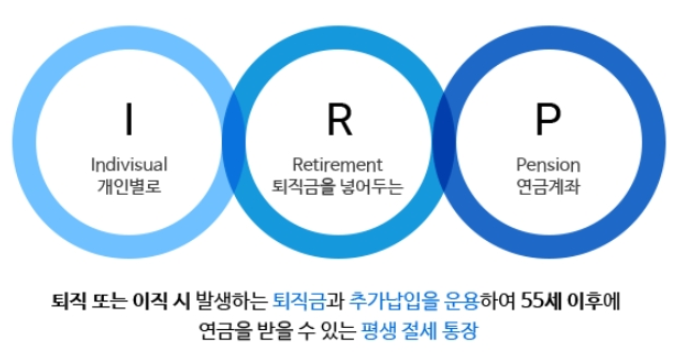
The Individual Retirement Pension system is a tax-saving product designed to allow workers to accumulate their severance pay, received upon changing jobs or retiring, in an account under their own name and manage it safely until retirement. In the past, the method was primarily driven by the company, but now it is an era where individuals directly select and manage products through financial institution applications. It has become a fundamental framework for retirement preparation, as anyone with income, including salaried employees, self-employed individuals, and freelancers, can join. The biggest advantage is that you can grow your assets by saving a fixed amount monthly or making additional contributions with bonuses. In particular, for modern people who frequently change jobs, it serves as a hub for consolidating and managing severance pay that was previously scattered.
Since the joining conditions are not strict, it is advantageous to open an account early in your career and gradually gain experience. You can easily open an account non-face-to-face through a mobile app or by visiting a financial institution such as a securities firm or bank. It is recommended to carefully compare the fee structures. Recently, many financial companies offer benefits such as waiving management fees for customers who open accounts non-face-to-face, significantly reducing the cost burden. Kim, a junior manager at a company, recently realized the importance of pension accounts and immediately opened one, starting small automatic transfers every month. This habit of starting early will create a massive compound interest effect in the future, serving as a sturdy pillar for a secure retirement.
IRP is a tax-saving retirement preparation account available to both employees and self-employed individuals.
2. Subheading

Tax Deduction Limits and Differences from Pension Savings
As the year-end tax settlement season approaches, the biggest concern for employees is undoubtedly tax-saving strategies to get a refund, with pension accounts always at the center. The combined contribution limit for tax deductions for pension savings and IRP is up to 9 million won, of which you can receive benefits for up to 9 million won with IRP alone. If your total income is 55 million won or less, you can receive a high deduction rate of 16.5%, resulting in a refund of up to 1.485 million won. Even if your total income exceeds 55 million won, you can get a refund of up to 1.188 million won with a 13.2% deduction rate, which is a guaranteed return far higher than typical deposit interest. If you already have funds in a pension savings account, it is wise to maximize tax efficiency by filling the remaining limit with IRP contributions.
Instead of just envying acquaintances who are happy about receiving tax refunds, you should take direct action. For example, Park, a manager with an annual salary of 50 million won, consistently contributed 750,000 won monthly to fill the 9 million won annual limit, resulting in a refund of over 1.4 million won during the year-end tax settlement. He is using this refunded amount for reinvestment or living expenses, greatly benefiting his household economy. However, you must accurately grasp your cash flow to avoid the pitfall of forcing yourself to meet the limit and ending up short on immediate living expenses. The safest approach is to set an appropriate monthly contribution amount that you can afford and make additional contributions only for the remaining amount at the end of the year.
You can contribute up to 9 million won annually to enjoy tax deduction benefits of up to 16.5%.
3. Subheading
Diversified Investment Products and Asset Allocation Strategies
In the past, retirement pensions were managed mainly with bank deposits and principal-guaranteed products, often criticized for failing to keep up with inflation. However, with recent regulatory relaxations, it has become possible to actively invest in various risky assets such as equity ETFs, bond-mixed products, and Target Date Funds (TDFs). In particular, strategies to enhance profitability through products mixing high-quality bonds and semiconductor stocks, or monthly dividend products, are gaining popularity, even within the regulation requiring at least 30% in safe assets. Recently, the ability to directly include individual investment bonds in the account has opened a new path to secure stable interest income from a long-term perspective.
For younger generations with a long time until retirement, it is advantageous to increase the equity ratio to actively grow assets, while those nearing retirement should increase the proportion of safe assets. Mr. Jung, a 40-year-old employee, completely revised his account portfolio after reading an investment success story about achieving high returns through aggressive asset allocation. He purchased products mixing high-growth AI-related indices and bonds equally using his monthly bonuses and surplus funds, securing both stability and returns. The ability to flexibly switch stocks according to market trends is the key to determining the size of your retirement funds. Rather than blindly following asset allocation methods recommended by experts, you should build your portfolio by comprehensively considering your investment style and the remaining time until retirement.
You can pursue both profitability and stability by utilizing various equity products and government bonds.
4. Subheading
Early Withdrawal Conditions and How to Avoid a Tax Bomb
Just as important as diligently saving money is the wisdom to avoid a tax bomb when you unexpectedly need to withdraw funds. In principle, funds in this account cannot be withdrawn before age 55, but early withdrawal is permitted only under exceptional circumstances such as purchasing a home or securing a deposit for a lease (for non-homeowners), a declaration of bankruptcy, or medical treatment requiring hospitalization for three months or more for oneself or a dependent. If you arbitrarily terminate the account simply because you need cash, despite not meeting these legal grounds, a 16.5% miscellaneous income tax will be imposed on the investment returns in addition to the tax deductions received. You will have the painful experience of a significant portion of your hard-earned assets disappearing as taxes, so you must never impulsively press the termination button.
You should learn from the stories of acquaintances who closed their accounts because they suddenly needed a large sum of money and were left devastated after receiving a tax notice. Mr. Lee, a manager, needed urgent cash and terminated his account without properly checking the specific conditions, only to face the unexpected burden of paying several million won in taxes. If unavoidable expenses arise, it is much more beneficial to first carefully check if they qualify for legal early withdrawal grounds, or to utilize bank collateral loans or other emergency funds. Simply knowing and responding to the detailed rules of the system serves as a great shield to protect your valuable assets.
Unauthorized withdrawal before age 55 leads to a heavy tax burden, so you must always check for legal grounds.
5. Subheading
Pension Receipt Methods and Tax-Saving Know-How
When the time comes to receive your retirement funds after age 55, the taxes applied vary greatly depending on how you receive the money. If you withdraw the entire lump sum at once, you may face a tax bomb of high comprehensive income tax or miscellaneous income tax, so it is advantageous to receive it in the form of a pension. If you adjust the annual pension receipt amount within the limits set by the government, you will only be subject to the very low pension income tax rate of 3.3% to 5.5%. If you transfer your severance pay to this account, manage it, and then receive it as a pension, you can also enjoy the exceptional benefit of a tax reduction of up to 30% on the original severance income tax. The longer you set the receipt period, the lower the tax burden, so wisdom is needed to design your post-retirement cash flow in the long term.
One of the biggest regrets of seniors nearing retirement is not having made a pension receipt plan in advance, resulting in paying unnecessary high taxes. Mr. Kang, who is planning to retire, decided to spread the receipt period over more than 10 years and receive only the minimum amount needed for living expenses as a pension each year, following the advice of a tax expert. As a result, he is receiving stable monthly income like a salary while minimizing the tax burden, significantly improving the quality of his retirement life. As such, small strategic differences at the receipt stage determine the abundance of your retirement, requiring a more cautious approach as retirement approaches. For us living in the 100-year era after retirement, a pension account is essentially the most reliable and trustworthy lifelong salary account.
Receiving funds in the form of a pension allows you to apply a lower tax rate, significantly reducing the tax burden.
6. Subheading
Practical Strategies for Successful Retirement Preparation
As reviewed above, the IRP account is not just a savings tool but the ultimate tax-saving weapon that every Korean employee should utilize. You must create a virtuous cycle of using the refund received during the year-end tax settlement as a foundation for reinvestment and steadily growing your assets through various financial products. No matter how fast the world changes or how unstable the economic situation becomes, a bright future awaits those who manage their pension assets with thorough planning and principles. Let’s start with the small action of immediately checking your account status today, setting the optimal monthly contribution amount, and setting up automatic transfers.
Time is on our side, and the magic of compound interest from starting even one day earlier will return as a massive asset in the future, warmly embracing our retirement. Do not hesitate; open a financial company app right now to check your tax deduction limit and managed products, and reorganize your portfolio anew. Your wise choice will be the most certain investment in making your post-retirement life comfortable and abundant. If you practice consistently with a firm resolve, anyone can complete a stable retirement pipeline that others will envy. Please do not forget that the small effort you make at this moment is the most powerful weapon to welcome a golden retirement in the future.
Consistent contributions and proper asset management are the shortcut to a successful retirement life.
Frequently Asked Questions
=