Currently, the representative fixed deposit interest rates for one-year terms at major commercial banks are formed within a narrow range of 3.30% to 3.45% per annum, making careful comparison essential. While banks are slightly adjusting rates to secure deposits, not all products are seeing uniform increases, so it is crucial to scrutinize the details before signing up. For example, Mr. Kim, an office worker living in Seoul, once regretted signing up for a deposit product based solely on the highest advertised rate, only to find he couldn’t meet the preferential conditions. Understanding the reasons behind the interest rate differences between commercial banks, savings banks, and the mutual financial sector is key to avoiding unnecessary losses. In this article, we will go through specific tips for finding the most favorable interest rates at the current moment, covering everything from the linkage with loan rates to how banks are responding to rising funding costs.
=
Latest Fixed Deposit Interest Rate Comparison for September 2026: How to Choose a Bank to Protect Your Money
1. Current Status of Deposit Interest Rates at Major Commercial Banks
Recently, the one-year fixed deposit rates at the top five banks have remained around 3.30% to 3.45% per annum, showing little difference. Banks are attempting to expand retail deposits to cope with rising funding costs, but the structure makes it difficult to significantly widen the interest rate gap with competitors. This is because customers can easily move their funds to other banks with just a few taps on their smartphone screens after comparing rates. In fact, while mortgage rates have remained high, banks have consecutively raised deposit rates by 0.1 to 0.6 percentage points to attract funds.
However, this upward trend does not apply equally to all first-tier financial products, so it is necessary to directly check individual bank disclosures. Rather than signing up unconditionally with your primary bank, it is advantageous to examine the preferential conditions of special sale products or non-face-to-face exclusive products. Mr. Lee, an office worker, insisted on using only his usual bank and ended up receiving lower interest than a friend who used a non-face-to-face exclusive product, forcing him to switch banks later. Using smartphone apps allows you to easily compare real-time rates from various banks without visiting branches. During periods of rising funding costs, you must carefully check bank-specific rate coupons or salary transfer conditions to maximize your returns.
The one-year fixed deposit rates at the five major commercial banks are competing within a narrow range of 3.30% to 3.45% per annum.
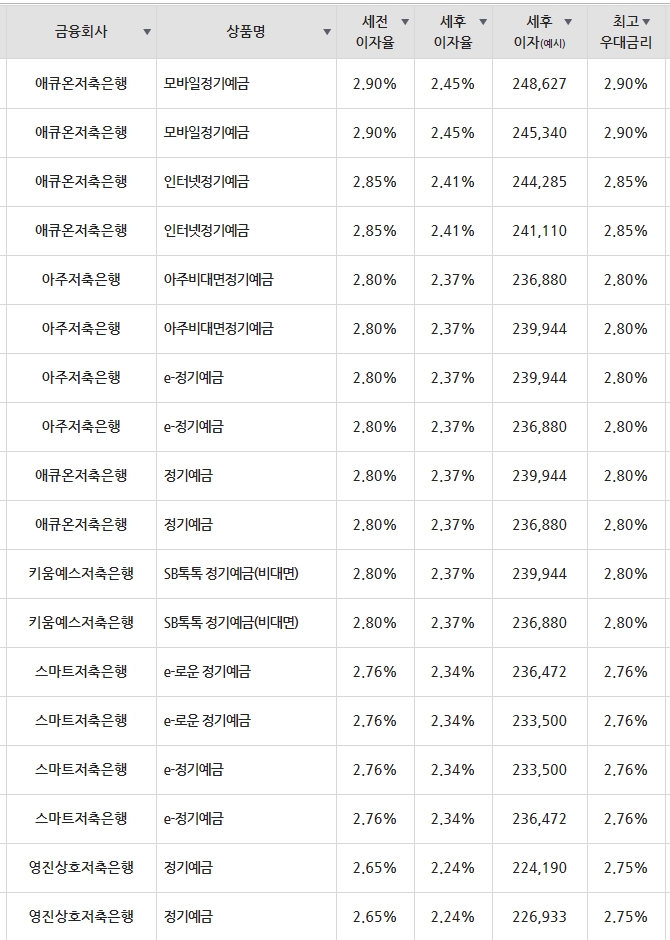
2. Interest Rate Comparison for Savings Banks and the Second-Tier Financial Sector

Second-tier financial institutions, such as savings banks and the mutual financial sector, often offer relatively higher interest rates than commercial banks, making them suitable for growing spare funds. However, since the management indicators and soundness status vary among savings banks, chasing only the highest rates can be risky. For instance, when a savings bank in a local area offered an exceptional special deposit, many customers rushed to sign up, but some expressed anxiety after depositing amounts exceeding the 50 million won deposit insurance limit.
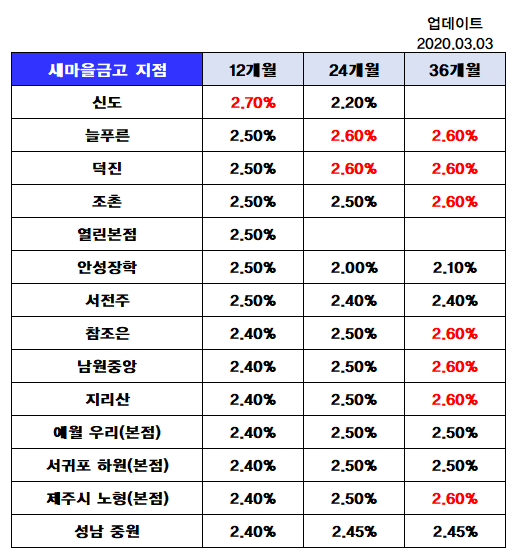
When utilizing products from mutual financial cooperatives or the Shinhung (Korea Credit Union), it is wise to check the management disclosures of each cooperative before signing up. Fixed deposit rates at the Nonghyup (Rural Financial Corporation) or Shinhung vary by branch, so it is recommended to compare rates not only at nearby branches but also in surrounding areas. Thanks to her diligence, Mrs. Park found a fixed deposit at a nearby Shinhung that offered much higher interest than commercial banks, allowing her to fully benefit from tax-exempt advantages. Utilizing internet financial information websites allows you to grasp the interest rate rankings of second-tier financial institutions across the country at a glance, saving significant time and effort.
While the second-tier financial sector offers higher interest rates, you must always check the deposit insurance limit and the soundness of individual cooperatives.
3. Deposit Insurance Limits and Safe Fund Diversification
You must keep in mind that the state guarantees the principal and interest up to a total of 50 million won deposited with a single financial institution. If you have 100 million won, it is safer to split it into 50 million won portions and deposit them in different financial institutions rather than putting it all in one place. The case of Mr. Kim, an elderly man who lost sleep worrying after depositing his entire retirement fund in a savings bank solely for the high interest, well illustrates the importance of diversification.
The deposit insurance system is a reliable safeguard where the Korea Deposit Insurance Corporation pays the principal and a prescribed interest if a financial institution goes bankrupt or has its business suspended. Therefore, it is advisable to diversify funds exceeding 50 million won into sound commercial banks or shift them to safe assets such as government bonds. You can directly verify whether an institution is covered by deposit insurance through the official app of the financial company or the financial authorities’ comparative disclosure sites. To maximize interest while safely protecting your principal, it is a top priority to leverage these institutional mechanisms wisely.
It is wise to adhere to the 50 million won deposit insurance limit by splitting deposits across multiple financial institutions.
4. How to Utilize Tax-Exempt and Tax-Preferred Products
If you fall under categories such as seniors aged 65 or older, persons with disabilities, or independence activists, you should actively utilize the limits for tax-preferred savings or tax-exempt comprehensive savings. A 15.4% interest income tax is levied on general deposit interest, but receiving tax-exempt benefits can significantly reduce this tax burden. For example, if you receive 10 million won in interest, a significant amount would be deducted as tax under general taxation, whereas the amount received would be higher if it were tax-exempt.
When signing up for deposits with cooperative corporations or mutual financial institutions, there is a system where becoming a quasi-member allows you to enjoy tax-exempt benefits by paying only a portion of the agricultural special tax. Mr. Jeong, an office worker, was able to significantly increase his after-tax return by finding and signing up for a tax-exempt deposit product suitable for his parents’ age group. When choosing financial products, you must not just look at the pre-tax rate but definitely calculate the after-tax interest you will actually receive at maturity. You can receive friendly guidance on the tax benefit limits applicable to you by inquiring at bank counters or customer service centers.
Utilizing the tax-exempt comprehensive savings for seniors or the tax-exempt system for mutual financial deposits can maximize your after-tax return.
5. Strategy for Switching Products During Interest Rate Hikes
During periods of rising market interest rates, it may be more advantageous to increase turnover with short-term products rather than unconditionally holding long-term products. Conversely, if interest rates are expected to fall in the future, it is wise to sign up for long-term products with high rates at the current moment to lock in the interest. Mr. Choi, a self-employed business owner, was able to fully enjoy the benefits of the rate-hiking period by splitting his deposits into six-month terms during a time of fluctuating rates.
You should closely watch the trend of commercial banks adjusting their wholesale funding ratio and retail deposit rates to reduce funding costs. If you are using mortgages or jeonse loans, you must manage your funds by comprehensively considering the impact of deposit rate fluctuations on loan rates. When considering switching banks, you must thoroughly calculate the profit and loss by comparing the early termination rate with the rate of the new product you are about to sign up for. There are cases where people suffer losses due to early termination fees by rashly canceling existing deposits, so checking the maturity date is essential.
Adjust deposit maturities according to interest rate cycles and consider early termination losses when switching.
6. Final Advice for Successful Fund Management
Fixed deposits are the safest means of asset growth with guaranteed principal, but wisdom is needed to consider the real return rate in light of the inflation rate. You should develop the habit of consistently checking economic indicators and interest rate trends released monthly through news or financial information apps. Mr. Seo, a university student, learned the joy of earning small interest income by locking his seed money, saved from part-time jobs, into short-term fixed deposits instead of leaving it in a regular account.
The most important thing in financial life is the attitude of proactively choosing products that fit your financial situation without being swept away by rumors. You must thoroughly filter out suspicious high-interest advertisements or quasi-deposit activities by private companies with unclear sources through the official comparative disclosures of financial authorities. Since the interest rate environment will continue to fluctuate depending on domestic and international economic conditions, you must maintain a flexible asset allocation strategy. Based on the interest rate comparison tips and deposit insurance system learned today, we hope you will grow your precious assets safely and robustly.
Continuously monitor interest rate trends considering inflation and your financial plan, and sign up proactively.
Frequently Asked Questions
=