Individual pension savings are an essential financial product that allows you to secure a robust tax deduction benefit during your annual tax settlement while simultaneously preparing for your retirement. It is common to see colleagues deducting a fixed amount from their monthly salaries to contribute to pension products, as this serves as an excellent tax-saving measure beyond simple savings. For instance, So-yeon, an office worker in Seoul, consistently deposits a fixed amount from her monthly salary into her pension savings, steadily preparing for her upcoming retirement. However, when it comes to actually signing up, many people find it confusing to distinguish between fund accounts and general pensions, and the tax deduction limits can seem complex. In this article, we will clearly explain the basic concepts of individual pension savings, the tax deduction benefits, and the differences from Individual Retirement Pensions (IRP), which often cause confusion. By reading through the content summarized here, you will be able to establish a definitive strategy for preparing your retirement funds that is most advantageous for you.
=
The Ultimate Guide to Comparing Individual Pension Savings Tax Deduction Limits and IRP
1. What is Individual Pension Savings?
Individual pension savings are a representative tax-advantaged financial product created by the government to help stabilize life in old age. In the past, these were often simply deposits left in banks, but recently, they have evolved into a method of investing in various products through securities firms. They serve as a reliable pillar, helping office workers maintain consistent savings and secure a stable cash flow after retirement. You can receive these funds in the form of a pension after the age of 55, during which a significantly lower tax rate is applied compared to general financial products.
While many people feel overwhelmed by retirement planning, effectively utilizing just this one account can significantly reduce your tax burden. We often meet people who rely solely on public pensions, such as the civil service pension or the National Pension, only to start looking into individual pensions when retirement approaches. However, public pensions alone may not be sufficient to defend against inflation and enjoy a comfortable retirement, so it is necessary to increase the proportion of private pensions. The quality of life after retirement can differ vastly between those who have consistently prepared since their youth and those who have not.
Individual pension savings are an essential tool for retirement preparation that creates a stable cash flow after retirement and helps save on taxes.
2. Tax Deduction Limits and Tax-Saving Effects
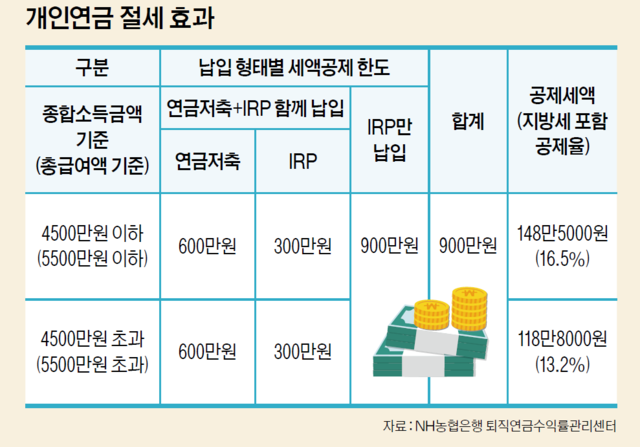
The biggest appeal of individual pension savings is the ability to receive a powerful tax deduction benefit on contributions during the annual tax settlement. With a pension savings account alone, you can receive a refund of a certain percentage of your contributions up to an annual limit of 6 million KRW. Employees with a total salary of 55 million KRW or less can benefit from a high deduction rate of 16.5%, saving up to 990,000 KRW in taxes.
Even office workers with a total salary exceeding 55 million KRW can apply a 13.2% deduction rate to secure a decent refund. Furthermore, by utilizing an Individual Retirement Pension (IRP) account together, you can increase your contribution amount up to the integrated limit of 9 million KRW, thereby maximizing the tax-saving effect. If you want to receive a generous “13th-month salary” every year, filling up the annual limit of this account is a smart financial tip. In fact, one of my colleagues mentioned that the secret to funding family trips with their annual tax refund is consistent pension contributions.
Pension savings offer a tax deduction benefit of up to 16.5% on contributions of up to 6 million KRW annually.
3. Differences Between Pension Savings and Individual Retirement Pensions (IRP)
While both pension savings and Individual Retirement Pensions (IRP) are representative tax-saving accounts for retirement preparation, there are several important differences in their operational methods and investment characteristics. First, pension savings have no special restrictions on eligibility, meaning any citizen of South Korea can freely sign up and make contributions. In contrast, IRP is available only to employees or business owners with income, and it is also an account that must be used when receiving severance pay.
There are also slight regulatory differences in the types of assets that can be invested, requiring a choice that suits individual preferences. Pension savings accounts allow 100% of assets to be invested in equity funds or exchange-traded funds (ETFs), enabling aggressive asset growth. However, IRP requires a mandatory allocation of 30% to safe assets, necessitating a relatively conservative portfolio. It is important to understand these characteristics of both accounts and allocate them appropriately according to your investment style and income level.
Pension savings are open to everyone and allow for a high proportion of equity assets, while IRP is for income earners and requires maintaining a certain proportion of safe assets.
4. Points to Note Regarding Early Termination
Since individual pension savings are a long-term product, terminating the account impulsively because you urgently need money can result in significant losses. If you terminate the account or receive the funds in a form other than a pension before reaching the pension receipt age, miscellaneous income tax will be imposed. A high tax rate of 16.5% is applied to the principal and profits for which you previously received tax deductions, potentially leading to a tax bomb.
Therefore, when you need a lump sum, it is wiser to utilize the legally permitted early withdrawal system rather than terminating the entire account. In cases of special circumstances, such as purchasing a home or paying a deposit for a rental house if you are a non-homeowner, or medical treatment for yourself or dependents, you can withdraw funds without a tax burden. It is not uncommon to find acquaintances who regret breaking their pension accounts because they suddenly needed money. You should predict your long-term cash flow, prepare separate living expenses, and maintain your pension until the end.
Early termination requires returning the tax deduction benefits received, so it should be maintained long-term unless there are special reasons.
5. How to Utilize in Connection with Comprehensive Asset Management Accounts
A strategy gaining attention is converting the maturity funds from Comprehensive Asset Management Accounts (CAMA), which many people are currently using, into pension savings to enjoy additional tax-saving benefits. Once the mandatory holding period for a CAMA is over, you can terminate the account and freely withdraw the principal and earnings. At this time, if you transfer all or part of the maturity refund to a pension savings account, you can receive an additional tax deduction of 10% on the transferred amount.
By effectively utilizing this system, even general office workers can enjoy a substantial tax-saving effect that far exceeds the annual deduction limit. For example, if you move 30 million KRW from a matured CAMA to a pension account, you secure an additional deduction limit of 3 million KRW. Financial experts actively utilize these inter-account transfer channels to reduce taxes and grow their investment assets. Although these financial products may seem complex, knowing how to connect them turns them into a powerful weapon for protecting your assets.
Converting maturity refunds from Comprehensive Asset Management Accounts into pension savings allows you to secure substantial additional tax deduction benefits.
6. Practical Strategies for Successful Retirement Preparation
To achieve a successful retirement through individual pension savings, the top priority is to set up automatic transfers immediately, even for small amounts. The habit of consistently contributing 100,000 or 200,000 KRW from your fixed monthly expenses will return as a massive compound interest effect later on. As retirement approaches, income tends to decrease, so you should fill up the contribution limit as much as possible during your younger years when your income is stable.
As the aging society deepens, it is expected to become increasingly difficult to maintain a comfortable life relying solely on pensions paid by the government. Therefore, you should review your annual contribution plan according to your financial situation and aim to fully utilize the tax deduction limit. Taking this article as an opportunity, please open your bank or securities app to check the status of your pension account. This small practical step will be the wisest choice that determines your bank balance and abundant retirement life years from now.
Consistently contributing a fixed amount via automatic transfer and holding it long-term until retirement is the key to a successful retirement.
Frequently Asked Questions
=