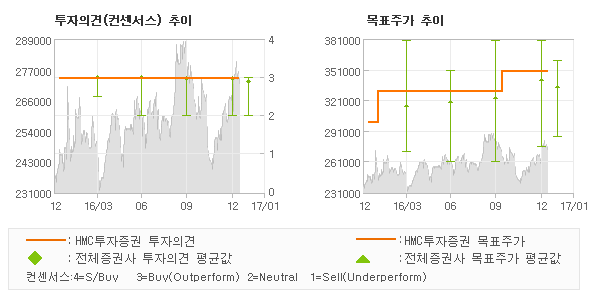
Samsung Securities recently issued a report significantly lowering Hyundai Mobis’s target price from 800,000 won to 650,000 won, a substantial 18.8% reduction. Despite the unprecedented high expectations for its massive future growth drivers in automotive electronics and robotics, investors are feeling considerable shock. This move fully reflects the recent sharp strengthening of the won and concerns over slowing sales volumes from its major client, Hyundai Motor. Amid the dark clouds of falling exchange rates and stagnant finished vehicle demand hanging over the entire auto parts industry, attention is turning to how Mobis will find a breakthrough. This article will thoroughly examine the specific reasons behind the target price cut and the medium-to-long-term potential held by its automotive electronics and robotics businesses. We will consider together whether now is the golden time to treat the stock price drop as a buying opportunity, or if it is better to wait and see a bit longer.
=
Why Hyundai Mobis’s Target Price Was Cut by 19% and the Outlook for Its Electronics and Robotics Businesses
1. Background of the 19% Target Price Cut
The most decisive factor in the lowered expectations for Hyundai Mobis in the securities market is the concern over slowing sales from its major client, Hyundai Motor. In the second half of the year, the finished vehicle industry is facing high oil prices due to strike risks and the lingering effects of prolonged wars. As a result, demand for traditional internal combustion engine vehicles has noticeably decreased, casting a red light on the earnings outlook for Mobis, the parts supplier. Reflecting these negative factors, Samsung Securities lowered its forecast for this year’s earnings per share (EPS) by 11.7% compared to previous estimates. It also significantly lowered next year’s EPS forecast by a whopping 20.5%, calling for a conservative approach. Additionally, the recent sharp strengthening of the won, which has shaken the market, fueled the downward revision of earnings forecasts. When the exchange rate falls, export-centric companies inevitably suffer because their dollar-converted revenues decrease. Given the structure of manufacturing auto parts and supplying them to finished vehicle manufacturers, Mobis inherently possesses a limitation of being sensitive to exchange rate fluctuations. Of course, there is also analysis suggesting that Mobis has relatively low exchange rate sensitivity among Hyundai Motor Group affiliates. Nevertheless, it is an undeniable fact that the deterioration of overall macroeconomic indicators has negatively impacted the company’s valuation.
Due to the combination of Hyundai Motor’s sales slowdown and the strengthening won, the securities market has lowered EPS forecasts for this year and next, leading to a downward adjustment of the target price.
2. Exchange Rate Sensitivity Analysis and Earnings Outlook
Hyundai Mobis is in a relatively mild position regarding earnings shocks from exchange rate fluctuations compared to other finished vehicle manufacturers. In the automotive electronics sector, since core semiconductors are primarily imported in dollars, a falling exchange rate has the effect of partially offsetting cost burdens. The module sector also forms a relatively neutral structure where exchange rate fluctuations have a limited impact on operating profit. Looking at the specific exchange rate sensitivity, it is estimated that operating profit fluctuates by approximately 1.7% for every 1% movement in the exchange rate in the after-sales service sector. The scale of Mobis’s net dollar exposure calculated by Samsung Securities is estimated at approximately $6.459 billion. This figure is only about half the level of Hyundai Motor’s or Kia’s exchange rate sensitivity. Even in situations where exchange rate shockwaves hit hard, Mobis possesses a business structure with relatively strong defensive capabilities. Based on this defensive strength, total revenue for this year is projected to reach 62.855 trillion won, a 2.8% increase from last year. Operating profit is also expected to achieve approximately 3.769 trillion won, a 12.3% increase year-on-year, continuing its external growth.
Mobis has lower net dollar exposure compared to competitors, resulting in relatively low fluctuations in operating profit due to exchange rate changes, and stable earnings growth is expected this year as well.
3. The Steep Growth of Automotive Electronics Systems
Separate from short-term earnings concerns, Mobis’s core growth engine, the automotive electronics systems sector, is expanding its territory at a frightening speed. Mobis’s revenue related to automotive electronics systems has been on a high-growth path of over 10% annually since 2024. In the first half of this year alone, revenue from the electronics sector reached approximately 5.2 trillion won, a 12% increase from the same period last year. The proportion of automotive electronics systems in total module revenue has also surged to 21%, marking a successful transformation of its business structure. Behind this dazzling growth lies the Software-Defined Vehicle (SDV) transition strategy being pursued by Hyundai Motor and Kia. As vehicles evolve into giant computers on wheels, the adoption rate of Mobis’s independently designed System-on-Chips (SoC) and automotive electronics systems will increase further. Finished vehicle manufacturers are trending towards strengthening software competitiveness by partnering with internal parts affiliates rather than relying on external technologies. Since the electronics sector consists of high-value-added items, increased revenue will significantly contribute to improving the company’s overall profitability. It is the most powerful weapon for Mobis to transform from a simple hardware parts manufacturer into a core technology supplier for future mobility.
Automotive electronics systems have repeatedly achieved double-digit growth annually, accounting for 21% of total module revenue, and have established themselves as a core growth driver alongside the transition to Software-Defined Vehicles.
4. The New Future Food Source: The Robotics Business
Alongside the electronics sector, another massive pillar elevating Mobis’s future value is the robotics business. Mobis supplies a large number of core components to Boston Dynamics’ next-generation humanoid robot, Atlas. Specifically, it plans to supply a whopping 31 actuators, which are the driving devices installed in Atlas. It has expanded its supply items beyond just actuators to include the head controller, which acts as the robot’s brain, and grippers for grasping objects. According to Samsung Securities’ analysis, Mobis is expected to handle a volume equivalent to a massive 60% of Atlas’s total hardware cost. This signifies that Mobis has received global recognition for its unparalleled technological capability and mass production capacity in the field of robot hardware manufacturing. In particular, the business related to robot actuators is analyzed to have a very high probability of achieving a full-fledged turn to profitability before 2030. The know-how in precision control and machine processing accumulated from past auto parts production is generating enormous synergy effects when combined with the new industry of robotics. For investors, this is the reason to pay close attention to the potential of the robotics industry rather than being pessimistic about the short-term stock price drop.
Mobis handles 60% of the cost of Boston Dynamics’ robot Atlas, supplying actuators and controllers, with a turn to profitability expected before 2030.
5. Second-Half Challenges for Profitability Improvement

Despite the dazzling future blueprint, the reality investors face immediately is the harsh trial of pressure to lower parts prices. As signs of slowing performance become clearer among finished vehicle manufacturers, demands for lower supply prices to parts partners inevitably intensify. Mobis is not completely free from this cost pressure, making short-term profitability defense a critical issue. How much the steep revenue growth in the electronics sector translates into actual profits is the key to determining the success or failure of second-half earnings. Ultimately, the core of a second-half earnings rebound depends on how favorably Mobis can receive cost settlements for core parts from its finished vehicle clients. Analysts diagnose that now is the inflection point where concerns over parts price cuts and expectations for profitability creation in the electronics sector are in a tense standoff. If Mobis successfully recovers its development costs and defends the margin rates of high-value-added electronics items, the stock price can seize a rebound opportunity at any time. From an investment perspective, rather than being shaken by the news of the target price cut, one must carefully examine the second-half cost settlement process and profitability indicators.
In the second half, the most important task is to ensure smooth cost settlements for core parts amidst cost pressure from the finished vehicle industry to defend profitability.
6. Future Outlook and Wise Investment Strategy
The market’s evaluation of Hyundai Mobis currently shows a chaotic state where expectations and concerns collide head-on. While short-term negative factors such as the strong won and Hyundai Motor’s sales slowdown led to a target price cut, the fundamentals themselves have not been damaged. The stable revenue expansion of automotive electronics systems and entry into the humanoid robot market prove that Mobis is a technology company that has transcended being a simple parts supplier. Rather than reacting emotionally to short-term stock price fluctuations, wisdom is needed to calmly verify the realization potential of medium-to-long-term growth drivers. In conclusion, now is a period worth approaching from the perspective of split buying as Mobis’s stock price adjusts due to macroeconomic concerns. However, it is necessary to confirm in the second-half earnings release whether the margin rate in the electronics sector is actually improving and whether robot parts supply is proceeding as planned. In the midst of the rapidly changing paradigm shift in the automotive industry, Mobis’s innovative moves will continue to receive hot attention from the securities market. We hope that you, the investors, will consistently monitor the company’s short-term earnings releases and the progress of its medium-to-long-term new businesses to formulate a successful investment strategy.
Although the stock price adjusted due to short-term negative factors, a strategy of aiming for the timing of a turn to strong performance, believing in the certain future growth of electronics and robotics, is valid.
Frequently Asked Questions
=