
It is increasingly common for people to sell their apartments based on online capital gains tax calculators, only to be left in shock when they receive a tax assessment notice far higher than expected. Although they may have tried to calculate the tax themselves to minimize their burden, the bill from the tax office is often much steeper than anticipated. When trading real estate, it is essential to carefully consider not just the difference in sale price, but also various deductions and necessary expenses to avoid such pitfalls. It is crucial to remember that online calculators are merely rough simulations and may differ from the actual tax amount. In this article, we will detail how to accurately calculate capital gains tax and share practical tips to dramatically reduce your tax liability. Only by understanding the correct calculation method can you hold a solid shield to fully protect your assets.
=
Why You Got Hit with a Tax Bomb After Trusting Online Capital Gains Calculators, and How to Calculate It Perfectly

1. Understanding the Basic Structure of Capital Gains Tax Calculation
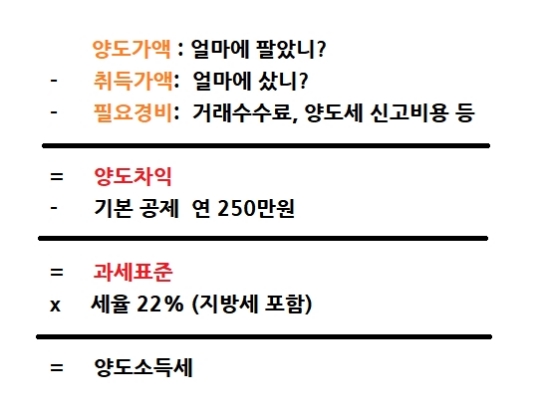
Capital gains tax is a tax levied on income generated from the sale of real estate after acquisition. The basic calculation structure appears simple: the capital gain is calculated by subtracting the acquisition cost and necessary expenses from the sale price. From this capital gain, the Long-Term Holding Special Deduction and the Basic Capital Gains Tax Deduction are sequentially subtracted to determine the taxable income. The applicable tax rate is then multiplied to derive the final tax amount. It belongs to an independent income category, calculated separately from employment or business income. Even for salaried employees, this tax is not combined with their primary income tax and must be filed separately.
For instance, Mr. Kim, who owns a home in Seoul, bought an apartment for 500 million won and sold it for 800 million won, initially thinking he had made a simple profit of 300 million won. However, when he did the math, the result changed completely once various necessary expenses and deductions based on the holding period were factored in. This is a typical scenario where people suffer significant losses by estimating taxes based on guesswork due to a lack of tax knowledge. Tax laws are much more intricate than one might think, and missing even a minor item can cause the tax amount to fluctuate significantly. Therefore, the first step is to firmly imprint the basic calculation structure in your mind.
To get an accurate tax amount, you must calculate the capital gain by subtracting the acquisition cost and necessary expenses from the sale price, and then apply various deductions and tax rates.
2. The Magic of Necessary Expenses: How One Receipt Can Change Your Tax Bill

The area requiring the most careful attention to reduce capital gains tax is the necessary expenses category. Capital expenditures incurred to repair or enhance the value of a home play a magical role in reducing the capital gain. For example, costs for a complete boiler replacement, veranda expansion, or new window frame installation are all recognized as deductible expenses. However, revenue expenditures such as simple wallpapering or flooring replacement are not recognized as necessary expenses, so it is crucial to distinguish between the two. To prove these expenditures, you must always keep supporting documents such as tax invoices, cash receipts, or bank transfer records.
Mr. Lee, who lives in the provinces, carelessly threw away receipts from a home renovation a few years ago and later faced a harsh reality. Due to a lack of supporting documents for the tax office, he could not have his tens of millions of won in repair costs recognized as expenses and had to pay them all as tax. If you paid an interior contractor several million won in cash without receiving a receipt, no one can help you later. Therefore, you must develop the habit of obtaining proper documentation whenever you repair or modify your home. This small piece of paper will return to you as a reliable shield that saves you millions of won in taxes.
Repair or interior costs that qualify as capital expenditures can be deducted as necessary expenses, so you must always keep proper documentation.
3. Practical Tips for Using the Hometax Simulator

The official Hometax system operated by the National Tax Service provides a user-friendly capital gains tax simulator for taxpayers. It is far more accurate than private calculators found on portal sites and is structured similarly to the actual tax return forms. You can easily access it by navigating to the Tax Filing menu on the main screen, clicking on the Capital Gains Tax Filing item, and selecting the simulation corner. Simply select the type of real estate you own and enter the acquisition date, sale date, and actual transaction amount in sequence. During the input process, the system also guides you on whether you qualify for tax exemption or reduction.
Mr. Park, a salaried employee preparing to move, used the Hometax simulator to carefully estimate his tax liability. While private sites frequently produced errors and incorrect amounts, using the official system allowed him to plan his finances with confidence. However, since the simulation is merely a reference result based on the input data, you must always reflect the latest tax law amendments at the time of actual filing. In particular, regulations on heavy taxation for multi-home owners and residency requirements change frequently depending on the timing, so caution is required. The safest method is to get a rough estimate using the simulator and then consult with a tax professional for a final review.
You should use the National Tax Service’s official simulator rather than private calculators, and carefully verify the results as they vary depending on the input data.
4. Significantly Reducing Tax Burden with the Long-Term Holding Special Deduction
The biggest gift the state offers to those who have lived in or owned a home for a long time is the Long-Term Holding Special Deduction system. Since a certain percentage is deducted from the capital gain based on the holding period, it can drastically reduce the tax burden. While a specific annual percentage is applied based on the holding period for general multi-home owners or land, the benefits for single-home owners are on a different level. If both the holding period and residency period requirements are met, the maximum deduction rate increases significantly, allowing you to dramatically avoid a tax bomb. However, under the strengthened tax standards as of 2026, you must thoroughly check the tax exemption criteria and residency requirements for single-home owners.
Mr. Choi, who had lived in Gangnam, Seoul, for a long time, fully benefited from the Long-Term Holding Special Deduction when he sold his house. Thanks to staying in one place for over 10 years, he was able to minimize his tax burden despite generating a capital gain of several hundred million won. If he had only held the property without meeting the residency period, the deduction rate would have been halved, and he would have had to pay a huge amount to the tax office. As you can see, the tax amount can fluctuate by tens of millions of won depending on when you bought the house and how many years you actually lived in it. If you are planning to sell your house, you should immediately check the real estate registry to verify the exact acquisition time and residency history.
The longer the holding and residency periods, the greater the Long-Term Holding Special Deduction benefit, so this should be a key metric when deciding the timing of your sale.
5. Points to Note When Selling Farmland and Special Real Estate
When selling farmland such as rice paddies or fields, rather than a general house, a completely different level of tax calculation applies. There is a special system that allows for capital gains tax reductions for self-cultivated farmland. However, to receive this reduction benefit, you must perfectly meet strict requirements such as the farmland ledger or agricultural business entity registration. Many farmers are rushing to use calculators expecting reduced tax amounts, only to end up paying the full tax due to insufficient documentation. Since the effective tax rate can reach the statutory maximum when local income tax is included, thorough prior review is necessary.
Mr. Jeong, who was organizing his rice paddy in Chungnam, carefully checked the 100 million won limit for self-cultivated farmland reductions before proceeding with the transaction. He had believed he had been farming for decades based on neighbors’ words, but his actual documentary evidence was insufficient, and he nearly suffered a major loss. Fortunately, with the help of a tax professional, he prepared the necessary evidence in advance and was able to fully secure the tax reduction benefit. Farmland or inherited real estate involves legal interpretations that are far more difficult and complex than those for general apartments. Therefore, it is a wise move to always undergo professional tax consultation in the relevant field when disposing of special-purpose real estate.
Self-cultivated farmland and inherited real estate have very strict reduction limits and documentation requirements, so thorough prior verification and expert consultation are essential.
6. Final Recommendations for a Successful Capital Gains Tax Filing
The process of disposing of real estate is one of the most significant moments in life where major financial movements occur. Relying solely on the simple numbers provided by internet calculators to make all decisions is like taking a very dangerous gamble. This is because tax laws are constantly being amended, and there are too many diverse exception clauses that apply depending on individual circumstances. You need the wisdom to start calculating in advance before signing a sales contract and to weigh the optimal timing for selling. The cold reality is that you can only save as much tax as you know, and you must return to the state everything you do not know.
Do not be swayed by rumors; instead, you should transparently organize the flow of assets in your name from acquisition to the present. It is most important to formulate a long-term asset management strategy that also considers family gifts and future inheritance issues. Starting today, try using the Hometax simulator yourself and begin the practice of collecting missing necessary expense receipts one by one. Only thorough preparation and calculation will serve as the only certain weapon to protect you from the fear of a tax bomb. I sincerely hope you will become a wise taxpayer, protect your precious assets, and design a comfortable future.
You can achieve perfect tax savings by combining thorough prior calculation, documentation management, and consultation with tax professionals.
Frequently Asked Questions
=