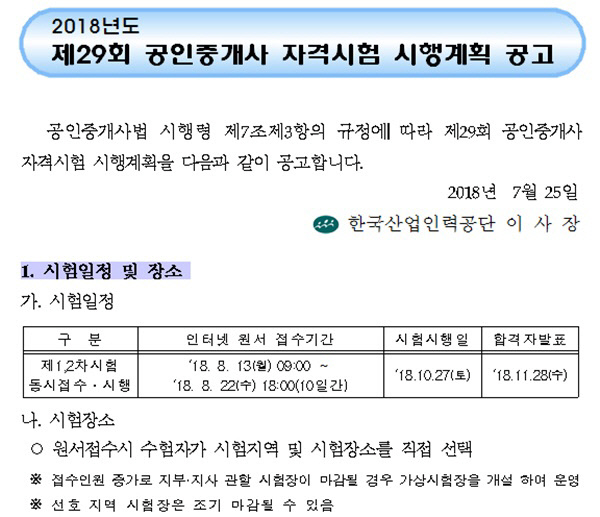
You must immediately log in to Q-Net to check the status of available seats and keep in mind that your eligibility to take the exam depends on whether you participate in the additional application process starting at 9:00 AM today. The 2026 37th Licensed Real Estate Broker Qualification Exam is scheduled for October 31, and the Korea Human Resource Development Service (HRD Korea) will conduct additional applications for empty seats from today, October 1, through tomorrow, October 2. Although the original application period has already ended, this opportunity has been created for candidates who missed the deadline due to errors or changes in their circumstances. Specifically, this additional application applies to both the 1st and 2nd stage exams, and you can apply from 9:00 AM on the first day until 6:00 PM on the last day. If you have time, the safest course of action is to prepare your documents immediately and wait for the access time. In this article, we will provide detailed information on the urgent additional application schedule and specifically introduce how to structure your study and finalize your preparation during the remaining D-7 period to cross the threshold of passing. We will consolidate scattered information to alleviate your last-minute panic and guide you toward a calm approach to the exam hall.
=
2026 37th Licensed Real Estate Broker Exam: Empty Seat Application & D-7 Final Strategy Guide
1. Essential Checklist for Empty Seat Additional Application to Prevent Mistakes
The additional application starting today serves as a robust safety net to prevent simple negligence. Even for those who usually adhere to schedules, it is not uncommon to inadvertently miss the exam due to sudden schedule changes or document upload errors. Therefore, you must verify your current application status through the ‘Exam Application Information Inquiry’ menu on the Q-Net homepage. If your status is displayed as ‘Not Applied’ or if there are errors such as your photo not appearing, you must contact the customer service center immediately. If it is difficult to reach them by phone, it is advisable to actively utilize chat counseling or the bulletin board to request corrections. Since there is little time left until the application deadline, if you have confirmed the notice about available seats, do not hesitate and proceed with preparations immediately.
Document preparation must be completed before the application starts, and necessary files such as copies of ID and qualification certificates should be scanned in advance. Since the items required on the online application screen may change suddenly or the server may become unstable due to a surge in access, it is also a good idea to test simultaneous access from multiple devices. Do not assume everything is fine just because the application is submitted; you must confirm that all processes, including payment completion and receipt issuance, are finished. If you used a card payment, please double-check the banking records to ensure the transaction has been processed correctly. These small details act as the only guardians ensuring that your years of hard work do not vanish overnight.
To make the most of the short time until the additional application deadline, it is essential to prepare documents in advance, handle potential server instability, and secure proof of final application completion.
2. Mind Control Techniques to Alleviate the Pressure of the One-Week D-7 Period
One week before the exam is a time when study volume is at its lowest while anxiety is at its peak. It is very common to feel like, “What have I been doing all this time?” and feel as if even a single page of your notebook has crumbled. What is important here is not the desire to absorb new knowledge, but to retrieve content that is already ingrained in you. For example, it is appropriate to simply open the chapter where you were confused about distinguishing between air rights and easements in Real Estate Law and review your own memorization notes. Pursuing perfection can actually lead to a loss of confidence and a high probability of breaking out in a cold sweat in the exam hall. You must set a psychological anchor by recalling small success stories and believing in your accumulated abilities.
Enjoying late-night snacks and looking at your smartphone until dawn is absolutely forbidden; you must start correcting your sleep rhythm from today. It is a priority to maintain a lifestyle pattern of going to bed around 11:00 PM and waking up around 6:00 AM to ensure a clear mind on the morning of the exam. Even if you have unfinished study from the previous day, finishing at least the minimum required and trading it for sleep is the shortcut to maintaining mental health. The most certain way to eliminate anxiety is not just preparation, but creating a ‘prepared condition.’ When your body is comfortable, your mind works better, and you can fill out the answer sheet calmly even in a large exam hall.
The D-7 technique should focus on reconfirming existing knowledge and regulating physical rhythms rather than adding new study material, with eliminating impatience as the top priority.
3. Practical Mock Exam Solving Strategy Aiming for the Absolute Evaluation Criteria of 6 Subjects
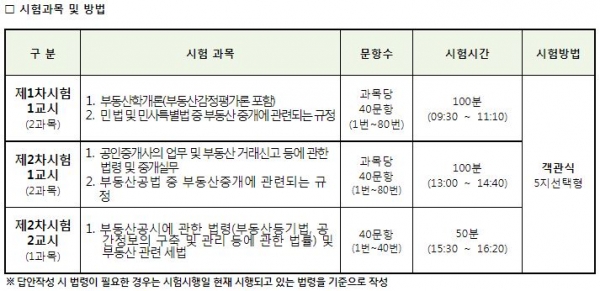
Since you must score 60 points or higher in all 6 subjects to pass the Licensed Real Estate Broker exam, you must strategically approach which subjects to prioritize and which to manage carefully. Today, the most effective use of the remaining time is to select high-frequency chapters from each subject and solve them in the form of mock exams. In particular, for subjects with complex terminology and concepts, such as Real Estate Law, you should dig into confusing words in advance while solving problems. When solving past exam questions, it is important to develop the habit of checking why the incorrect options are wrong, rather than simply matching the correct answer.
For instance, if you were confused about the relationship between specific performance rights and subrogation rights, practice recalling actual contract cases and writing out the application process step by step. This will allow you to approach similar questions logically without panic in the exam hall. To manage time allocation, it is also a good method to set a timer for a slightly shorter duration than your usual practice. In the final week, you should spend your energy training ‘how not to make mistakes’ rather than just trying to increase your correct answer rate.
To achieve 60 points in all subjects, repeatedly reinforce only the confusing core concepts and focus on mistake-prevention training through analysis of incorrect answers from past exams.
4. Key Points Reflecting Legal Amendments and Latest Exam Trends
Every year, legal amendments are frequently included in the exam right before the test date, so it is essential to verify them. It is advantageous to briefly review recent real estate-related legal amendments applicable to the 2026 exam. Major education providers like Eduwill reportedly operate free special lectures on the 24th and 25th, one week before the exam. Through these short-term intensive courses, you can quickly grasp how these changes are reflected in this year’s exam. If it is difficult to attend external lectures, creating your own notes summarizing major legal amendments is an excellent alternative. Since legal terminology changes rapidly, always keep in mind that content in existing textbooks may differ this year.
In particular, life-related legal changes such as the apartment transaction reporting system or adjustments to the number of houses owned are frequently tested types. Although these parts can be boring, they are the most commonly used items in actual broker work, making them a favorite for the exam committee. Identifying your own keywords and memorizing them as mnemonics helps them stay in your memory longer. While it is not the case that new concepts suddenly increase right before the exam, the task of marking ‘this part was revised this year’ is important. This way, when the exam asks for specific figures, you can retrieve accurate knowledge without guessing blindly.
Organize recent legal amendments in a separate note and refer to D-7 special lecture videos from major education companies to quickly grasp the latest changes reflected in the 2026 exam.
5. Strategy for Filling Fine Gaps by Re-examining Incorrect Answer Notes
After months of studying, incorrect answer notes can swell to hundreds of pages. However, since you cannot review everything in the final week, you must select only those questions you have repeatedly gotten wrong in the last month. For example, if you have made mistakes more than twice regarding the order of provisional registration security and jeonse rights in Property Law, create a routine of recalling this problem once every morning until the exam day. This prompts the brain to prioritize that part and facilitates the transition from short-term to long-term memory. Another method is to honestly review time allocation issues from mock exam days. Record how much time you spent on each subject and which subjects lacked time.
Using the remaining time to solidify the basic concepts of weak subjects maximizes efficiency. This is a time when precise strikes are needed rather than a total attack. Additionally, self-studying candidates can gauge the exam atmosphere in advance by networking with veteran brokers or seniors/juniors. Hearing practical tips like “Should I fill the answer sheet completely, or solve it selectively?” provides mental reassurance. Anxiety comes from the unknown, and maintaining a state of knowing what you know is the essence of the D-7 technique.
Select only repeatedly incorrect answers to memorize as a morning routine, and review mock exam time management records to concentrate remaining time on weak subjects.
6. Management on Exam Day (October 31) and Preparation After Passing
On the morning of the exam, it is better to have a light meal rather than a heavy dinner the night before. Be careful with excessive caffeine intake, as it can interfere with relaxation or cause digestive issues. Arrive at the exam hall at least 40 minutes early and check essential items such as your ID, admission ticket, and calculator. In the trend toward digitalization, securing your equipment properly is a basic necessity. Also, since you must take both the 1st and 2nd stage exams, you should plan the travel time and meal time between the two exams in advance to avoid any embarrassment.
Assuming you are aiming for a pass, do not be greedy in the exam hall; it is also a strategy to lightly skip confusing questions. You need the composure to not spend energy on questions that do not help secure the overall passing line. After the exam ends, rather than just resting, you can start preparing documents for qualification registration and planning career development. The Licensed Real Estate Broker qualification does not end with just obtaining the certificate; it becomes a key to opening doors to new jobs. Please do not forget that all preparations from today are part of the process to make that key stronger.
Managing your condition on exam day and checking essential documents are essential, and starting qualification registration and career planning immediately after the exam is necessary to build a sustainable career.
Frequently Asked Questions
=