Many employees suffer from unexpected tax burdens or unnecessary financial losses because they do not fully understand the methods for receiving their retirement pensions. To put it simply, it is far more tax-efficient to receive your retirement pension in installments through a pension account after turning 55 than to take it all at once as a lump sum. For instance, Mr. Kim, a 53-year-old manager who received an honorable discharge from a major corporation in the first half of 2026, ended up paying a high retirement income tax of approximately 15% because he received his severance pay in a regular checking account instead of transferring it directly to an Individual Retirement Pension (IRP) account. In contrast, his colleague, Manager Lee, was able to steadily grow his retirement funds while enjoying tax deferral benefits by immediately transferring the funds to an IRP account. It is crucial to understand that to fully enjoy tax benefits, your retirement benefits must be transferred to your personal IRP account, rather than being deposited directly into your regular bank account by the company. In this article, based on the latest regulations as of 2026, we will carefully examine the most sensible procedures and precautions for receiving your retirement pension.
=
How to Receive Your Retirement Pension: Comparing Lump Sum vs. Annuity for Those Retiring at Age 55
1. Eligibility and Basic Conditions for Receiving Retirement Pensions at Age 55
Upon reaching the age of 55, you legally become eligible to receive your retirement pension. However, it is essential to carefully consider not only your age but also your enrollment period. The valuable assets accumulated through your company’s Defined Benefit (DB) or Defined Contribution (DC) plans cannot simply be converted into cash just because you have reached the required age. Even if you retire before the mandatory retirement age, you cannot receive the funds as a pension or lump sum before turning 55; they must be held in an Individual Retirement Pension (IRP) account. If you have received an intermediate settlement in the past or have changed jobs multiple times, it is advisable to check your enrollment period in advance through the Integrated Pension Portal or the websites of various banks. For example, Mr. Park, who changed jobs twice in his 40s, was pleasantly surprised to discover that his total enrollment period exceeded 10 years while consolidating his scattered pension assets from multiple financial institutions into one. As retirement approaches, it is essential to accurately grasp the size of your assets and the timing when you can receive them. If you hastily terminate your pension or withdraw funds incorrectly due to a lack of knowledge about the system, you may face unexpected disadvantages. The longer your enrollment period, the greater the tax deduction benefits for pension income, so you must review and adjust your asset portfolio starting a few years before retirement.
You become eligible to receive your retirement pension at age 55, and it is essential to consolidate scattered assets into an Individual Retirement Pension (IRP) account.
2. Comparing Tax Differences Between Lump Sum and Annuity Receipt
There is a significant difference in the type of tax and tax rate applied when receiving a retirement pension as a lump sum versus receiving it as an annuity. If you receive it as a lump sum, retirement income tax is imposed. However, if you receive it as an annuity over a period of 10 years or more after turning 55, pension income tax applies, allowing for a tax reduction of up to 30% to 40%. For example, an employee with a total severance pay of 200 million KRW would have to pay tens of millions of KRW in taxes at once if they choose the lump sum option. In contrast, if they receive it in installments through a pension account, a lower tax rate is applied as long as the annual receipt amount does not exceed a certain limit. According to the National Tax Service’s guidelines on pension account taxation as of 2026, if private pension income does not exceed a certain annual amount, you can opt for separate taxation, which significantly reduces the burden of comprehensive income tax. It is not uncommon to find acquaintances who regret choosing the lump sum option simply because they needed a large sum of money after retirement, only to receive a high tax bill. Therefore, if you do not have any immediate large expenses, it is wise to receive part or all of your retirement pension as an annuity to build a stable monthly cash flow. To maximize tax benefits, you need to consult with financial experts to design the most advantageous receipt period and amount for your situation.
Receiving your pension in installments allows you to enjoy significant tax reduction benefits for retirement income and pension income compared to a lump sum.
3. Procedures for Transferring and Applying for an Individual Retirement Pension Account

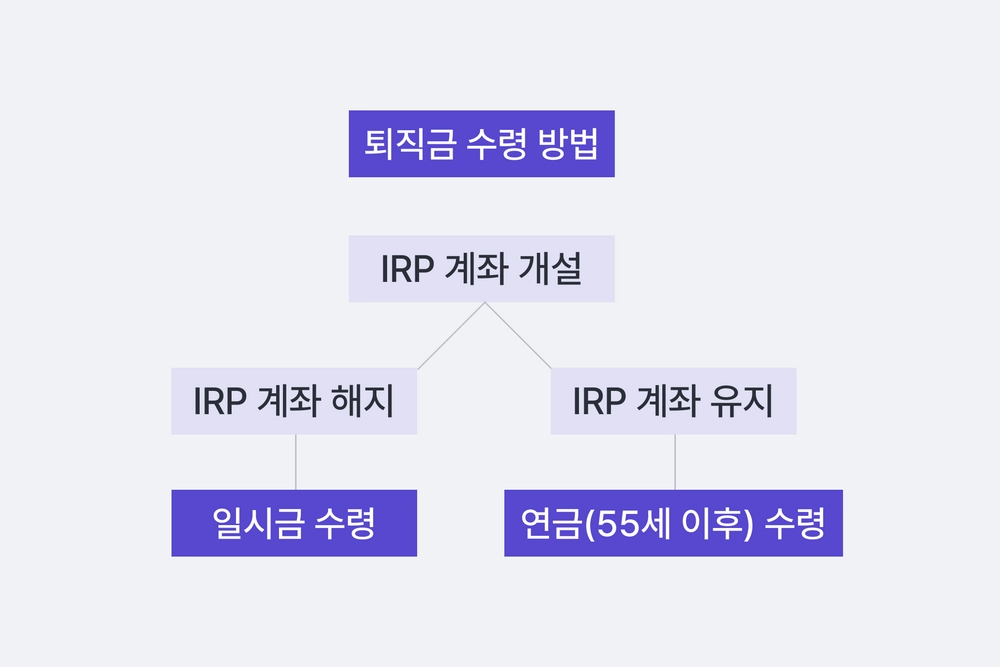
When retirement benefits are generated at your company, the funds must be transferred to an Individual Retirement Pension (IRP) account in the employee’s name for the proper receipt procedure to begin. You should open an account in advance with the pension provider designated by your company or a bank/securities firm you usually deal with, and then provide the account information to the relevant department at your company to ensure the deposit is made without delay. Some employees often want to receive their severance pay directly into a regular checking account, but legally, retirement benefits are required to be transferred to a pension account; otherwise, the tax deferral benefit is lost. In practice, using the apps of major financial institutions such as KB Kookmin Bank or Hana Bank allows you to easily open an account and complete the transfer application via smartphone without visiting a branch. After the retirement benefits are deposited into the account, you can continue to grow your assets by selecting investment products that match your investment style, such as principal-and-interest guaranteed products or performance-linked funds. During periods of high financial transaction volume, such as the Chuseok holiday or year-end, there may be slight delays in pension payment schedules, so it is safe to confirm the schedule with the financial institution in advance. When filling out the receipt application form, you must carefully check whether you will receive payments monthly or quarterly, and determine the duration of the receipt period.
Retirement benefits must be transferred to an Individual Retirement Pension (IRP) account to maintain tax deferral benefits, and the application can be easily made via mobile apps.
4. Payment Schedules and Precautions by Type of Investment Product
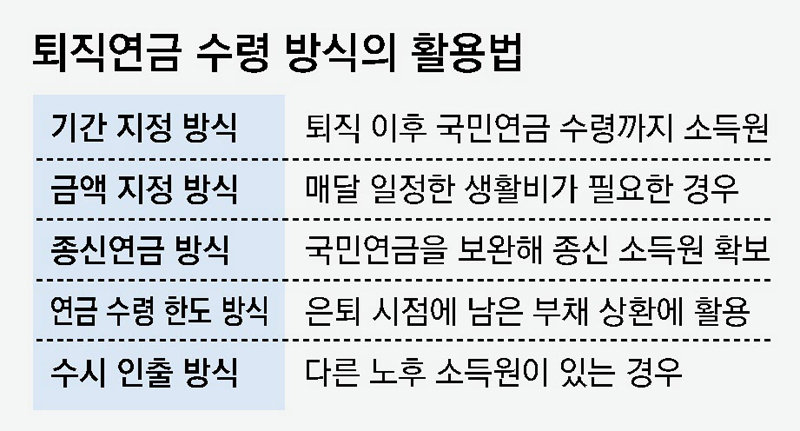
The type of investment product included in your retirement pension can significantly affect the actual payment schedule when the money is deposited into your account. Principal-and-interest guaranteed products, such as deposits and fixed-term deposits, have fixed maturity dates or require early termination procedures, so it may take several days from application to actual receipt. On the other hand, performance-linked products, such as equity funds and Exchange-Traded Funds (ETFs), typically take from 3 business days to nearly a week to be cashed out after a sell order is executed. According to financial industry guidelines as of 2026, if a retirement pension payment is scheduled during a holiday period, the date of receiving the funds may be delayed until after the holiday depending on the timing of the product sale. Therefore, it is advisable to apply for pension receipt and product sales with at least two weeks to a month of buffer time before you urgently need the funds. Many employees encounter errors when trying to apply for pension receipt without selling their products first; therefore, you must follow the order of cashing out your investment products before applying to start the pension. Utilizing premium personal vault services from securities firms or retirement asset management programs can help you easily manage this complex asset allocation and selling timing with expert assistance.
Cash-out and payment schedules vary by product type, so you should apply with a buffer before you need the funds.
5. Combination Strategies with the National Pension and Personal Pensions
For a successful retirement life, a multi-layered pension pipeline strategy that combines the National Pension and personal pensions is essential, in addition to understanding how to receive your retirement pension. It is advantageous to maximize your enrollment period in the National Pension, a public pension paid by the state, to increase the benefit amount, as this supports your minimum living expenses after retirement. By harmoniously arranging the National Pension, retirement pension, and personal pension savings (which offer tax deduction benefits), you can create a stable monthly cash flow similar to rent. Mr. Jeong, a worker in his 50s, set his expected monthly living expenses after retirement at 3 million KRW and developed a strategy to fill the gap by carefully comparing his expected National Pension receipt, retirement pension installments, and personal pension receipts in an Excel file. Even for the same financial products, there are significant differences in taxes and returns depending on whether they are managed directly by the individual or through a pension system, requiring meticulous prior calculation. Retirement planning experts strongly recommend a diversified receipt strategy that sets the start dates for each pension slightly differently to prepare for the period when income stops. For example, a representative method is to start receiving the retirement pension at age 55 and wisely bridge the income gap until the National Pension receipt period begins.
You must organically combine the National Pension, retirement pension, and personal pension to build a multi-layered pension pipeline to prevent financial ruin in old age.
6. Prospects for Retirement Pension Management and Wise Practices
As the aging society deepens, public interest in how to receive retirement pensions and the level of financial knowledge among consumers are expected to increase further. The era of simply receiving money as given by the company or recklessly spending a lump sum after retirement is over; the ability to save on taxes and manage returns determines the quality of life after retirement. Even now, numerous financial institutions are enhancing their mobile platforms and providing customized pension design services to create a better environment. If you are approaching age 55 or have already retired, please check your pension account balance, enrollment period, and expected taxes today. Small attentions and careful choices will become the most powerful weapons to complete a secure and comfortable retirement life. You will realize that the complex and difficult pension receipt procedures can be perfectly controlled by your own efforts if you check them step by step. Open your main bank’s app or access the Integrated Pension Portal right now to check your valuable pension assets and take a wise first step toward your future.
Systematic management of pension assets determines the quality of life after retirement, so you should check your account and make a plan immediately.
Frequently Asked Questions
=