Personal pension savings are the most reliable financial product for preparing for life after retirement while also securing tax refund benefits during the annual year-end tax settlement. Many office workers rush to start preparing for their year-end tax settlement around October each year, checking their pension account contributions. If it is difficult to reduce fixed expenses deducted from your salary, the wise secret to smart wealth management is to actively utilize products with significant tax benefits. If you listen to the stories of people in their 40s who have already built solid assets, you will notice that they all effectively used pension accounts as the core vessel for their assets. In this article, we will carefully examine the structure of personal pension savings, effective contribution strategies, and how to check your assets at a glance.
=
A Complete Guide to Personal Pension Tax Deduction Limits and Secure Retirement Planning
1. What is Personal Pension Savings?
Personal pension savings is a representative tax-benefited financial product created by the government to help secure retirement. It involves contributing a fixed amount monthly to receive it as a pension after retirement. You can join through various financial institutions such as banks, securities firms, and insurance companies, and depending on the nature of the product, you can either pursue stable interest or invest directly in stocks and bonds. For example, office worker So-yeon consistently saves from her monthly salary but feels the need to adjust her savings ratio more precisely. Unlike simply piling up money in a regular account, utilizing pension products allows you to enjoy tax-saving effects while growing a large sum of money over the long term. In particular, for those in the early stages of asset accumulation, such as single-person households or childless households, it serves as a sturdy pillar for preparing for the future while managing living expenses. This account, considered the first step in retirement preparation, typically requires a holding period of at least 5 years and must be maintained until the pension receipt age to fully enjoy the tax benefits. If you do not prepare consistently from a young age, it will be difficult to fill the sudden economic gap at retirement, so it is advantageous to start now.
Personal pension savings is an essential financial product that secures both retirement security and tax benefits.
2. Understanding Tax Deduction Benefits and Limits

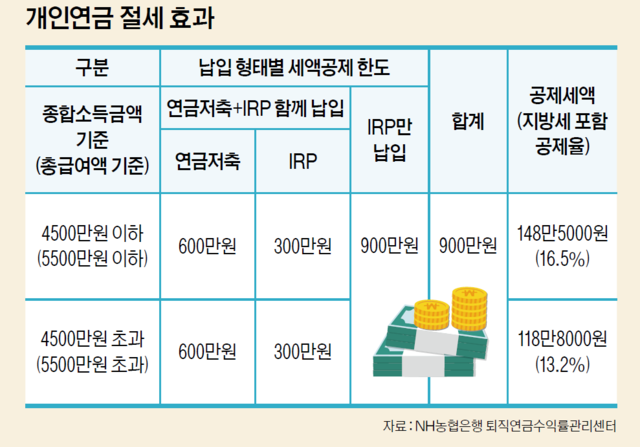
The first thing to pay attention to when joining a personal pension savings plan is the tax deduction benefit you can receive during the annual year-end tax settlement. Contributions to pension savings accounts are eligible for tax deductions within an annual limit, and the deduction rate varies depending on total income. For example, if you contribute up to the annual limit, you can enjoy the joy of receiving a refund of several hundred thousand to over one million won each year. For middle-aged and senior citizens or employed individuals with income, missing out on this benefit is a significant loss, so you should check your contribution amount in advance starting from autumn each year. If you feel that the standalone limit for pension savings is insufficient, there is also a method to utilize an Individual Retirement Pension (IRP) account together to increase the deduction limit. However, if you rashly close the account because you urgently need money, you may have to return the tax benefits received so far, so you should approach this cautiously. From a long-term perspective, the wise tip for wealth management is to consistently contribute only the amount that will absolutely not be touched.
Pension savings increases the real income of office workers through year-end tax settlement tax deduction benefits.
3. Checking Your Assets via the Integrated Pension Portal
It is not easy to grasp at a glance how much of your National Pension, Retirement Pension, and Personal Pension Savings are held where. In such cases, visiting the Integrated Pension Portal website operated by the Financial Supervisory Service allows you to check all your pension assets for free at a glance. First-time users need to complete identity verification and a simple consent procedure, and accurate data is typically linked and displayed on the screen after about 3 business days. People often panic when they cannot remember the insurance or securities products they have joined, but this inquiry service makes it easy to find hidden assets. Since you can estimate how much pension you will receive monthly at retirement, it serves as a compass for retirement planning. It is recommended to regularly access this portal to check your asset status and plan additional contributions if you find a shortfall in your retirement funds.
Using the Integrated Pension Portal allows you to check all pension assets nationwide at a glance without any fees.
4. Linkage Strategy with Individual Savings Accounts (ISA)
The Individual Savings Account (ISA) is an all-purpose account that allows you to invest in various financial products, from deposits to savings, while enjoying tax-exempt benefits. When this account reaches maturity, if you have a large sum of money that you do not need immediately, transferring that amount directly to a pension savings or Individual Retirement Pension (IRP) account is an excellent strategy. Moving assets this way not only allows you to receive additional tax deduction limits but also significantly reduces the tax burden on long-term investment returns. Among investors in their 40s, the trend of routing funds through this account before converting them to pensions, rather than investing in a regular account and paying full taxes, has become the mainstream. Both young and middle-aged/senior individuals should organically combine these two types of accounts according to their income base and stage of asset accumulation. Experts also actively recommend utilizing the linkage between these two accounts as the most efficient way to reduce tax burdens and grow assets.
Transferring matured account funds to pension savings secures additional tax benefits and retirement funds simultaneously.
5. Safe Asset Management and Legal Protection
It is necessary to know in advance how your precious pension savings assets, contributed for retirement, are protected in the event of unexpected economic crises or legal disputes. Products with a social insurance nature, such as the National Pension or Retirement Pension, which are solely responsible for securing retirement, tend to be strongly protected by law. Therefore, even if you face difficult situations such as personal rehabilitation or bankruptcy, it is difficult to definitively state that assets like personal pension savings will be entirely used to pay off debts. Since the scope of protection can vary depending on each legal procedure and situation, it is wise to seek expert advice especially during times of crisis. Even for those who have diligently accumulated assets without debt, knowing about asset protection mechanisms is a great strength in the twists and turns of life. You should carefully examine the joining conditions and maintain your assets safely to ensure that your pension assets, the last bastion of your retirement, remain stable.
Pension savings is a sturdy shield that firmly protects the foundation of your retirement within a legal safety framework.
6. Practical Measures for a Successful Retirement
Life after retirement is much longer than expected and requires a substantial amount of money, so you must start preparing as soon as possible to become a winner. Carefully check your monthly expenses, reduce unnecessary consumption, and steadily accumulate the surplus funds in your pension savings account. Rather than being fixated on small, immediate returns, you should treat pension accounts as a vessel for core assets that remain stable from a long-term perspective. Considering the current inflation rate and economic situation in 2026, if you do not prepare for your own retirement, you may face significant economic difficulties later. Please connect to the Integrated Pension Portal right now to check your pension status and have the courage to gradually increase your monthly contributions.
Thorough prior preparation and consistent contributions are the only guarantees for a prosperous and stable life after retirement.
Frequently Asked Questions
=