If you max out the annual contribution limit of 9 million won in your personal pension savings account, you can receive a tax refund of up to 1.48 million won during your year-end tax settlement. If you are an office worker who has always felt disappointed looking at your final tax amount during the year-end settlement season, you should check your pension account immediately. This is the most reliable wealth management tool that helps you prepare for life after retirement while drastically reducing your immediate tax burden. If you have felt left behind while your colleagues were receiving generous refunds thanks to various income and tax deductions, it is a good idea to learn the definitive method this time. In this article, we will explain the structure of pension savings, specific refund amounts, and investment strategies to boost returns in an easy-to-understand manner.
=
How to Max Out the 9 Million Won Tax Deduction Limit for Personal Pension Savings and Get a Year-End Tax Refund
1. The Secret to Tax Deduction Limits for Pension Savings and IRP
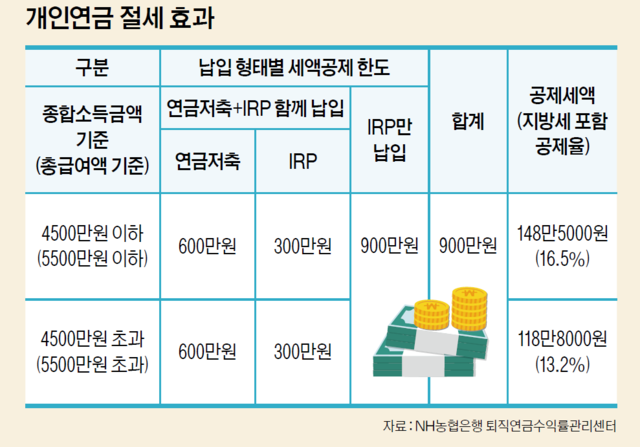
A pension savings account alone offers a tax-deductible contribution limit of up to 6 million won, but this limit increases to a total of 9 million won when combined with an Individual Retirement Pension (IRP). Many people are confused about the differences between the two accounts, but utilizing both simultaneously to leverage their respective strengths is the key to tax savings. For example, if you contribute 6 million won to a pension savings account and an additional 3 million won to an IRP, you can exactly fill the 9 million won deduction limit. Employees with a total salary of 55 million won or less are subject to a 16.5% deduction rate, resulting in a massive refund of 1.48 million won. Self-employed individuals and freelancers who meet the comprehensive income amount criteria can also fully enjoy this deduction benefit, making it a top choice for reducing annual income tax. It is wise not just to save, but to accurately understand the deduction rates for each income bracket and set the optimal contribution amount based on your salary. Trying to dump a large sum into the account just before the year-end settlement because monthly living expenses are tight can place a heavy burden on your household finances. Therefore, you should develop the habit of setting up automatic monthly transfers from the beginning of the year to minimize the impact on your household income. For instance, Mr. Kim, a colleague, consistently contributed 750,000 won to his pension account every month, which allowed him to receive a refund equivalent to one month’s salary during last year’s settlement, which he used to cover his vacation expenses. Since tax deduction benefits are like earning money while sitting still, all economically active individuals with income should prioritize this above all else.
By combining pension savings and IRP to meet the annual contribution limit of 9 million won, you can enjoy a tax deduction benefit of up to 1.48 million won.
2. Differences in Deduction Rates Based on Total Salary and Comprehensive Income
The tax deduction benefit for pension savings is not applied uniformly to everyone; it varies based on an individual’s total salary or comprehensive income amount. For employees, the threshold is a total salary of 55 million won. Those earning below this amount are subject to a high deduction rate of 16.5%. On the other hand, high-income employees with a total salary exceeding 55 million won are subject to a 13.2% deduction rate, resulting in a slight difference in the refund amount. For freelancers and self-employed individuals, the deduction rate changes based on a comprehensive income amount threshold of 45 million won, so it is essential to identify your exact income bracket. It is important to check your previous year’s income in advance through the year-end settlement simplification service or comprehensive income tax filing notices to plan your contribution strategy. Just because the deduction rate differs by income bracket does not mean that high-income earners have little to gain from tax savings, so there is no need to be disappointed. Even with a 13.2% deduction rate, the return is overwhelmingly superior to ordinary bank deposits or savings products. For example, if you max out the 9 million won contribution, you are guaranteed a tax refund of over 1.18 million won, even at the 13.2% rate. This constitutes a certain and powerful guaranteed return that cannot be obtained by joining any high-interest savings product available in the market. Therefore, smart investors who want to maximize their after-tax returns should prioritize pension account contributions regardless of their income bracket.
A tax deduction rate of 16.5% applies to those with a total salary of 55 million won or less, while 13.2% applies to those exceeding it, providing a definite tax-saving effect.
3. The Cheat Code: Converting ISA Maturity Funds to Pensions
As you grow your assets through investment activities, you will eventually reach the maturity date of your brokered asset management account (ISA). This is the golden time for tax savings. If you simply withdraw the matured funds into a regular checking account, you will miss out on valuable tax-exempt benefits and waste a precious opportunity for tax savings. Instead, if you transfer the matured funds directly to a pension savings or IRP account, you can receive a significant additional tax deduction benefit as a bonus. An additional deduction is granted for 10% of the transferred amount, and the limit increases by up to 3 million won. This means the existing 9 million won limit can be expanded to a maximum of 12 million won for tax-deductible contributions. Wealthy individuals who utilize this system well actively employ a strategy of moving funds from their asset management accounts to pension accounts whenever they have a lump sum. If you lock in the seed money you have steadily accumulated since your early career into a pension at maturity, you can achieve both retirement fund preparation and tax savings simultaneously. In reality, it is easy to see cases where people transferred their ISA maturity funds to a pension after five years of working and received a tax refund of several million won at once. Even if you do not know all the complex tax laws, remembering and practicing this one core rule will put you in a much more advantageous position than others. The value of this pension conversion system shines brighter as retirement approaches, so you must not miss it and should definitely utilize it.
Transferring ISA maturity funds to a pension account provides an additional contribution limit of up to 3 million won, yielding substantial tax-saving effects.
4. Comparing Investment Autonomy: Pension Savings Funds vs. IRP
Among pension savings accounts, pension savings funds opened through securities firms are popular because they allow investment in various equity index-tracking products and bonds. On the other hand, IRP accounts face certain restrictions on including derivatives or specific futures-type products due to legal regulations. Therefore, investors who want to aggressively grow their assets are better off using pension savings funds, which offer higher operational autonomy, as their main account. The younger the generation and the further away retirement is, the more they should increase the proportion of equity assets to maximize the effect of compound interest, leading to significant asset growth over the long term. You will be able to see with your own eyes how your assets snowball as investment returns are added to the principal you contribute monthly. Even investors who prioritize safety can flexibly construct their portfolio by combining deposits and safe bond-type assets within their pension account. There is no better environment for practicing diversification than moving away from the approach of putting all your assets into a single product. Mr. Park, an office worker, consistently invested in global indices through his pension savings fund account and achieved enormous unrealized gains compared to his principal within a few years. This is the most ideal wealth management method that captures both the immediate benefit of tax deductions and long-term investment returns. Adjusting the proportions within your account according to your investment style and periodically reviewing your portfolio will yield good results.
Pension savings funds offer high investment autonomy, allowing free inclusion of equity products, whereas IRPs have certain investment restrictions.
5. Pension Income Tax and Tax Deferral to Watch Out For When Receiving Pensions
When you finally start receiving and using your pension after retirement, it is common to feel happy while simultaneously worrying about taxes. Fortunately, pension savings benefit from tax deferral, which postpones taxation until the funds are withdrawn, giving your money time to grow on its own. Even when you receive the pension later, a very low pension income tax rate of 3.3% to 5.5% is applied depending on your age, reducing the burden. A tax rate of 5.5% applies to those under 70, 4.4% to those under 80, and 3.3% to those 80 and older, so the tax burden decreases as you age. While ordinary financial income is subject to a 15.4% tax on each interest or dividend payment, pensions have a structure that favors retirees. However, if the annual pension receipt exceeds 12 million won after retirement, it may be taxed in combination with other comprehensive income, so managing the receipt amount is necessary. If the monthly pension amount is too large, you could face a tax bomb, so you must carefully design your post-retirement cash flow. Wisdom is required to manage the amount so that you do not exceed the annual limit by extending the receipt period or appropriately distributing the monthly amount. Retirement planning experts recommend the strategy of extending the receipt period to lower the tax bracket as the best method. Only those who prepare for retirement by understanding these detailed aspects in advance can enjoy a prosperous life in old age without tax worries.
When receiving a pension, a low pension income tax rate of 3.3% to 5.5% applies depending on age, and the tax deferral benefit makes asset growth advantageous.
6. Practical Strategies for a Successful Retirement with Pension Savings
As we have seen, personal pension savings is not just an option but an essential and superior tool for tax savings and investment for both office workers and business owners. Even those who have insisted on regular savings because they couldn’t spare 90,000 won a month will nod in agreement once they receive a tax deduction refund, realizing why everyone praises pension accounts. Starting this month, try setting up automatic transfers to split a certain amount from your salary between pension savings and IRP. Put aside the excuse that you don’t have a lump sum; if you consistently save even small amounts, you will soon find yourself facing a well-stocked pension account. We hope you become a wise economic actor who fully enjoys the definite tax-saving benefits supported by the state while also securing a solid retirement fund. While tax laws and the financial environment may change slightly in the future, financial knowledge that allows you to protect and grow your assets yourself will serve as a powerful weapon for life. Those who manage their assets based on accurate facts and statistics will ultimately win when others are floundering relying on hearsay. We strongly recommend that you use this article as an opportunity to open a pension account you have been putting off or to check your existing contribution amounts to max out the limit. This is not a story about a distant future called retirement, but a small action taken today that will completely change your life 10 or 20 years from now. Take the first step toward a prosperous and comfortable retirement today and enjoy the pleasure of a warm year-end tax refund every year.
By maintaining consistent annual contributions and thorough portfolio management to activate your pension account, you can achieve both a successful retirement and definite tax savings.
Frequently Asked Questions
=