When receiving your retirement pension, choosing between a lump sum and an annuity can mean facing a massive tax bill or saving millions of won. If you simply withdraw everything at once because you need a large amount of cash, a significant portion will be deducted as retirement income tax, so extreme caution is required. Since retirement pensions can be received from age 55 onwards, the net amount you receive varies greatly depending on how you choose to split the payments. For instance, Manager Kim, who had a long career, regretted receiving his severance pay as a lump sum after paying a hefty amount in taxes. On the other hand, Deputy Manager Park, who carefully planned to transfer the funds to an annuity account and receive them in installments, significantly reduced his tax burden and secured a stable monthly income. In this article, we will detail the most advantageous retirement pension payout methods and tips for saving on taxes.
=
Retirement Pension Payout Methods: Lump Sum vs. Annuity – Tax Comparison and Guide to the Best Choice
1. The Two Paths of Retirement Pension Payouts: Lump Sum vs. Annuity
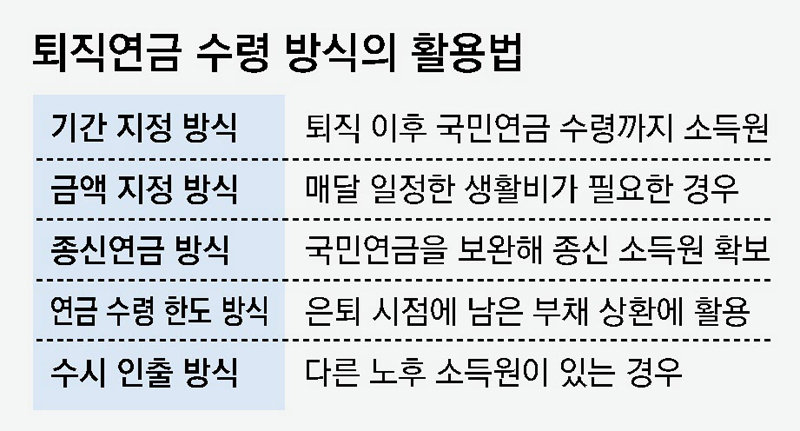
The first choice you face when receiving a retirement pension is whether to withdraw the entire amount as a lump sum or receive it in installments as an annuity. While a lump sum offers the advantage of immediate access to a large sum of cash, it is highly disadvantageous in terms of tax rates. If you receive your accumulated severance pay all at once after many years of service, a high taxable base applies, causing your tax burden to spike dramatically. Conversely, choosing the annuity payout method grants you a significant benefit: a reduction of 30% to a maximum of 40% on the retirement income tax. Therefore, unless you have a specific need such as buying a house or paying off a large debt, receiving the pension as an annuity is far more advantageous. It is common to see people who rejoice at receiving a lump sum, spend it all, and then struggle in their old age. Before receiving your severance pay, you must carefully and realistically assess your future financial plans and monthly expenses. Many employees regret signing the lump sum application form based solely on the advice of bank or financial company staff, only to receive a shocking tax notice later. The government offers exceptional tax incentives for receiving pensions in annuity form to encourage stable retirement living for citizens. Simply utilizing this system actively can extend the lifespan of your retirement assets by several years. Resisting the temptation of a lump sum and choosing the annuity path is the first step toward wise retirement preparation.
Receiving a retirement pension as an annuity rather than a lump sum significantly reduces taxes and protects your retirement funds.
2. The Key to Saving on Taxes: Differences Between Annuity Income Tax and Retirement Income Tax
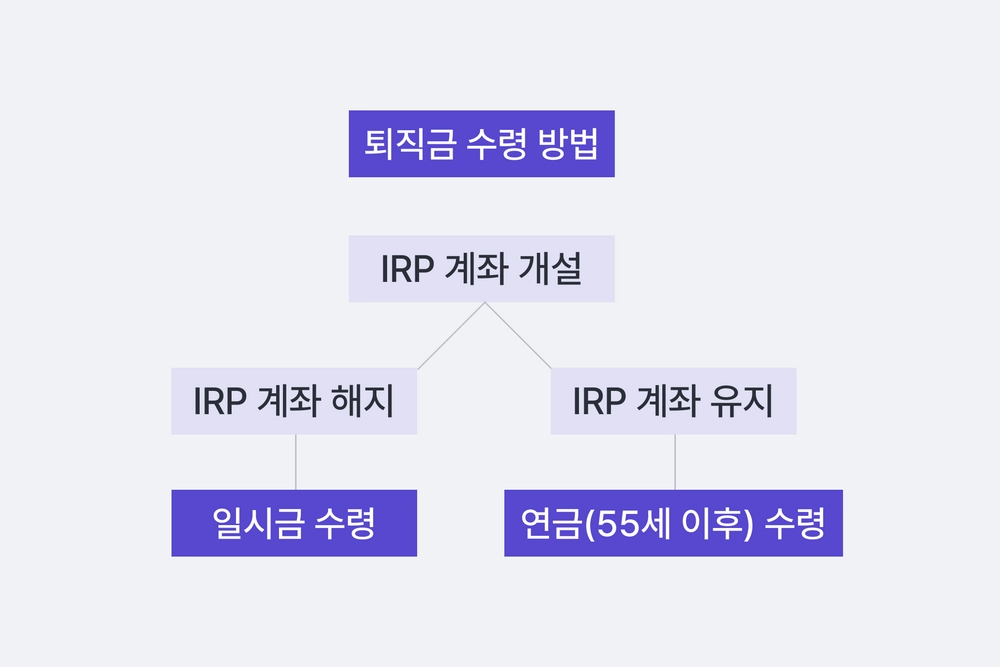
If you receive your retirement pension as a lump sum, retirement income tax is applied. However, if you keep the funds in an account and receive them as an annuity, a relatively lower annuity income tax rate applies. Under tax law, when receiving an annuity, you only pay 70% of the retirement income tax that would otherwise be due, and this rate drops further to 60% if the payout period exceeds 10 years. For example, if you receive 100 million won as a lump sum, a large amount of tax is deducted at once. However, if you spread the payments over 10 years, the tax is distributed. In addition to this distribution effect, the applicable tax rate itself is lower, resulting in a significant difference in the net amount received. To receive this benefit, you must open an Individual Retirement Pension (IRP) account, transfer your severance pay to it, and then proceed with the payout process. Many people make the mistake of just taking the lump sum as offered by their company or handling it carelessly because calculating taxes seems complex. However, by taking a little interest and examining the system, you will realize that you can save anywhere from a few million to tens of millions of won in taxes. It is also important to clearly state your intention to receive an annuity when consulting with financial company advisors or tax experts. Sometimes, even the company’s retirement pension department does not provide detailed tax-saving methods, so you must study the rules yourself. Tax knowledge is one of the most powerful tools in determining the size of your post-retirement assets.
By receiving payments in installments through an annuity account, you can apply the lower annuity income tax rate instead of retirement income tax, significantly saving on taxes.
3. Annuity Payout Requirements Retirees Over 55 Must Know

To receive your retirement pension as an annuity, you must meet several strict legal requirements. Basically, the subscriber must be at least 55 years old, and the retirement pension account must have been held for at least 5 years. If you try to withdraw funds without meeting these conditions, you may be subject to miscellaneous income tax or excessive taxes instead of annuity income tax. If you take early retirement or leave your company before age 55, you must deposit the funds into an Individual Retirement Pension (IRP) account and wait. You can formally apply for annuity payments starting from the year you turn 55, so you should carefully calculate the timing of your retirement relative to your age. As retirement ages are getting younger, more employees are leaving their companies in their early 50s, which often causes confusion. Since income stops until age 55, you may face a shortage of living expenses, but you must maintain your retirement pension account. If you rashly close the account or make an early withdrawal, you will lose all tax benefits, so you should prepare separate emergency funds. While financial companies may automatically guide subscribers on starting their annuities based on age, it is safer to manage the schedule yourself. How you bridge the gap between retirement and age 55 is a critical factor in determining the success of your overall retirement plan.
You can start receiving an annuity under the most favorable conditions once you are at least 55 years old and have held the account for at least 5 years.
4. The Magical Period: Further Tax Reductions for Payouts Exceeding 10 Years
Setting your retirement pension payout period to exceed 10 years, rather than keeping it short at 10 years or less, reduces your tax burden even further. According to tax law amendments, if the actual number of years you receive the annuity exceeds 10, you only need to pay 60% of the retirement income tax that would otherwise be due. Even if the monthly amount received is slightly lower, extending the payout period to 10 years or more is highly beneficial for tax savings. You need a strategy to set the period as long as possible, within the limit that your monthly living expenses are not severely strained. Life after retirement is longer than many expect, so it is good to practice spreading your funds out over a long period in advance. The 10-year benchmark is not just a duration; it is a crucial number that acts as a major turning point for tax savings. It is not uncommon to find acquaintances who wanted to use their money quickly and withdrew their entire annuity within 5 years. However, in such cases, they end up paying the National Tax Service significantly more in taxes than others, leading to a very regrettable outcome. Asset management experts strongly recommend long-term payout plans that spread retirement funds over 15 or 20 years. This allows you to enjoy the dual benefit of saving on taxes and preventing the risk of your assets running out.
Setting the annuity payout period to exceed 10 years results in further tax reductions, increasing your actual income.
5. Managing Your Own Retirement Pension: Utilizing Default Options and Risk Asset Limits
In Defined Contribution (DC) or Individual Retirement Pension (IRP) accounts where you manage the funds yourself, you can choose from a variety of investment products. There is a restriction that you can only invest up to 70% of your total accumulated funds in risky assets such as equity funds or Exchange-Traded Funds (ETFs). You need the wisdom to maximize returns by balancing this limit with stable deposit and savings products. Recently, pre-designated management systems, which automatically invest your money without separate instructions from the subscriber, are also widely used. If you manage the funds yourself and incur losses, your final retirement payout amount may decrease, so thorough market research is essential. Since stability is the lifeblood of retirement funds, you must absolutely avoid investing your entire fortune in high-yield, high-risk products. You are required to periodically check the monthly returns and adjust your portfolio according to market trends. Using financial company apps to monitor your asset status in real-time and referring to expert analysis reports can be helpful. As you approach retirement, the standard practice is to reduce the proportion of stocks and increase the ratio of safe cash assets. You must accurately understand your investment style, manage the risk of principal loss, and steadily grow your assets.
When managing your retirement pension yourself, you must adhere to risk asset limits and utilize pre-designated management systems to balance returns and stability.
6. Practical Strategies for a Successful Retirement: Choosing Your Payout Method
Based on the content reviewed so far, you should design the most suitable retirement pension payout method for yourself right now. As your retirement date approaches, visit a bank or securities firm for a consultation before submitting any documents. If you are under 55, you must safely transfer your valuable severance pay to an Individual Retirement Pension (IRP) account and patiently wait for time to pass. The key is to carefully calculate your post-retirement monthly expense budget and create a long-term installment payout plan of 10 years or more. Never forget that saving on taxes can make your life in old age more abundant. Since no one can predict future economic conditions, how you utilize the sturdy fence of an annuity will determine the quality of your retirement. Do not be swayed by hearsay; make wise judgments based on guidance from reputable financial institutions and tax law standards. Even at this very moment, valuable taxes that could have been saved with a little attention may be disappearing into thin air. Starting today, please check the status of your retirement pension account and create a concrete action plan for your future. I sincerely hope that the severance pay earned through a lifetime of hard work is used in the most valuable and beautiful way possible.
Through thorough preparation and a long-term installment payout plan, you can save on taxes and complete a stable retirement life.
Frequently Asked Questions
=