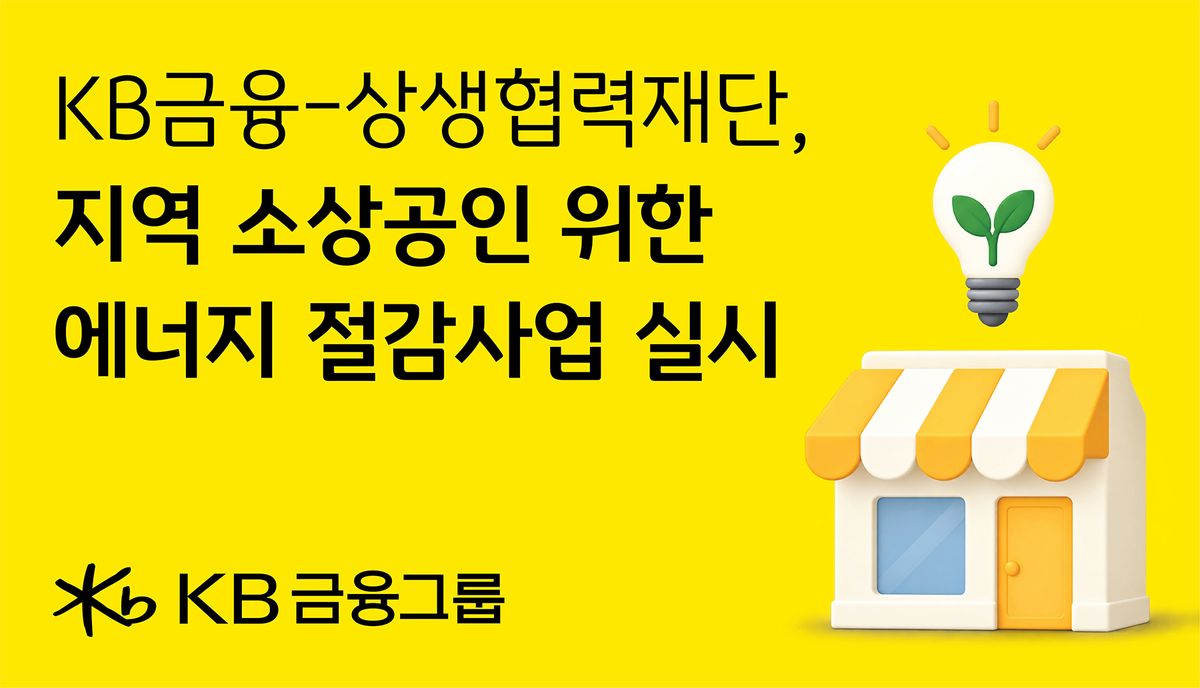
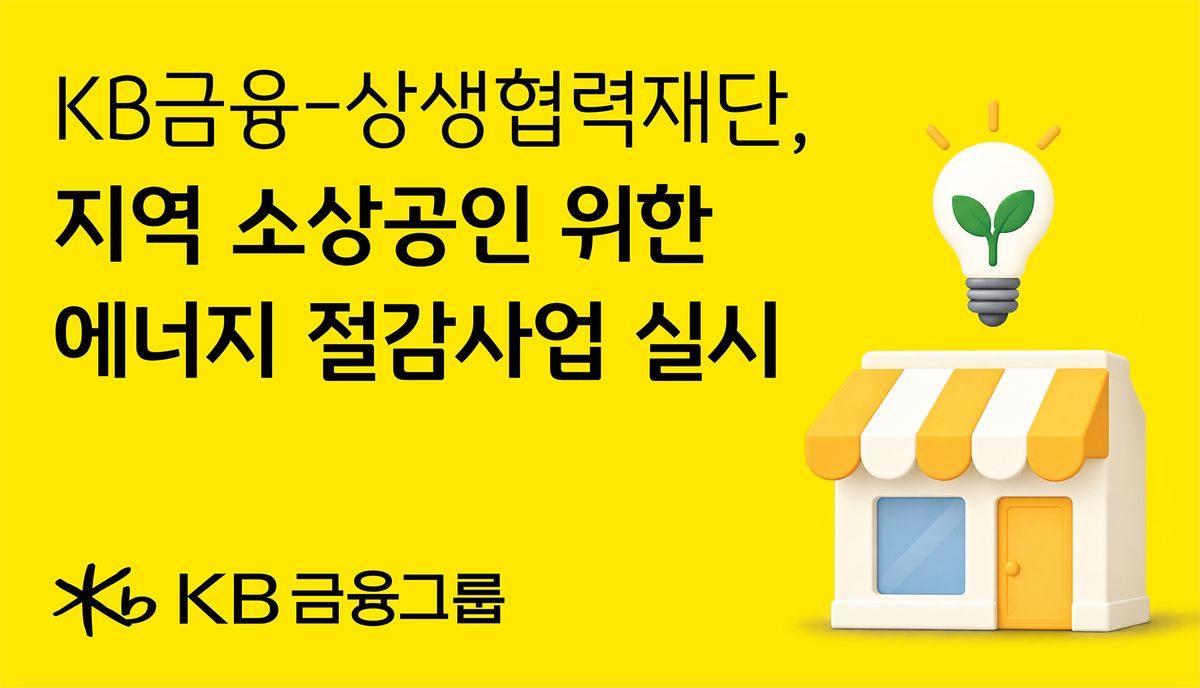
KB Financial Group is partnering with the Foundation for Cooperation between Large and SMEs and the Fisheries and Agriculture Sector to fully launch the “2026 KB Financial Energy-Saving Facility Support Program.” This initiative aims to support carbon neutrality and ESG (Environmental, Social, and Governance) practices among local small business owners in 2026. With a total investment of 600 million won, the program is designed to provide substantial improvements to business environments, offering relief to self-employed individuals in local commercial districts who have been struggling with high fixed costs such as electricity bills. For small business owners who have faced difficulties operating their stores due to soaring energy prices, this support is a welcome relief. Notably, the program goes beyond simple cash subsidies by assisting with the replacement of aging equipment and the introduction of eco-friendly devices, thereby facilitating fundamental structural improvements. In this article, we will examine in detail the specific support scale, eligibility criteria, and participation methods for this program, which is set to be implemented in 2026. If you know anyone who runs a small business, please share this information to help them take advantage of this beneficial opportunity.
=
KB Financial Group Launches 2026 Energy-Saving Facility Support Program for Small Business Owners, Investing 600 Million Won
1. Background of the Energy-Saving Program to Alleviate Burdens on Small Business Owners
The background behind KB Financial Group’s planning of this program lies in the realistic hardships faced by small business owners in local commercial districts who are reaching their limits due to soaring electricity and heating/cooling costs. Monthly fixed energy expenses are cited as one of the main factors eroding the net profits of self-employed individuals, making long-term solutions urgently needed. The Green Transition funds from the Large-SME Cooperation Fund, contributed by KB Financial to promote mutual growth between large corporations and SMEs, serve as a solid foundation for this program. By joining forces, the government and large corporations aim to strengthen the fundamental vitality of local commercial districts and lay the groundwork for small business owners to participate in the massive trend of carbon neutrality. This effectively lowers the barriers to entry, ensuring that ESG management is not the exclusive domain of large corporations but can be naturally practiced even in small neighborhood shops. In line with this spirit, many self-employed individuals across the country are showing great interest, anticipating long-term cost-saving benefits. This program, jointly planned by KB Financial and the Cooperation Foundation, was established to help small business owners—the capillaries of the regional economy—survive and to promote eco-friendly management. The ultimate goal is not just one-off support, but to fundamentally transform the nature of business operations to enable sustainable management.
KB Financial has planned a support program utilizing the Cooperation Fund to reduce energy cost burdens for small business owners and assist in practicing carbon neutrality.
2. Support Details and Target Local Governments for the 600 Million Won Program

The total scale of this support program reaches 600 million won, with up to four local governments nationwide selected to receive focused support based on their proposed outstanding projects. The review process is conducted based on energy-saving ideas autonomously planned by metropolitan and basic local governments to reflect the unique characteristics of their local commercial districts. Selected locations will receive project funds ranging from a minimum of 100 million won to a maximum of 300 million won. The supported funds will be entirely used for improving the store environments and reducing electricity bills for individual business owners, self-employed individuals, and small business owners in the region. For example, the program is meticulously designed so that stores in traditional markets in Seoul or restaurants in small provincial cities can feel the practical benefits. Since local governments best understand the characteristics of their local commercial districts, efficient fund execution through tailored approaches is expected. Local governments will take the lead in reflecting the voices of local merchants in their project plans and partner with specialized institutions to participate in the open competition. Through a transparent and fair review process, the regions deemed most urgent and likely to yield significant effects will be designated as the final beneficiaries.
With a total resource of 600 million won, up to four local governments will be selected to provide tailored project funds to local small business owners.
3. What Facilities Are Supported? A Look at Key Support Areas
Eligible business sites can choose the items most essential to their stores from three main areas to receive support. The first area is energy efficiency improvement, which involves completely replacing aging wiring or installing high-efficiency LED signs with low power consumption to dramatically boost power efficiency. The second area is eco-friendly equipment support, such as introducing eco-friendly heat pumps or installing reduction devices that significantly cut down cooking fumes, a common nuisance in restaurants. The third area is the establishment of smart energy management systems, which involves distributing smart meters and standby power cutoff outlets utilizing IoT technology to intelligently manage the store’s overall energy. These facility improvements not only noticeably reduce immediate electricity bills but also create a comfortable and safe store environment, thereby increasing customer satisfaction—a two-for-one benefit. In practice, neighborhood supermarkets exposed to fire risks due to old wiring, or small restaurants that had conflicts with neighbors over fumes, can find significant relief through this opportunity.
The program supports three key areas that enhance energy efficiency in small business stores: replacing aging wiring, eco-friendly equipment, and smart standby power cutoffs.
4. Bonus Point System and Application Methods to Encourage Local Government Participation
A special incentive, the bonus point system, has been established to encourage local governments to roll up their sleeves and participate more actively in this program. If a participating local government adds its own budget to the Cooperation Fund to join the project jointly, it can receive a solid 5-point bonus during the selection review process. This can be seen as a strong expression of the will for the central government, local governments, and private financial institutions to act as one to provide robust protection for small business owners. Local governments wishing to participate must submit their official application forms and required documents via email to the ESG Support Department of the Cooperation Foundation by October 11. It is advantageous to include a creative proposal that leverages the characteristics of the local commercial district, along with evidence of cooperation with a specialized implementing agency capable of faithfully executing the project. Once the document submission deadline passes, the projects will undergo in-person evaluation by a rigorous operating committee composed of top experts in the relevant fields, with the final results officially announced in the third week of October.
Local governments that contribute their own budget to participate will receive a 5-point bonus. Applications must be submitted via email by October 11.
5. A New Model of Cooperative Management and Its Impact on Local Commercial Districts
KB Financial’s move is evaluated as a exemplary case of cooperative management that goes beyond simple social contribution activities to help local commercial districts—the roots of the regional economy—develop self-sufficiency. This is because the capital of large corporations and the administrative power of local governments have come together to precisely target the most needed task on the ground: reducing energy costs. In the midst of the massive national task of carbon neutrality, it was a harsh reality that small self-employed individuals found it difficult even to dream of an eco-friendly transition due to cost burdens. However, through this support program, individual stores can save on heating and cooling costs and transform into eco-friendly shops, thereby securing long-term competitiveness. From the customer’s perspective, being able to use services in an eco-friendly and comfortable environment creates a virtuous cycle that revives the vitality of the entire local commercial district. This warm companionship from the financial sector will serve as a good example for other companies, becoming an opportunity for the culture of cooperation that grows together with the community to spread even wider.
This program is an excellent cooperative model where small business owners participate in carbon neutrality and reduce costs, leading to the sustainable growth of local commercial districts.
6. Expectations and Future Outlook for the Successful Implementation of the Program
Once the final selection results are announced in mid-October, each local government and implementing agency will begin full-scale on-site construction to complete the program without issues during the following year, 2026. The successful energy-saving achievements gained in the up to four selected regions will serve as a precious cornerstone for expanding the program to other local governments nationwide. We sincerely hope that this support program will be a ray of light for small business owners in South Korea, who are currently passing through the tunnel of high inflation and high interest rates, allowing them to smile again. We also ask our readers to actively share this useful policy information with anyone around them who runs a business, helping many people enjoy the benefits. We promise to deliver the latest and most accurate cooperative news and substantial information that warms every corner of our society. We look forward to a future where a robust safety net is built, allowing more self-employed individuals to reduce management burdens and focus solely on their core business.
We expect this program, which will be fully implemented in 2026, to serve as a sturdy support for small business owners and inject vitality into the regional economy as a whole.
Frequently Asked Questions
=