Individual pension savings are the most reliable financial tool for securing a robust retirement fund while enjoying substantial tax deduction benefits during your annual tax settlement. Seeing others get hundreds of thousands of won back every year from their pension savings can sometimes make you feel anxious, as if you are the only one losing out. Mr. Kim, an office worker, didn’t have the extra funds last year to give his parents pocket money, but this year he has decided to contribute 300,000 won monthly to his pension savings. While there are countless financial products on the market, few can simultaneously achieve tax savings and asset growth from a long-term perspective. In this article, we will carefully examine the basic concepts of individual pension savings, contribution limits, and tips for maximizing tax deduction benefits. If practiced consistently, you will be well on your way to achieving the goal of creating a stable monthly cash flow upon retirement.
=
Individual Pension Savings: Tax Deduction Limits and Strategies for Secure Retirement Asset Management
1. What is Individual Pension Savings?
Individual pension savings are a representative tax-advantaged financial product created by the government to encourage citizens to voluntarily prepare for their retirement. The structure involves subscribers saving or investing a fixed amount monthly to ensure stable income after retirement. In the past, this primarily took the form of simply depositing money in a bank, but nowadays, you can choose from a variety of products through securities firms. Mr. Park, an office worker, deposits money into his pension account with the same mindset as making regular savings deposits, believing that this account will become an unending spring for his retirement. To fully enjoy the tax benefits provided by the state, you must contribute for at least five years, and you can receive the funds in the form of a pension only after turning 55.
Many people understand the importance of retirement preparation intellectually but often postpone it due to the pressure of immediate living expenses. However, funds prepared gradually from a young age, when combined with the effects of compound interest and tax benefits, create a significant difference over time. By utilizing online inquiry portals like the Integrated Pension Portal, you can get a clear overview of your current National Pension, retirement pension, and individual pension. The habit of periodically checking the exact scale of your retirement assets is the first step in establishing a sound asset management strategy.
Individual pension savings are an essential retirement asset management tool that the government supports with tax benefits to ensure a stable life after retirement, intended for long-term operation.
2. Understanding Tax Deduction Benefits and Limits

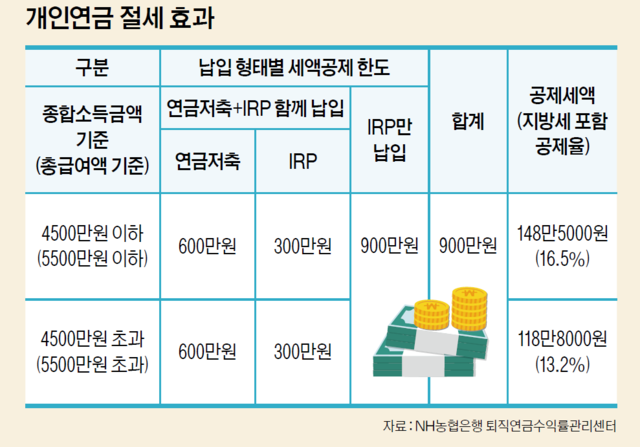
The biggest appeal of individual pension savings is undoubtedly the generous tax deduction benefit provided during the annual tax settlement. Since a certain percentage of the tax is refunded on the annual contribution amount, it is considered a mandatory enrollment item among office workers. Employees with a total annual income of 55 million won or less can receive a deduction of 16.5% of their contributions, while those earning more can receive a deduction of 13.2%. Ms. Lee, a freelancer, fully enjoys this tax-saving effect when filing her comprehensive income tax return and is hooked on the pleasure of receiving her annual refund.
Currently, for individual pension savings products alone, the annual contribution limit eligible for tax deduction is up to 6 million won. If you combine this with an Individual Retirement Pension (IRP), you can increase the deduction limit to a maximum of 9 million won, thereby maximizing the tax-saving effect. If you consistently contribute 500,000 won monthly to reach 6 million won annually, you can receive a tax refund of up to 990,000 won, depending on your income bracket. If you reinvest this refund or use it as an emergency fund, your assets will grow even faster.
You can receive a tax deduction of up to 16.5% on contributions of up to 6 million won annually, making it an essential tax-saving strategy for office workers.
3. Comparing Differences Between Banks and Securities Firms
Many people are unsure whether to choose a bank, insurance company, or securities firm when enrolling in individual pension savings. Bank pension savings trusts offer the stability of principal protection, but the drawback is that recent low interest rates make it difficult to defend against inflation. On the other hand, pension savings funds handled by securities firms allow direct investment in various equity products or Exchange-Traded Funds (ETFs), offering the potential for higher returns. Mr. Choi, an office worker, initially insisted on a bank because he was afraid of losing his principal, but after taking advice from a friend, he switched to a securities firm account and has since achieved considerable returns.
Using a securities firm account allows you to freely allocate funds to promising global indices or high-dividend stocks. While you may feel anxious whenever stock market volatility increases, from a long-term investment perspective, it is a much more favorable environment for growing assets. Additionally, you can enjoy the tax-deferral benefit, which allows you to postpone taxes on dividends until the time of pension receipt. It is wise to flexibly adjust your portfolio by gradually increasing the proportion of safe assets as your retirement date approaches.
If you prioritize stability, choose banks or insurance companies; if you seek aggressive returns, it is advantageous to invest in various products through a securities firm account.
4. Cautions Regarding Early Termination
Since individual pension savings are long-term products, terminating them prematurely just because you need money urgently can result in significant financial loss. If you terminate the account before completing the required period, you must return all the tax deduction benefits you have received. Furthermore, a high tax rate is applied to operating profits under the category of miscellaneous income, significantly reducing the amount of money you actually receive. Mr. Jung, an office worker who was considering termination to buy a house or secure a deposit for a rental, did the math and concluded that it would be better to look into a collateral loan instead.
If you are in a situation where you urgently need money, it is much wiser to utilize the pension account collateral loan system offered by financial institutions rather than terminating the account. This system allows you to borrow the necessary cash at a low interest rate while maintaining the assets in your account, thereby preserving the tax benefits. Additionally, you can transfer your account to another financial institution in its entirety through the transfer system without any tax disadvantages. Considering the unique nature of retirement assets, you need to maintain a posture of managing only with surplus funds that you do not need to use immediately.
Early termination may result in the return of tax deductions and a heavy miscellaneous income tax burden, so it is safer to utilize loan or contract transfer systems.
5. Utilizing ISA Maturity Funds for Pension Conversion
As the maturity date of your Individual Savings Account (ISA) approaches, you can immediately convert those funds into individual pension savings to enjoy additional benefits. To help citizens build robust retirement assets, the government provides additional tax deduction benefits when maturity funds are transferred to a pension account. Since an additional deduction is granted on 10% of the transferred amount, this is a prime opportunity to elevate your tax-saving effect to the next level. Mr. Kim, active in a financial community, transferred the lump sum from his matured ISA account to his pension savings, saving on taxes and solving his retirement preparation all at once.
To utilize this method, you must complete the deposit procedure into a pension account through a financial institution within 60 days of the maturity date to fully receive the benefits. Since an additional deduction limit is provided separately from the general annual contribution limit, it is perfect for efficiently managing large assets. These transferred funds will be subject to a lower tax rate when received as a pension later, significantly reducing the tax burden. As this is a powerful weapon that can change the landscape of long-term asset management, you should mark the maturity schedule on your calendar in advance.
Transferring funds from a matured ISA to a pension account allows you to secure both additional tax deductions and tax-saving benefits.
6. Practical Strategies for a Successful Retirement
Individual pension savings are more than just a means to save on taxes; they are the most reliable pillar determining the quality of life after retirement. Setting up automatic transfers for a fixed monthly amount ensures that you continue saving without forgetting, even amidst a busy daily life. You need a strategy to gradually increase your contribution limit as your income grows, maximizing the magic of compound interest. You should also cultivate the flexibility to restructure your assets into stable, dividend-centric products by closely monitoring market conditions as your retirement date approaches. Although it may seem like a small amount right now, it will return as a massive asset in ten or twenty years, warmly embracing our retirement. Do not hesitate; please review a pension product that fits your financial situation today and take the first step.
You must grow your pension assets long-term through automatic transfers and consistent portfolio management to achieve a stable retirement.
Frequently Asked Questions
=