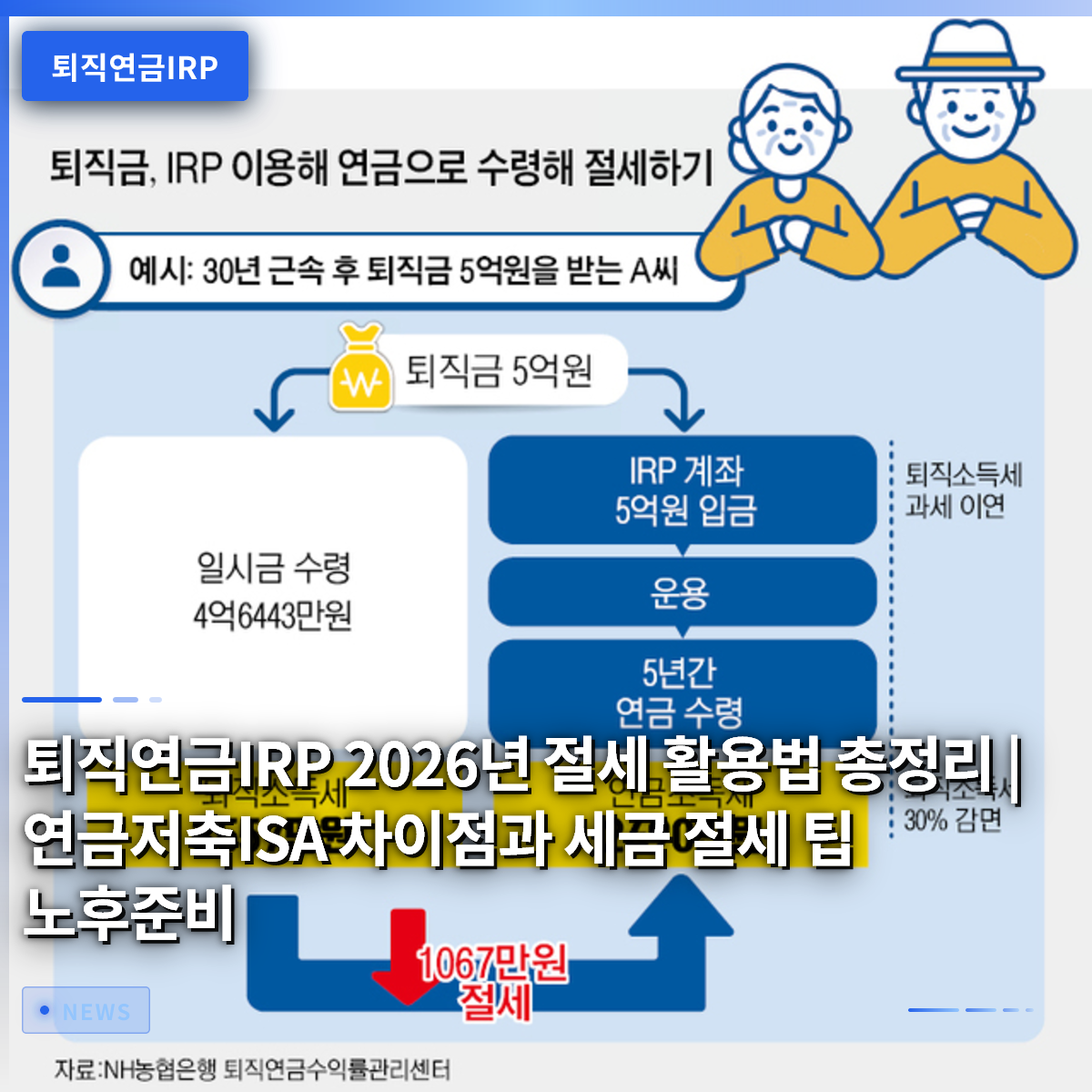
Retirement pension IRPs have become a central pillar of retirement planning as of 2026. By effectively utilizing tax-saving accounts, including pension savings and ISAs, you can save up to 9 million KRW in taxes annually. In particular, since tax laws are scheduled to be revised in 2027, delaying a review of your accounts could result in unnecessary tax payments or a reduction in your retirement funds. I often find that many working friends view the retirement pension IRP as a savings account to be opened only upon retirement, but it is actually the starting point of retirement preparation that begins from your first day on the job. Even if you are enrolled in a Defined Contribution (DC) or Defined Benefit (DB) plan at your company, you can continue managing your assets by transferring them to an Individual Retirement Pension (IRP) when you change jobs. It is also crucial to understand that while pension savings are accounts individuals can join freely, IRPs are dedicated accounts for receiving transferred retirement benefits, resulting in different regulations. In this article, I will provide a detailed overview of tax benefits for each type of tax-saving account, projections for the 2027 tax law revisions, and specific methods for receiving funds.
=
Complete Guide to Tax-Saving Strategies for Retirement Pension IRP in 2026 | Differences Between Pension Savings and ISA, and Tax Tips for Retirement Planning
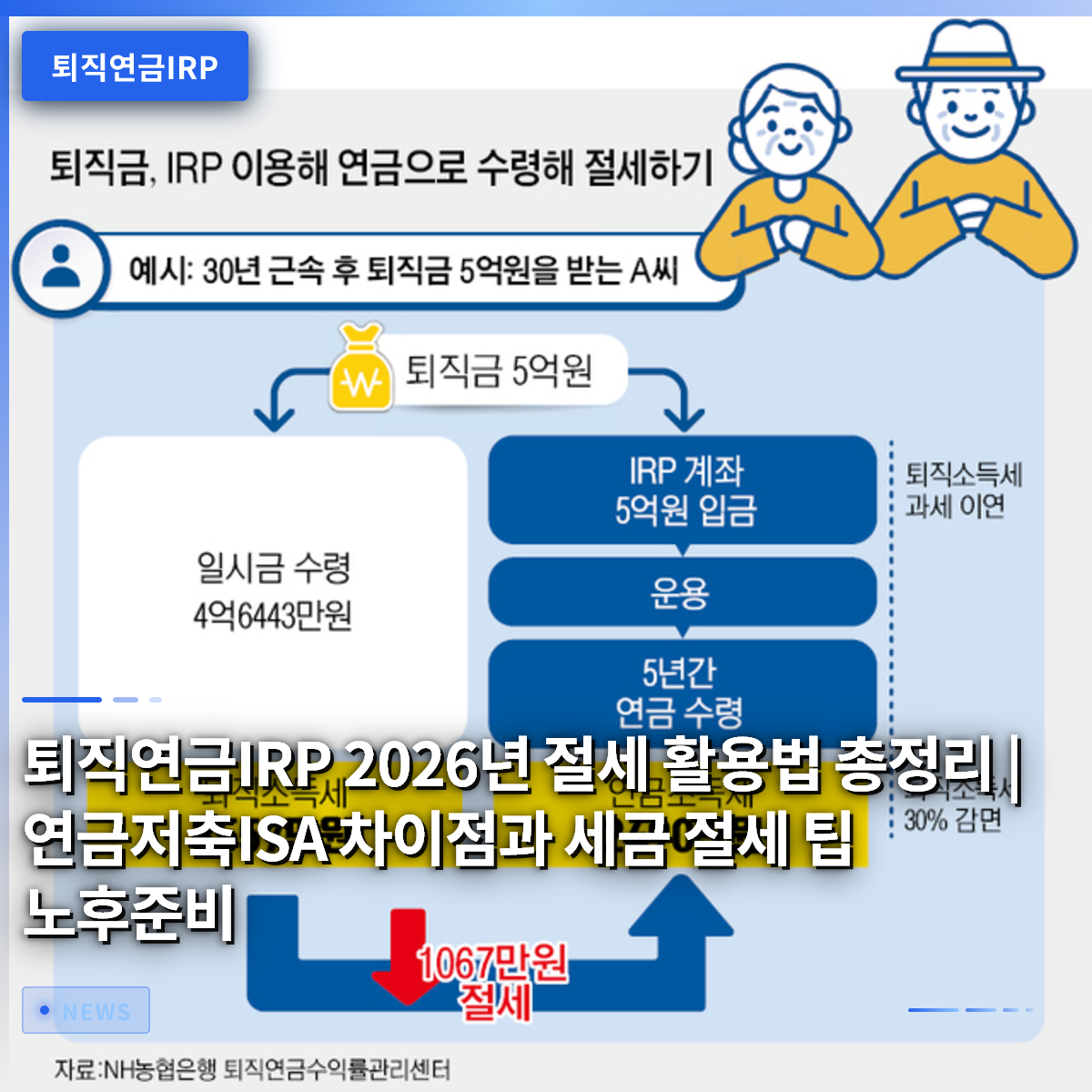
1. Basic Concepts and Tax-Saving Effects of Retirement Pension IRP

The retirement pension IRP is a system that allows you to transfer company retirement benefits to a personal account upon changing jobs or retiring, enabling you to continue managing the funds. For example, if you transfer funds from a Defined Contribution (DC) plan to an IRP, you can enjoy tax benefits while managing them long-term. You can receive income deductions of up to 7 million KRW annually when combined with pension savings, meaning the tax-saving effect is significant for those with higher salaries. For instance, if an employee with an annual salary of 60 million KRW contributes 5 million KRW to an IRP, their taxable income decreases, saving approximately 150,000 KRW in taxes. Since the tax-exempt limits for pension savings and IRPs are scheduled to be adjusted in 2027, contributing now may be advantageous. In particular, those who accumulate a substantial amount in their IRPs in their mid-50s will see a stable increase in retirement income if they receive it as a pension after age 60.
The tax-saving effect of an IRP goes beyond simply getting a tax refund; it also enhances the compound interest effect. Imagine your contributions growing to 2.6 times the initial amount over 20 years with an annual return rate of 5%. In reality, if you contribute 500,000 KRW monthly for 20 years starting in your early 40s, the total could reach approximately 120 million KRW. However, if you had paid taxes on these contributions, the amount would have been limited to around 90 million KRW. However, please note that if you withdraw funds before age 55, a 14% separate tax applies, so these funds should strictly be used for retirement. Transferring retirement benefits directly to an IRP when changing jobs has the advantage of extending the management period, which can lead to higher returns. Thus, the IRP is a core tool for retirement planning that simultaneously achieves tax reduction and asset growth.
The IRP is a dedicated account for transferring retirement benefits, allowing you to receive tax credits of up to 9 million KRW annually and enjoy long-term compound interest effects.
2. Comparison of Differences Between Pension Savings, ISA, and IRP
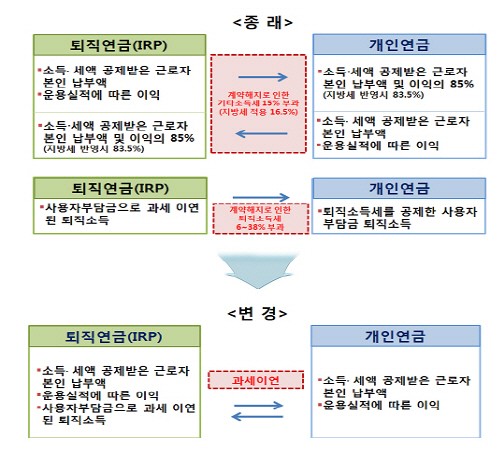
While both pension savings and IRPs are for retirement planning, their starting points and regulations are completely different. Pension savings are accounts that individuals can join freely, whereas IRPs are dedicated accounts for receiving transferred retirement benefits, meaning they can only be opened while employed. The ISA (Individual Savings Account) is a specialized product that bundles pension savings, IRPs, and ISAs to provide additional tax reductions of up to 2 million KRW annually. For example, if a worker in their 40s contributes 3 million KRW to pension savings and 4 million KRW to an IRP simultaneously through an ISA, they can receive income deductions within the annual limit of 7 million KRW. However, since the ISA tax-exempt rate is limited to 9.9%, its structure is more advantageous for middle- and low-income earners than for high-income earners. Since it becomes difficult to open a new ISA after leaving a job, it is advisable to set it up while currently employed.
IRPs are subject to strict regulations under the Act on the Guarantee of Workers’ Retirement Benefits, which limits investment options, whereas pension savings offer a wider range of fund choices. ISAs offer significant tax benefits, but since investable products are mainly ETFs and bonds, the upper limit on returns may be lower. For those in their 50s, securing retirement income is a priority, making IRP pension receipts stable; however, those in their early 40s might prefer the complex wealth management options offered by ISAs. In terms of taxes alone, you can combine deductions of up to 7 million KRW for IRPs, 2 million KRW for ISAs, and 3 million KRW for pension savings, potentially achieving tax savings of up to 12 million KRW in total. However, actual deduction limits vary depending on income levels, so you should allocate funds according to your specific situation. In conclusion, pension savings offer flexibility, IRPs offer tax-saving effects, and ISAs offer integrated management; therefore, utilizing all three together is the best strategy.
Pension savings offer flexibility, IRPs offer tax-saving effects, and ISAs offer integrated management; therefore, utilizing all three together is the best strategy.
3. Strategies for Preparing for the 2027 Tax Law Revisions
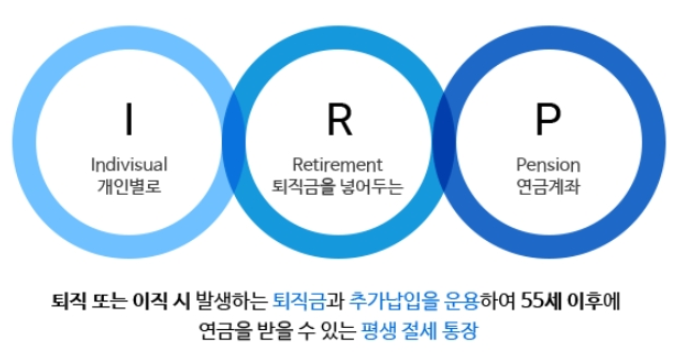
The 2027 tax law revision bill is expected to change some of the tax-exempt limits and deduction methods for tax-saving accounts, so preparation should begin now. According to news reports, companies like Woori Investment & Securities have held webinars explaining the tax changes for 2027, with a focus on how to utilize pension savings, IRPs, and ISAs. In particular, since there is a possibility that tax-exempt limits may be reduced, high-income workers are rushing to make contributions. For example, if the pension savings limit decreases from 12 million KRW to 10 million KRW next year, a strategy of contributing as much as possible within 2026 would be advantageous. Similarly, for IRPs, contributing by 2026 allows you to benefit from current tax rates, maximizing tax savings. The core of preparing for 2027 is to fill up your accounts as much as possible by combining pension savings and IRPs, similar to a “fill up to 9 million KRW” campaign.
Reviewing tax-saving accounts involves more than just checking the amounts; you must simultaneously verify the contribution history and receipt conditions for each account. If your company’s DC retirement pension has been automatically transferred to an IRP, you can directly change the investment products, so it is advisable to replace funds with low returns. If the ISA tax-exempt scope is reduced in the 2027 revision bill, you should reallocate your assets with a focus on pension savings and IRPs. The Woori Investment & Securities webinar included real-time Q&A sessions, allowing participants to receive advice tailored to their individual account situations. However, since webinar content may lead to sales pitches, it is important to selectively refer to information that meets your specific needs. Ultimately, before the 2027 tax law revisions, maximizing the use of current deduction limits is