Personal pension savings is not merely about accumulating money; it is a strategy to prepare for retirement while maximizing tax benefits. In particular, as of 2026, the importance of the revised tax deduction limits and the selection of investment products has become even more prominent. Personal pension savings and IRP (Individual Retirement Pension) offer different tax deduction benefits and investment flexibility, so how you combine them can result in annual differences of several hundred thousand won. For example, Mr. Kim, a company employee, contributed 4.5 million won to pension savings and 4.5 million won to IRP, respectively, to meet the 9 million won tax deduction limit, resulting in a tax savings of approximately 1.2 million won. In this article, we will guide you through specific examples that anyone can apply, from setting up personal pension savings in 2026 to practical investment strategies.
=
Personal Pension Savings 2026 Latest Strategy: How to Prepare for Retirement with Pension Savings and IRP
1. What is Personal Pension Savings?
Personal pension savings is a system where individuals directly prepare for retirement funds in addition to the National Pension, while receiving tax benefits. The government encourages savings through tax deductions for personal pension savings, and as of 2026, not only corporate employees but also self-employed individuals and freelancers can participate. Personal pension savings is broadly categorized into various products such as pension savings insurance, pension savings funds, and severance payment insurance, each with different tax deduction limits and investment strategies. For example, Mr. Park, a 40-year-old office worker, contributed 3 million won to pension savings insurance and received a tax deduction benefit within three years, resulting in tax savings of approximately 400,000 won. Since personal pension savings is premised on long-term savings, a penalty may be imposed in case of early termination, so it is best to make a retirement plan before joining. Additionally, pension savings offers significant tax benefits at maturity in addition to tax deductions, making it highly valuable in terms of long-term asset formation.
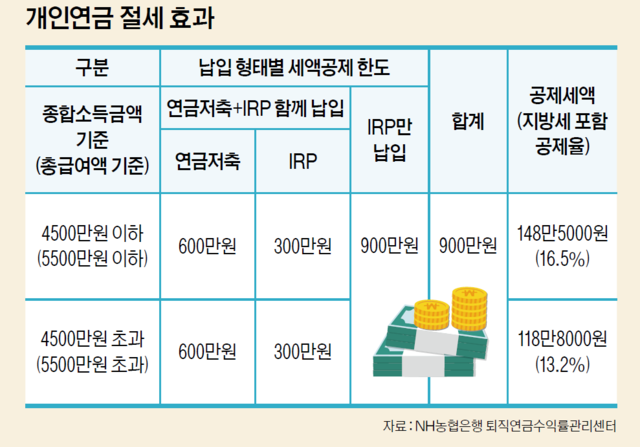
The tax deduction limit for personal pension savings is up to 4.5 million won as of 2026, and benefits are available to all individuals with income, including corporate employees and self-employed business owners. The tax deduction offers a 15% tax savings effect when combining income tax and local income tax, resulting in a tax savings of approximately 670,000 won for a contribution of 4.5 million won. While pension savings products have not changed significantly, if managed in conjunction with an Integrated Capital Account (ICT), the additional tax deduction limit may be higher, so it is necessary to check the guidance from financial institutions.
Personal pension savings offers a tax savings effect of several hundred thousand won annually through tax deductions and is a core means of preparing retirement funds.
2. What is the role of IRP (Individual Retirement Pension)?
IRP is an account where individuals can freely choose investment products, offering higher investment flexibility compared to personal pension savings, which is advantageous for younger demographics or those with smaller asset sizes. The tax deduction limit for IRP is up to 9 million won in total with personal pension savings as of 2026, of which IRP allows contributions of up to 4.5 million won. For example, Mr. Lee, a 35-year-old office worker, invested 4.5 million won in IRP and received a 670,000 won tax deduction, which he used for additional savings. Since IRP may incur losses in the short term, it is essential to understand the risks and make appropriate asset allocation before investing. Additionally, IRP offers a wider range of investment options than pension savings products, allowing you to build a portfolio according to your personal investment style.
IRP has high investment freedom, allowing investment in various assets such as stocks, bonds, and principal preservation depending on individual investment preferences, but this also means a higher risk of investment loss. Therefore, those starting with IRP are advised to begin with safe funds or ETFs to gain experience and then gradually increase the proportion of risky assets. Additionally, since the tax deduction limit for IRP cannot exceed 4.5 million won annually, it is necessary to adjust contribution amounts with this in mind.
IRP offers high investment flexibility and is effective for forming retirement assets in conjunction with tax deductions.
3. 2026 Personal Pension Savings Tax Deduction Strategy
As of 2026, the tax deduction limits for personal pension savings and IRP are 4.5 million won each, with a combined maximum of 9 million won. To maximize this, it is necessary to utilize both systems in a balanced manner. For example, an office worker with an annual salary of 60 million won can contribute 4.5 million won to pension savings and 4.5 million won to IRP, respectively, to receive a 9 million won tax deduction, resulting in tax savings of approximately 1.35 million won. However, filling the entire tax deduction limit is not always the best option; contribution amounts should be adjusted according to individual economic situations and investment goals. For instance, if funds are limited, one might focus on investing in IRP and make additional contributions to pension savings when funds become available. Additionally, since tax deductions vary based on annual contribution amounts, it is important to contribute regularly from January to December 2026.
Personal pension savings offers significant tax benefits not only through tax deductions but also at maturity, making it highly valuable in terms of long-term asset formation, not just tax savings. For example, if one contributes 4.5 million won annually to pension savings for 30 years, they can withdraw the entire investment return tax-free at maturity. Therefore, utilizing personal pension savings and IRP as long-term asset preparation tools is the most efficient strategy.
Balanced utilization of the 9 million won tax deduction limit in 2026 results in an annual tax savings effect of 1.35 million won.
4. Core Strategies for Selecting Investment Products
When selecting investment products for personal pension savings and IRP, one must consider individual investment goals and risk tolerance. For example, those adopting a conservative investment strategy in their 50s should choose bond-centric funds or low-volatility ETFs for safety. On the other hand, younger people in their 30s can maximize long-term returns by increasing the proportion of stocks, but this also increases investment risk, so risk must be managed through diversification. Additionally, ETFs with a high proportion of large-cap stocks like the US S&P 500 have recently become popular among individual investors and are often utilized in pension savings and IRP accounts. For example, the TIGER US S&P 500 ETF can be invested in through pension savings accounts, attracting attention as a representative investment product with individual net purchases reaching 4.9 trillion won.
When selecting investment products, one should consider not only the rate of return but also management fees and tax deduction benefits. Additionally, it is advisable to carefully review materials provided by financial institutions before investing and avoid complex products. Since personal pension savings and IRP are premised on long-term investment, it is necessary to cultivate a consistent investment habit to avoid being swayed by short-term market fluctuations.
Investment products should be selected based on individual investment goals and risk tolerance, with diversification and long-term investment being the core strategies.
5. Strategy for Linking ISA and Pension Savings
ISA (Individual Savings Account) is an account where one can invest freely without tax benefits, offering higher flexibility than personal pension savings or IRP, but with limited tax incentives. However, there is a strategy to secure additional tax deduction limits by saving a certain amount in ISA and then transferring it to pension savings or IRP. For example, Mr. Choi, a 30-year-old office worker, saved 2 million won in ISA and then transferred it to pension savings to receive tax deduction benefits. While ISA allows easy withdrawal midway, which is useful for those who need to use it for living expenses, utilizing it for long-term asset formation can yield higher efficiency. Additionally, linking ISA and pension savings can maximize tax benefits, so it is necessary to manage them strategically by leveraging their respective strengths.
Although ISA does not offer tax deduction benefits, it provides tax-exempt benefits on investment returns, making it advantageous for long-term investment. Therefore, a strategy of starting with ISA and gradually transferring funds to pension savings or IRP can be considered. Additionally, since ISA has no investment restrictions, it allows investment in various assets, which also helps in portfolio diversification.
Linking ISA and pension savings can secure additional tax deduction limits, making it useful as a long-term asset formation strategy.
6. 2026 Personal Pension Savings Management Outlook and Reader Action Guidelines
The management outlook for personal pension savings and IRP in 2026 is expected to be heavily influenced by interest rate cuts and stock market trends. In particular, changes in the US Federal Reserve’s interest rate policy affect global investment fund flows, so those investing in overseas ETFs through IRP need to monitor this closely. Additionally, changes in government tax policies are also important variables, so it is necessary to consistently check for changes in annual personal pension savings laws and tax deduction limits. For example, the expansion policy for Integrated Capital Accounts (ICT) implemented from the end of 2025 is having a positive impact by broadening the personal pension savings tax deduction limit, so one should not miss this. Personal pension savings and IRP are strategies to grow assets in the long term, not just to save money, so it is important to invest consistently and adjust the portfolio according to market trends. Additionally, regularly reviewing investment performance and readjusting asset allocation when necessary can lead to higher returns.
In 2026, with the possibility of continued expectations for interest rate cuts and stock market recovery, it is worth considering expanding the proportion of stock investments through IRP. Additionally, it is worth anticipating the expansion of government policies supporting retirement fund preparation, so it is necessary to respond sensitively to policy changes. Finally, it is safe to manage personal pension savings and IRP with expert advice, and it is important to make plans according to one’s financial situation and investment goals.
Personal pension savings and IRP in 2026 should be managed strategically considering interest rates and market trends, and one must respond sensitively to policy changes.
Frequently Asked Questions
=