The KOSDAQ index surged to the 879 level on October 1, 2026, standing in stark contrast to the stagnation of the KOSPI. This is interpreted as a strong rebound signal, breaking away from the sideways trend that had persisted for the past month. While the KOSPI paused around the 6,800 level, the KOSDAQ recorded a rise of over 2%, driven by large-scale net buying from institutional and foreign investors. Notably, the performance of newly listed tech stocks like Brills and Physical AI-related stocks was seen as a key driver of the index. Unlike the temporary tailwind seen when the National Growth Fund was announced in May, this rally is significant because it is accompanied by substantial capital inflows, not just policy expectations. Today, we will specifically examine the current position of the KOSDAQ index, the reasons for its divergent path from the KOSPI, and the key sectors and investment points that will drive the October stock market.
=
KOSDAQ Index October Rebound Signal: Reasons for Divergence from KOSPI and Investment Strategies
1. KOSPI Pauses Amid Pressure, KOSDAQ Launches Steep Rally
The KOSPI index is hovering around the 6,810 level due to the sluggish performance of large-cap stocks on the KRX. This is because the US 10-year Treasury yield has risen to 5.28%, placing a heavy burden of high interest rates on the entire index. Additionally, the dollar index fluctuating around 101.46 continues to exert pressure on the won, leading to negative sentiment for export stocks. In contrast, the KOSDAQ index closed at the 879 level, surging 2.78% from the previous trading day, proving strong buying momentum. Recording a daily gain of over 2% for the first time in nearly a month since September 9 is highly unusual.
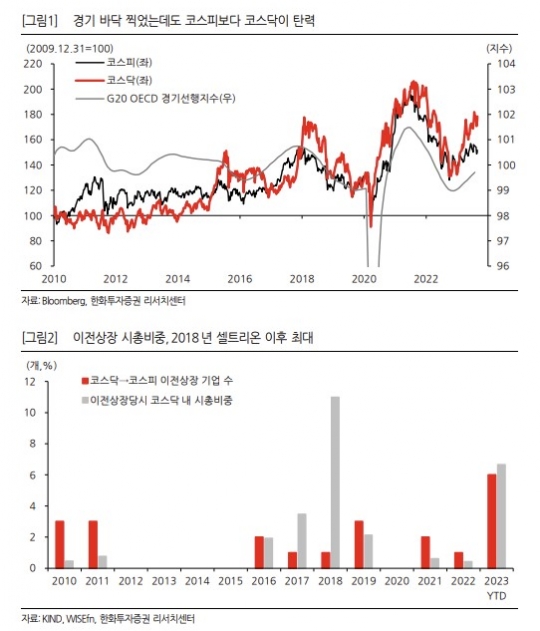
This rise at a turning point can be read not merely as a reduction in volatility, but as a potential trend reversal. Notably, even on a day when top KOSPI market-cap stocks all fell, all top 10 KOSDAQ market-cap stocks rose. From the perspective of individual investors, this suggests a shift away from risk-averse sentiment and the beginning of a re-evaluation of growth stocks. For large capital, an environment has been created where relatively undervalued KOSDAQ stocks become attractive given the increasing valuation burden on the KOSPI. The net buying of 100.1 billion won by institutions and 153.6 billion won by foreigners observed in today’s session serves as the basis for this judgment.
Unlike the KOSPI’s high-interest-rate burden, the KOSDAQ showed clear strength, recovering the 879 level due to institutional and foreign capital inflows, reflecting expectations for policy or real economy improvement.
2. Expectations for the 2nd National Growth Fund and Physical AI Momentum Join Forces
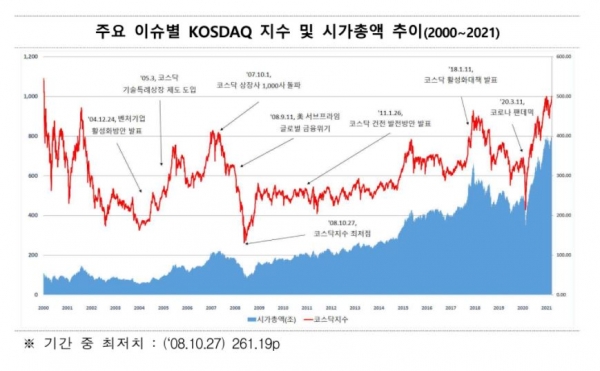
Market expectations for the “2nd National Growth Fund” played a major role in the background of this rise in the KOSDAQ market. Following the experience of the index surging to the 1,161 level when the first fund was launched in May, market participants believe the second fund will also inject massive capital into growth industries such as AI, semiconductors, and biotech. Indeed, newly listed stocks like Brills succeeded on their first day, highlighting the competitiveness of Physical AI and robot modularization technology. This indicates that the market is undergoing a process of substantive corporate value re-evaluation, rather than just thematic price fluctuations.
In particular, individual investors’ attention is focused on Physical AI, which combines robotics with physical intelligence. As demand for automation in manufacturing sites grows, a premium is forming for tech stocks that combine hardware, unlike software-centric AI. Traditional companies like Sungkwang Bend, which announced share buybacks to defend their stock prices, also contributed to supporting the index. The simultaneous rebound across various sectors can be interpreted as an improvement in overall market liquidity, which could serve as a powerful catalyst for a sustained rise in the KOSDAQ index.
Expectations for the 2nd National Growth Fund, along with the listing momentum of Physical AI and robot stocks like Brills, acted as the core driving force behind the KOSDAQ’s rise.
3. Institutional and Foreign Buying Concentrated, Individuals Focus on Profit-Taking

It is necessary to clearly understand the market characteristics by analyzing the drivers of this rally. Institutional investors net bought 100.1 billion won, and foreign investors net bought 153.6 billion won, leading the index rise. This is interpreted as a strong signal that institutional quant systems and foreign fund managers are jointly buying high-quality value stocks within the KOSDAQ. On the other hand, individual investors recorded net selling of 226.8 billion won, showing a tendency to realize short-term profits.
Looking at past cases, the pattern where individuals sell while institutions and foreigners buy has historically had a positive impact on stock prices in the medium to long term. As newly listed stocks experienced sharp initial gains followed by individuals reducing their positions, the overall index volatility tended to decrease. This also signifies that institutions and foreigners are beginning to approach the market from a long-term investment perspective. It is also possible that stocks heavily sold by individual investors could present good buying opportunities. From a market liquidity perspective, large-scale foreign capital inflows are strengthening the fundamental resilience of the domestic stock market.
Joint net buying by institutions and foreigners drove the index rise, contrasting with individual profit-taking selling, thereby increasing the likelihood of medium-to-long-term stabilization.
4. Biotech and Secondary Batteries Play Supporting Roles, Sectoral Return Gaps Widen
While the KOSPI decline was concentrated in large semiconductor stocks, the biotech and secondary battery sectors served as solid pillars in the KOSDAQ. Thanks to revived energy investment momentum, earnings from secondary battery-related component and material companies are consistently exceeding expectations. It is widely assessed that the limit-up rally in robot stocks made a decisive contribution to driving further gains after the index settled at the 855 level. This broadly distributed rise within sectors indicates that the index is not relying on just one or two stocks, but that the overall market is becoming more robust.
On the other hand, considering that the KOSDAQ index has fallen 7.52% year-to-date, I would like to emphasize that the recent rebound is important in terms of “recovering half of the losses.” Although cases of losses from long-term holding of newly listed stocks have been reported, this is an issue of individual stock volatility and is separate from the re-evaluation of the index average. In the second half, strategies to find differentiated sources of return, such as dividend stocks or growth stocks, appear necessary. In particular, data from late September shows that the stable flow of secondary battery stocks is playing a crucial role in raising the average return of the KOSDAQ index.
By reducing dependence on semiconductors and seeing balanced growth in various sectors like biotech and secondary batteries, the structural stability of the KOSDAQ index is being enhanced.
5. US Treasury Yield Variables and Exchange Rate Sensitivity: Risk Management is Essential
The biggest variable constraining further rises in the KOSDAQ index remains US monetary policy. The high-interest-rate environment where the US 10-year Treasury yield exceeds 5% acts as a risk factor for global stock markets in general. WTI crude oil prices surpassing $90 are also stimulating inflation concerns, functioning as a factor that erodes expectations for rate cuts. In such a macro environment, the domestic stock market is no exception, with the potential risk of foreign capital outflows when the dollar index rises.
Therefore, a keen sense for macro indicators is required, not just for individual stock selection. If the timing of rate cuts is delayed, the burden of overvaluation in KOSDAQ stocks could become significant again. One must always keep in mind the risk of significant valuation adjustments for growth stocks, which are sensitive to interest rate fluctuations. Component manufacturers that may be negatively affected in export performance due to exchange rate fluctuations also require caution. It is wise to implement an asset allocation strategy that can hedge these macro risks when constructing an investment portfolio.
Sustained US high interest rates and exchange rate fluctuations are the biggest risks blocking further KOSDAQ gains, making macro indicator monitoring unavoidable.
6. October KOSDAQ Investment Outlook and Individual Investor Action Guide
The outlook for the KOSDAQ index in October can be seen as a preparation stage for challenging the 900 level again. Given the current situation where policy benefits and technological innovation momentum are combined, unlike the KOSPI, a split-buying strategy during corrections will be effective. In particular, it is important to verify whether the Physical AI theme is leading to actual earnings improvements rather than just rumors. Since the stock price volatility of newly listed companies can be high, they should be approached within a range that controls risk.
Individual investors are advised to adjust their buying volume in 2-3 tranches, focusing on high-quality stocks where institutional and foreign buying continues, rather than entering the market hastily all at once. A growth-stock-centric portfolio may be advantageous while the KOSDAQ’s relative performance against the KOSPI remains superior. However, it is important to respond calmly in sections where profit-taking selling emerges after short-term sharp rises. Based on the sectoral trends and foreign investor movements discussed in this article, please make rational judgments that suit your investment style.
October is a period combining policy expectations and earnings verification; a strategy centered on split buying and risk management while monitoring institutional trends is recommended.
Frequently Asked Questions
=