As of today (October 1), the Nasdaq Composite Index was the sole gainer among the major U.S. stock market indices, capturing significant market attention. It closed at 26,861.06 points, up 63.52 points (0.24%) from the previous trading session, driven by defensive buying in technology stocks. In contrast, the Dow Jones Industrial Average fell by 443.87 points and the S&P 500 dropped by 19.30 points on the same day. This divergence indicates that the market is focusing on high-growth expectations rather than risk aversion, with a clear concentration in specific sectors. Despite ongoing interest rate pressures, key stocks like Intel and Nvidia are providing support, keeping investor interest high. This article examines the background of this tech-led rally and provides specific insights to help navigate the upcoming October market trends. Key Takeaway: The Nasdaq Composite closed up 0.24% on strong tech buying, showing a distinct divergence from the declines in the other two major indices.
=
October 1, 2026: Nasdaq Composite Daily Closing Review and Future Outlook Analysis
1. Background of the Nasdaq’s Modest Rise Amid Mixed Market
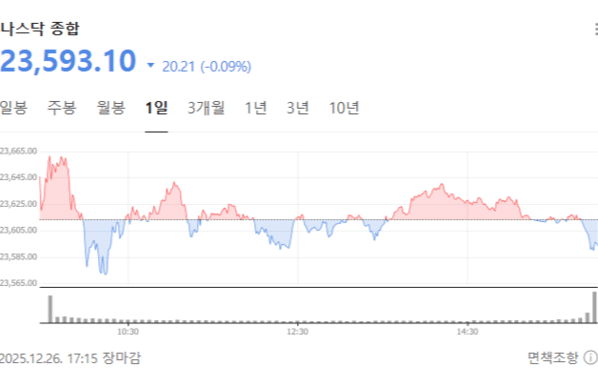
During the regular session on September 30, the U.S. stock market showed a mixed trend lacking clear direction, but the Nasdaq maintained its upward momentum. This suggests a divergence in sentiment among market participants, as broad tech optimism prevailed despite the high interest rate sensitivity of growth stocks. The semiconductor giant Intel surged 3.71%, providing solid support for the index. Major tech giants like Nvidia and Apple also joined in, effectively acting as pillars to defend against a broader market decline. Conversely, selling pressure in the industrials and healthcare sectors increased downward pressure on the Dow, widening the gap between the indices. Ultimately, this sent a clear signal that capital is shifting toward the technology sector, which offers strong defensiveness and high growth potential. This trend indicates that the market is prioritizing selective, earnings-based buying over indiscriminate speculation.
A second point of note is whether market sentiment remained stable despite the modest rise. The U.S. August PCE data released the previous day came in below market expectations, slightly easing inflation concerns. However, with long-term interest rate burdens still present, the market’s reaction was limited to minor adjustments rather than a significant move. The Nasdaq’s 0.24% gain can be interpreted as a session focused on establishing a high rather than a sharp rally. Due to its high weighting in tech stocks, the index remains sensitive to interest rate fluctuations, but AI-related expectations are offsetting this. This balance is likely to serve as the benchmark for the early October market, suggesting adjustments and restructuring within the current range rather than drastic volatility. For individual investors, now is a time to review existing portfolio compositions rather than rushing new entries. Key Takeaway: Despite favorable PCE data, long-term rate pressures limited the rise, indicating a phase of adjustment.
Rising stock prices in tech giants like Intel and Nvidia defended the Nasdaq index, confirming a trend of capital concentration in the tech sector.
2. Analysis of the Decline in the Dow and S&P 500
In stark contrast to the Nasdaq’s rise, the Dow Jones Industrial Average and the S&P 500 both declined, causing confusion among investors. The Dow’s sharp drop of 443.87 points to close at 50,906.05 is primarily attributed to weakness in financials and industrials. These sectors are directly affected by interest rate levels and tend to show weakness first when rate cut expectations weaken or economic slowdown concerns emerge. The S&P 500 also fell 0.25% to 7,651.54, reflecting a broader risk-off sentiment in the market. Selling was also observed in consumer staples and healthcare, stemming from caution regarding potential economic deceleration. Ultimately, the decline in these two indices is less about specific stocks and more about macroeconomic uncertainties impacting the market at a macro level.
In such a declining session, investors are easily prone to fear that this weakness will continue. However, historically, periods where individual indices move in opposite directions can be interpreted as a time of market restructuring. The Dow’s larger drop can be seen as a combination of short-term profit-taking and a cautious stance, which does not necessarily signify a trend reversal. Rather, when viewed alongside the Nasdaq’s relative strength, it is more appropriate to see this as a process of selective reallocation within sectors, rather than a shift from growth to value stocks. Therefore, it is necessary to adopt a mature perspective rather than concluding that the entire market is deteriorating based solely on the Dow’s decline. Future differentiated performance among indices may vary depending on sector-specific earnings reports and policy news, so close monitoring is required. Key Takeaway: Index divergence may indicate market restructuring; a selective approach is needed rather than excessive fear.
Weakness in interest-rate-sensitive financial and industrial sectors led the decline in the Dow and S&P 500.
3. AI Expectations and the Standalone Strength of Tech Stocks

The most notable feature this week is that only AI-related tech stocks rose, even in a high-interest-rate environment. Upon closer inspection, some semiconductor stocks, including Meta Platforms and AMD, led the rally, serving as the driving force behind the Nasdaq’s rise. This shows that market participants are placing greater value on individual companies’ innovation capabilities and earnings growth potential than on macro indicators. In particular, the momentum has continued without fading even after hitting an all-time high on September 22, reinforcing confidence in tech stocks. This argument suggests that the investment logic that cost-saving effects from AI adoption outweigh high interest rates is strong. Therefore, it can be interpreted that market perception has shifted from viewing these as mere thematic stocks to recognizing them as companies with substantial revenue and no signs of slowdown.
These individual stock movements are acting as a core factor determining the overall resilience of the Nasdaq Composite Index. Intel, for instance, recorded a meaningful 3.71% rise, escaping its long period of sluggishness and rekindling market interest. This is analyzed not just as a rebound, but as a reflection of expectations for increased data center demand. Leading companies like Nvidia also joined in, increasing the weight of the tech sector and playing a role in defending the index. As a result, the phenomenon of the Nasdaq moving independently has been strengthened. If this trend continues, a seesaw effect between market indices is expected, creating a favorable environment for portfolios with high tech exposure. Key Takeaway: Earnings expectations for major tech stocks like Intel and Nvidia have strengthened the index’s independence.
Tech stocks continue to show standalone strength due to AI innovation and proven profitability, becoming a driving force that overcomes interest rate burdens.
4. Global Market Correlations from a Korean Investor’s Perspective
Trends in the U.S. Nasdaq market are exerting selective influence on the Korean stock market, particularly in the tech sector. Reports of buying interest in Japanese semiconductor equipment stocks like Advantest and Tokyo Electron can be seen as a direct extension of the recent strength in U.S. tech stocks. This is an excellent example of the tight connectivity of the global supply chain centered on AI and semiconductors. It is also why Korean investors need to monitor global tech trends in real-time and refer to them when structuring their own portfolios. The expansion of services providing information on non-listed stocks, such as the Nasdaq Private Market (NPM), can also be understood as part of this trend. As options have increased, methods of accessing global innovative companies are becoming more diverse.
In particular, rumors regarding the listing of Solidigm, a subsidiary of SK Hynix, are an issue that Korean investors must check. While the company has stated that nothing is confirmed, market observers note active discussions about a pre-IPO for a potential Nasdaq listing. Since such speculative news can have a psychological impact on actual market prices, a cautious approach is required. If the listing materializes, it could serve as an opportunity to elevate the global standing of the Korean semiconductor ecosystem. Conversely, volatility driven by rumors can cause short-term price distortions, so discernment is needed to distinguish between essential changes and noise. Key Takeaway: Solidigm listing rumors may cause psychological volatility in the Korean market, necessitating fact-checking and wise judgment.
Global tech strength is spilling over into the Japanese and Korean semiconductor sectors, strengthening market correlation.
5. Overall Review of the New York Stock Market Close on the First Trading Day of October
It is important to note that this review is based on the closing metrics of the New York regular session on the previous day (Tuesday, September 30), which corresponds to Thursday, October 1, in Seoul time. An unusual session unfolded where the three major indices moved in different directions for the first time in three days. The Dow fell, the S&P 500 dipped slightly, and the Nasdaq rose slightly, sending complex signals. Such days should be understood as a process of the market probing for its next direction. Investors will now focus on which sectors will regain strength in the October session or whether the current upward pressure will persist. Continuous movement is more important than a single rise or fall, and it is wise to grasp trends through data.
What can be learned from this settlement is that the market is no longer stuck in a simple sideways pattern. Instead, while tech stocks are defended by relying on the solid foundation of AI, the process of shedding weaker sectors has provided a heterogeneous interpretation. In other words, it can be concluded that this is a time for sector rotation and verification of individual company earnings, rather than an unconditional market rise or fall. Specific figures, such as the Dow’s closing price of 50,906.05 and the Nasdaq’s closing price of 26,861.06, accurately show the market’s current position. Please use these figures as a guide to map out the October stock market. Key Takeaway: Recognize the phase of sector rotation and earnings verification, and formulate strategies based on specific closing price figures.
The September 30 close was mixed, indicating a directional exploration phase, with high likelihood of continued sector differentiation through early October.
6. Future Outlook and Practical Tips for Readers
The upcoming October is a crucial month in the U.S., with the Federal Reserve’s interest rate decisions and major economic indicator releases scheduled. Therefore, the possibility of increased volatility in the Nasdaq Composite Index cannot be ruled out, but it is likely to move within the range defined by the AI innovation cycle. Investors should closely monitor the currently formed price range and employ strategies such as dollar-cost averaging or staged selling. In particular, putting all assets into tech stocks is risky, so balancing the portfolio with defensive value stocks or dividend stocks is a viable method. It is wise to maintain an appropriate cash reserve to allow for flexibility when volatility is high.
The most realistic action individual investors can take is not to be swayed by news flows. Whether it is Solidigm listing rumors or the Bank of Japan’s interest rate policy, reacting immediately to stock news that comes out three times a day can easily lead to losses. A consistent learning attitude and a long-term perspective on asset management are necessary. Today’s 0.24% rise in the Nasdaq is a small number, but it was a meaningful signal reaffirming the structural strength of tech stocks. Please read the signals the market throws out slowly but clearly, alongside the upcoming earnings season. Key Takeaway: Emphasized the importance of maintaining a long-term perspective on learning and asset management without being shaken by short-term news.
October may see increased volatility, but it is expected to remain within a range driven by the AI cycle; respond with staged trading and cash reserves.
Frequently Asked Questions
=