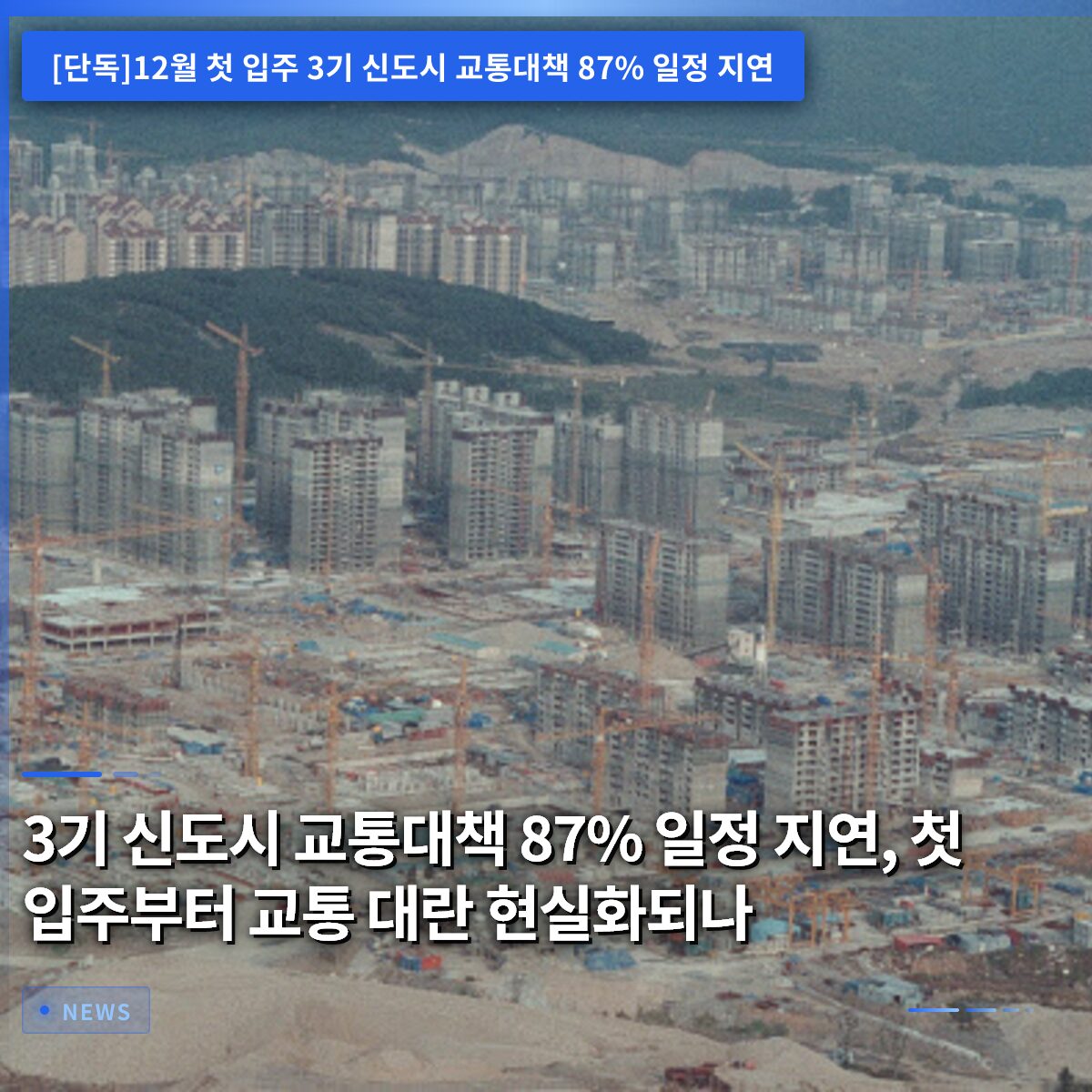
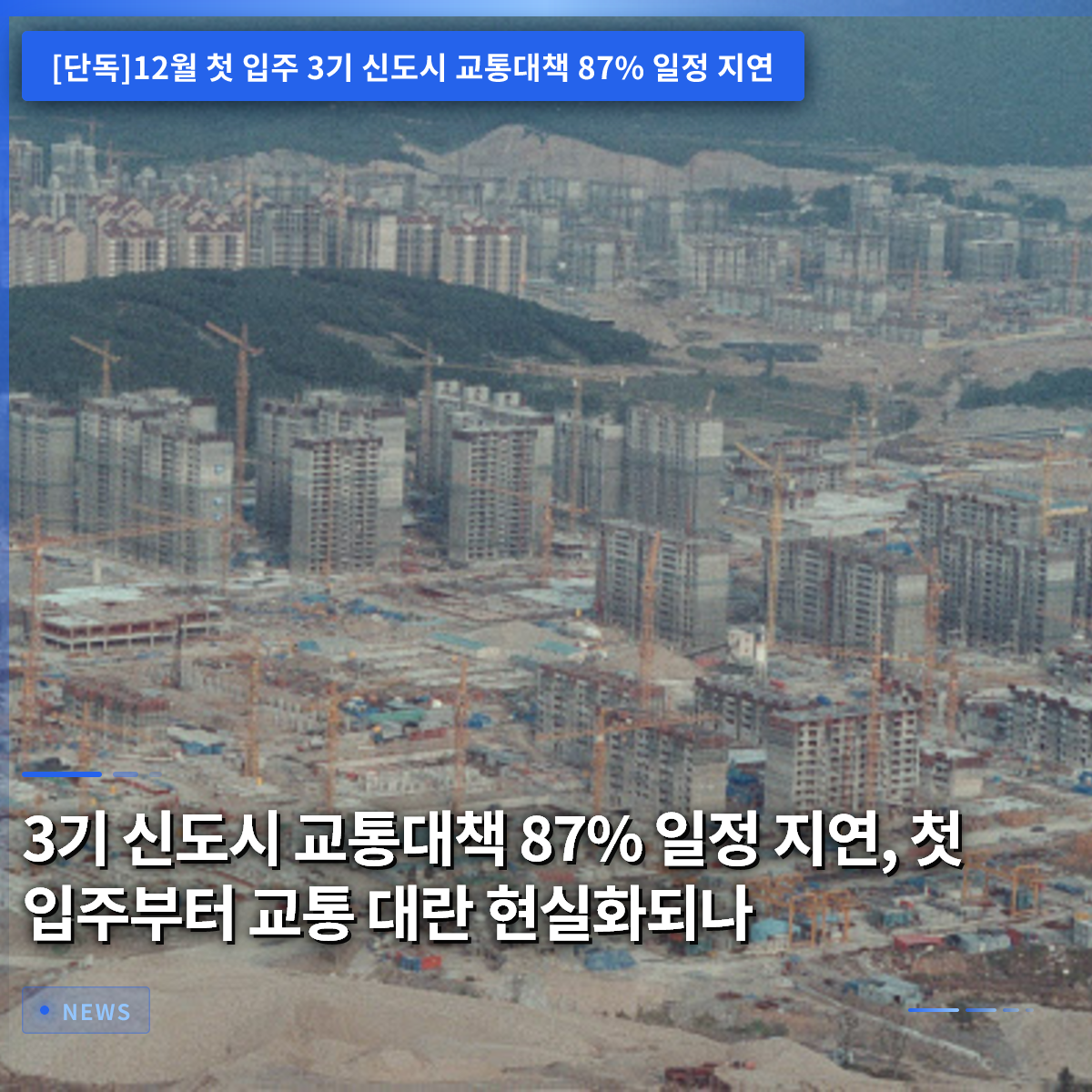
It has been revealed that 87% of the schedules for key metropolitan traffic projects in the 3rd-generation new cities are facing delays, just as the first move-ins in Incheon Gyeoyang are scheduled for December this year. The government’s long-standing principle of “transportation first, housing later,” which was repeatedly emphasized whenever new cities were announced in the past, is once again on the verge of becoming nothing more than an empty slogan. According to data from the Korea Land & Housing Corporation (LH), the completion dates for 77 out of 89 total projects have been pushed back from the original plans, with a significant portion expected to be completed only after 2030. Furthermore, eight projects have no set completion date at all, raising concerns about fierce backlash from residents and severe traffic congestion. The terrifying commute hell and traffic chaos experienced during the era of the 2nd-generation new cities are highly likely to be fully replicated in the 3rd-generation new cities. We will thoroughly examine the causes of this traffic network delay and the hardships that future residents will face.
=
87% of 3rd-Generation New City Traffic Plans Delayed: Will a Traffic Chaos Erupt from the First Move-In?
1. First Move-In in Incheon Gyeoyang Imminent, Yet the Traffic Network Remains an Empty Lot
By December this year, the long-awaited first housing supply and move-in for the 3rd-generation new cities will finally begin with the Incheon Gyeoyang district. However, upon closer inspection, the core public transportation networks and road expansion projects that residents will rely on are making little to no progress. While the government and relevant agencies have long promised thorough preparation, the reality on the ground completely betrays residents’ expectations. In fact, out of the 15 traffic measures allocated to Incheon Gyeoyang, nine projects are expected to be completed well past 2030. Even the Bus Rapid Transit (BRT) system construction, which was supposed to be finished within this year, has been thrown into uncertainty due to plan changes related to the extension of the Daejang-Hongdae Line.
As the clock for move-in ticks by rapidly, there is no sign of visible traffic infrastructure being completed, pushing residents’ anxiety to its peak. The first residents, who are moving in with high hopes of owning their own homes, are set to face a daily battle against severe traffic congestion on their commute. It is certain that bus stops and subway stations will be packed with people pacing anxiously every morning. One cannot help but question who benefits from the administrative decision to forcibly move people in before the infrastructure is fully in place.
Major public transportation measures for the 3rd-generation new cities, including Incheon Gyeoyang, which is set for move-in by the end of this year, are past their completion deadlines, foreshadowing resident inconvenience.
2. The Shocking Reality: 77 of 89 Metropolitan Traffic Improvement Measures Delayed
Documents submitted by the Korea Land & Housing Corporation (LH) to an office of a member of the National Assembly’s Committee on Land, Transport and Tourism have fully exposed the poor state of traffic in the 3rd-generation new cities. Out of the 89 metropolitan traffic improvement measures ambitiously announced by the government between 2020 and 2021, the schedules for 77 projects have been delayed. This accounts for a staggering 86.5% of the total, meaning the vast majority have failed to meet the originally promised deadlines. These measures include railway openings, new subway stations, major road expansions, and the installation of bus-only lanes, all of which are intended to serve as the lifeline for new city residents.
Even more shocking is the cruel truth that the majority of these massive projects—58 in total—are not expected to be completed until after 2030. Furthermore, eight projects have no completion date listed at all, leading to criticism that they are effectively being neglected. Actual demanders who submitted applications based solely on the glossy blueprints drawn on paper are left feeling a sense of massive betrayal and despair. Despite such large-scale planning failures, relevant agencies appear more busy watching each other’s moves than providing responsible explanations.
77 projects, accounting for nearly 87% of all traffic measures, have been delayed, with a significant portion pushed to completion after 2030.
3. Fear of Traffic Hell Spreading to Later-Stage New Cities Like Hanam Gyo-san
Not only Incheon Gyeoyang, which breaks ground on its first move-in at the end of this year, but also Hanam Gyo-san, which is preparing for its first move-in in June 2029, faces a similar situation. As the entire 3rd-generation new city sector shows signs of being swept into a vortex of traffic hell, prospective residents are sighing deeply. While massive residential complexes are being built to accommodate tens of thousands of people at once, the roads and railways meant to transport them are facing years of construction delays. There is a high probability that the terrifying scene of bidirectional lanes turning into parking lots during rush hours will be enacted across major new cities such as Hanam, Namyangju, and Goyang.
Subway extension projects have repeatedly failed to secure contractors or hit walls during feasibility studies, with many not even having broken ground. Road expansion works are also delayed due to compensation issues and budget shortages, posing a high risk of resulting in half-baked openings. The typical plague of “housing first, transportation later” is being replicated, with large-scale apartment complexes standing alone in barren lands where no infrastructure is in place. Transportation is the most important metric for determining the success of a new city, yet the government is breeding distrust by failing to keep even the most basic promises.
Other 3rd-generation new city districts, including Hanam Gyo-san, are also facing delayed traffic network expansions, raising concerns of commute chaos across the region.
4. The Recurring Nightmare of the 2nd-Generation New Cities: What Went Wrong?
Experts sharply point out that the current traffic network delays in the 3rd-generation new cities are a carbon copy of the painful nightmares experienced during the 2nd-generation new city era. Professor Kim Jin-yu of the Department of Urban Transportation at Kyunggi University highlighted the structural contradiction where traffic network expansion and land development fail to harmonize. He noted that friction and delays inevitably occur in administrative procedures and budget execution when authorities force traffic facilities to be rushed to coincide with land development completion. This is the result of focusing solely on the speed of housing supply under the guise of stabilizing home prices, while pushing the most important infrastructure investment to the back of the line.
Given the nature of railway projects, which involve numerous stakeholders and require years for budget feasibility reviews, the government bears significant responsibility for its casual predictions. The organic coordination system between project implementers, local governments, and government ministries has collapsed, with each entity pursuing its own interests. Every time a problem arises, the response is merely passing the buck between ministries, rushing to offer temporary fixes rather than fundamental solutions. The shameful history of 3rd-generation new city residents inheriting the commute hell that 2nd-generation residents endured for years is being repeated.
The government’s casual administration, which focused only on the speed of housing supply while neglecting traffic infrastructure construction, has exacerbated the situation.
5. Residents’ Traffic Inconvenience Becomes Reality: Is a Solution Possible?
With traffic measures being delayed one after another, residents moving in from December face extreme inconvenience, having to rely solely on private cars or local buses. In a situation where long-distance buses are severely insufficient and subway connections are missing, entering Seoul for work will be a near-impossible challenge. The pain of “hell trains” and packed buses, where leaving home in the early morning still results in being late for work, is falling squarely on the shoulders of new city residents. Some residents are seriously considering delaying their move-in or re-listing their homes for rent, venting their frustration.
The government and the Korea Land & Housing Corporation (LH) have announced that they will establish temporary bus routes or expedite the operation of dedicated lanes to put out the immediate fire. However, there are strong voices arguing that deploying temporary buses without opening the fundamental railway network could be a blunder that only worsens road congestion. As residents’ complaints reach the heavens and political criticism continues, authorities are belatedly moving to assess the situation and formulate supplementary measures. It remains to be seen whether the government can soothe residents’ frozen hearts and prevent traffic congestion through effective measures.
Residents, who have no alternative but temporary buses due to the lack of a railway network, must endure an extreme commute traffic war.
6. Has the Myth of “Transportation First, Housing Later” Shattered? Future Outlook
Ultimately, the grand slogan of “transportation first, housing later” that permeated the 3rd-generation new cities has been proven to be a complete fiction due to thorough management negligence and administrative delays. The price of focusing solely on meeting housing supply quotas while neglecting essential infrastructure has fallen entirely on the innocent citizens. The key to the remaining move-in period will be how strongly the government intends to accelerate the delayed traffic projects. If special measures such as concentrated budget investment and the introduction of a fast-track for permits are not implemented, the value of the new cities will plummet.
If you are planning to apply for a new city apartment or move in the future, you must carefully scrutinize not just the sale price or location, but the actual opening dates of the traffic network. Moving in based solely on announced schedules could lead to the unfortunate situation of enduring a hellish commute for years. The government must stop making excuses about delays, transparently disclose progress, and actively communicate with residents. For new cities to truly transform into livable residential spaces, a bone-grinding innovation in traffic measures is urgently needed right now.
Without effective traffic innovation measures, the future of the 3rd-generation new cities is bleak, and thorough verification by move-in residents is necessary.
Frequently Asked Questions
=