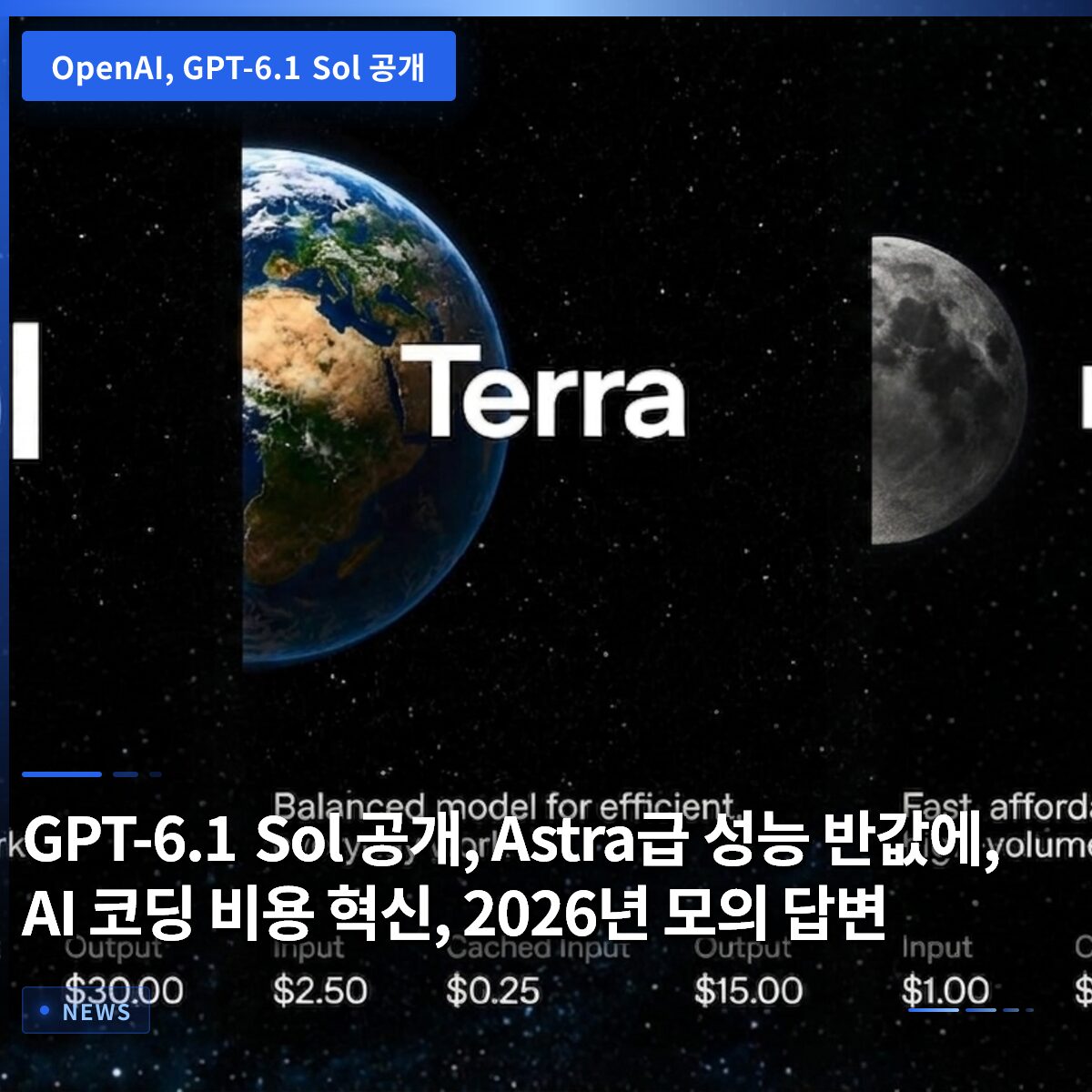
GPT-6.1 Sol is a balanced model that delivers powerful performance comparable to GPT-6 Astra while reducing costs to one-fifth of the original. OpenAI made a surprise announcement of this latest upgrade version on September 29, 2026, attracting significant attention from developers and enterprises. It not only offers substantial performance improvements over the previous Sol model but also provides the flexibility to adjust reasoning intensity to maximize cost efficiency. In particular, it delivers top-tier results across a wide range of specialized tasks, from coding to scientific research, drawing attention from many teams. In this article, we will examine in detail the specific performance metrics of GPT-6.1 Sol, how its pricing has changed, and what practical benefits it offers in real-world work. It is also impressive that the rate of factual errors when handling complex prompts has been improved. Beyond simply selecting a model, let’s look at the numbers to see how much cost can be saved.
GPT-6.1 Sol Unveiled: Astra-Level Performance at Half the Cost, Revolutionizing AI Coding Expenses, 2026 Simulated Answers
1. Innovative Performance Improvements in Coding and Agent Tasks

GPT-6.1 Sol has demonstrated unparalleled results in the field of software engineering. Based on the DeepSWE v1.1 benchmark, it shows accuracy levels comparable to GPT-6 Astra while costing only about one-fifth as much. This is a score 6.4%p higher than the previous GPT-6 Sol’s best score, with the key being that it achieves this with lower-cost reasoning intensity. For example, while complex bug fixes or legacy codebase cleanup previously required premium models, standard subscriptions can now ensure sufficient quality. It also showed excellent stability in building agent-based autonomous code testing and deployment pipelines. In the medium reasoning mode of AutomationBench, it recorded a score 2.2%p higher than competing models. These figures signify a significant improvement in actual developer productivity beyond just benchmark numbers.
The reasoning capability of machine learning models becomes increasingly important as code complexity rises. GPT-6.1 Sol has thoroughly improved this aspect, minimizing errors even in large-scale structural refactoring. In tasks involving understanding specialized documentation and code conversion, the cost per task has dropped to less than half that of Opus 5.5. This is a feature that will be particularly popular with startups and small-to-medium enterprises with limited budgets. It opens the way to implement top-tier performance without high-cost models. As a result, it creates a situation where the quality of development team deliverables is maintained while operational costs are significantly reduced.
GPT-6.1 Sol achieves Astra-level performance at one-fifth the cost in coding benchmarks, revolutionizing development cost efficiency.
2. Analysis of Computer Use and Specialized Task Handling Capabilities
In the OSWorld 2.0 benchmark, which tests computer use capabilities, GPT-6.1 Sol delivered performance 7%p higher than the previous Sol in max reasoning mode. This means the performance gap with GPT-6 Astra is a mere 2.1%p. Meanwhile, the cost per task is about one-seventh of Astra’s, making it highly competitive. It demonstrates human-level accuracy in actual office tasks such as document calculations, data aggregation, and report writing. It handled complex electronic spreadsheet manipulation and multi-tab browser-based information retrieval without confusion. Additionally, in the Terminal-Bench Science 0.1 test, it recorded more than double the score of GPT-6 Sol, significantly proving its scientific research support capabilities.
The core of specialized task handling is the ability to execute long logic chains to the end without interruption. GPT-6.1 Sol achieved excellent scores across various reasoning settings in specialized document understanding tests like GDP.pdf. It was decisively superior compared to Opus 5.5 and fallback combinations. This enhances reliability in fields requiring precision, such as legal document review and financial report analysis. It is positioned as a model that saves time for professionals while minimizing costs. In practical roles, it has been confirmed that it can be an equal partner in tasks requiring complex judgment, going beyond simple repetitive work.
We confirmed significant performance improvements and dramatic cost reduction effects in computer automation and scientific research benchmarks compared to previous models.
3. Detailed Breakdown of Cost Structure and API Pricing Policy
The biggest strength of this update is its reasonable pricing. For API usage, the input cost is $2 per million tokens, and the output cost is $10. Specifically, for cached input tokens, the rate is $0.10 per 100,000 tokens, which is 95% cheaper than standard input. This leads to substantial expenditure savings for enterprise clients with many repetitive prompt patterns. In average cost-per-task analysis, GPT-6.1 Sol is $5.47, which is more than 75% lower than competing top models like Opus 5.5 ($23.21) or GPT-6 Astra ($23.80). The value index, which is the performance-to-cost ratio, is setting a new standard in the market.
The API model ID is registered as gpt-6.1-sol, allowing developers to switch easily by simply changing the model string in their existing code. It is structured so that cost benefits can be enjoyed immediately without a complex migration process. The unit price of output tokens, which is often the biggest burden when using large language models, is also maintained at a reasonable level. When building systems that run AI agents constantly in the long term, budget forecasting becomes much clearer. OpenAI is demonstrating a strategy to expand the market through sustainable commercialization prices rather than simple technical boasting.
The API pricing system enables long-term AI operational cost optimization through specialized discounts for cached inputs and low token unit prices.
4. Inherent Performance Limitations and Improvements in Factual Error Rates
GPT-6.1 Sol is not a perfect model, but it is in the process of significantly reducing its weaknesses. GPT-6 Astra still maintains its position as the top-performing frontier model at 68.1%. However, the Sol lineup is a successful attempt to minimize that gap. In particular, it effectively suppresses the rate of factual errors (hallucinations) that occur when handling high-difficulty prompts. The error rate of GPT-6.1 Sol is 4.1%, which is lower than the previous version Sol’s 4.5%. This is a figure very close to Astra’s 4.0%.
Reliability is crucial for AI services, and reducing error rates directly improves the quality of the real-world user experience. It acts as a solution to the problem of arbitrary information generation experienced by previous Sol users. It provides reliable grounds even in mathematical problems or legal interpretations requiring complex logical reasoning. This is a key driver for reducing user churn and increasing long-term model dependency. It has proven that even if not perfect, it can be the optimal choice in terms of practicality.
While the difference from Astra is minimal, the reliability improvement due to reduced error rates constitutes the core of its practical value.
5. Launch of GPT-6.1 Sol Ultrafast and New Pro Tier
OpenAI also simultaneously unveiled the GPT-6.1 Sol Ultrafast version, which maximizes speed. This model boasts response speeds up to 8 times faster than GPT-6 Astra. While its intelligence level is close to Astra, the API cost is set at almost the same level. It is optimized for real-time customer service chatbots and real-time translation services requiring low latency. This fast processing capability significantly improves user interface responsiveness. The Pro tier subscription has been newly established at $500 per month.
This new tier guarantees maximum usage and grants the right to use the Ultrafast model in Work and Codex. It provides much higher throughput and priority processing order compared to regular Plus subscribers. It will be an essential option for engineering teams that frequently perform large-scale batch tasks. It becomes an important breakthrough for tech companies that do not want to fall behind in the speed competition. The model lineup has been segmented not just by performance, but also by speed and subscription plan diversity.
Through the Ultrafast model and the new Pro subscription plan, it provides options optimized for low-latency environments and high-load task processing.
6. Availability Scope and Future Adoption Strategy Outlook
Currently, GPT-6.1 Sol is immediately open to users of Work and Codex Plus, Pro, Business, Enterprise, and Edu. It is essential to recognize that it is not yet available in general chat services. It is being distributed only to specific plan subscribers, aiming for an initial limited effect. This suggests a strategy to build a strong B2B-centric revenue model. Developers can immediately feel the benefits in the code writing ecosystem through IDE integration.
In the future, the general library may be introduced as early as next year. We have entered an era where AI cost efficiency is no longer an option but a necessity. Corporate IT managers should include GPT-6.1 Sol cost calculations from the initial budgeting stage. Infrastructure cost optimization can be achieved simply by changing the model name. If you want to reduce the proportion of AI costs in your tech stack, now is the optimal time to consider switching.
The limited initial release reflects a B2B-centric strategy, and companies should immediately formulate adoption strategies to benefit from cost reduction effects.
Frequently Asked Questions
=