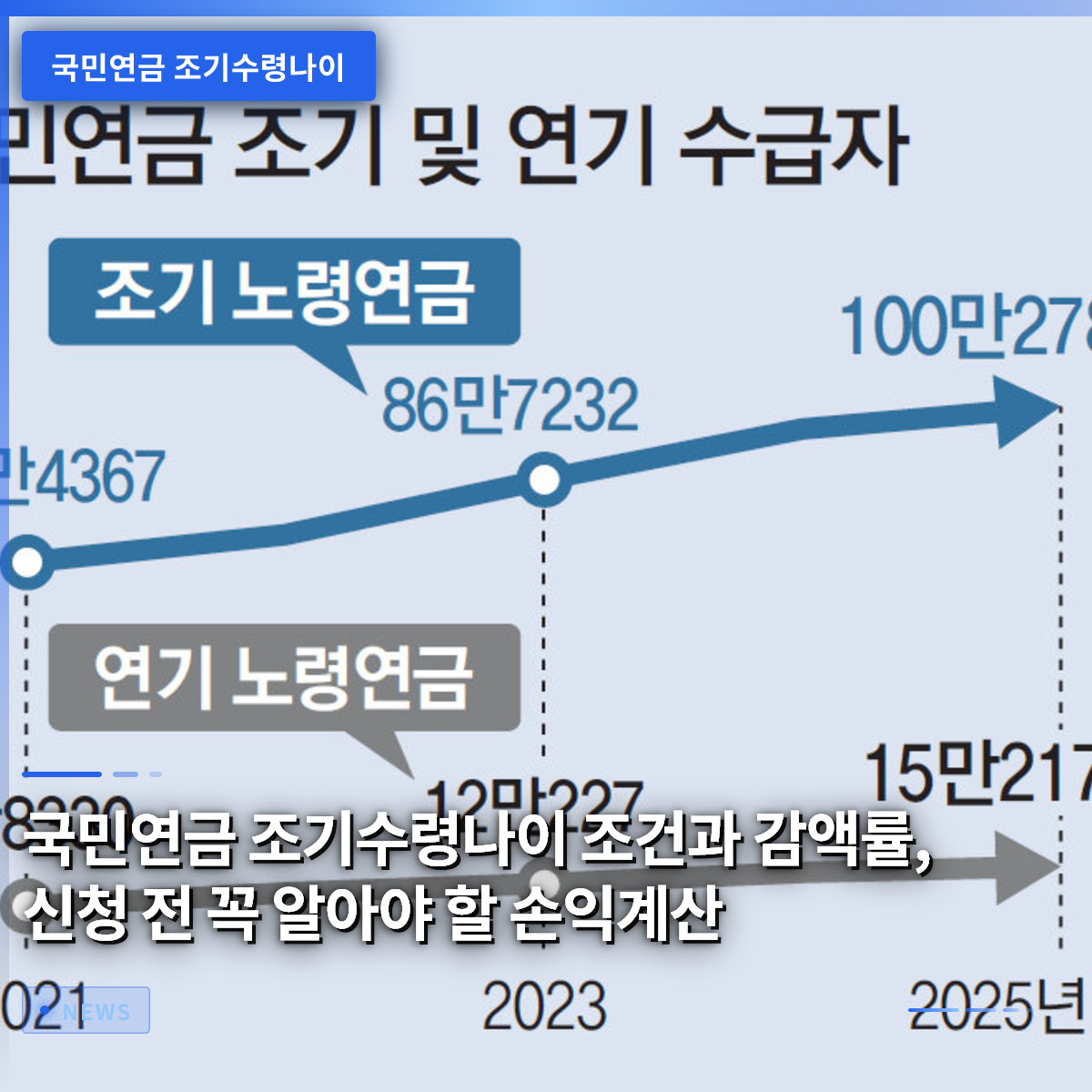
The age for early receipt of the National Pension allows you to start receiving benefits up to 5 years earlier than the standard eligibility age, but you must remember that the payment is permanently reduced by 6% for each year of early receipt. Recently, Mr. Oh, who recently retired at the mandatory retirement age, has been struggling with the decision of whether to bring forward his monthly pension payments to bridge the income gap caused by the sudden loss of his salary. With no reliable cash flow after leaving his job, he felt an urgent desire to secure income as soon as possible. However, after hearing from people around him that applying for early receipt without careful consideration could lead to lifelong regret, he has been unable to make a decision. It is essential to carefully calculate when receiving the pension is the most financially prudent way to minimize losses and prepare for old age. In this article, we will clearly explain the precise conditions for early old-age pension, the reduction rates, and the key factors you must consider before applying.
=
National Pension Early Receipt: Age Conditions, Reduction Rates, and the Profit/Loss Calculation You Must Know Before Applying
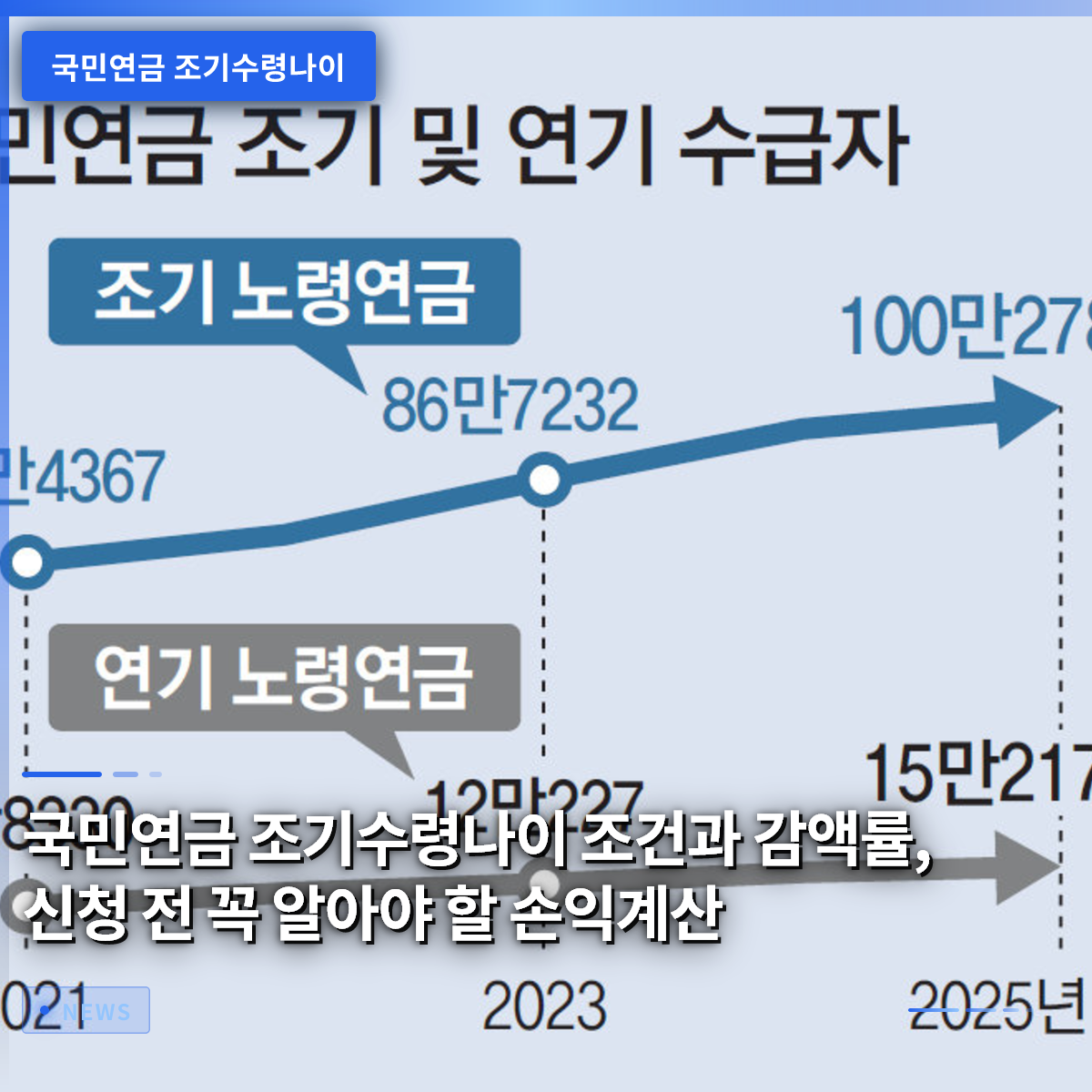
1. Basic Concepts of the Early Old-Age Pension System and the Condition for Up to 5 Years of Early Receipt

The National Pension’s early old-age pension system is a valuable provision that allows recipients to receive benefits up to 5 years earlier than the standard old-age pension eligibility age. It acts as a lifeline for retirees who have suddenly lost their jobs or faced business difficulties and are immediately short on living expenses. Since the standard eligibility age varies depending on the year of birth, the first step is to accurately confirm your specific eligibility age. For example, if your year of birth corresponds to a standard eligibility age of 65, choosing early receipt allows you to start receiving benefits at age 60. Since the government does not simply provide this benefit without conditions, thorough preliminary calculations are necessary. It is common to see people who hastily applied for early receipt to cover immediate living costs and later regretted it in their old age. For retirees who find it difficult to endure the income gap, the early receipt system may feel like the only escape route. However, to utilize this system, you must meet strict conditions, such as fulfilling a minimum enrollment period and having income below a certain threshold. Not everyone who reaches a certain age is eligible, so you should first check your enrollment history through the National Pension Service. Since the purpose of the system is to help those whose income has been cut off after retirement, carefully reviewing the eligibility requirements is essential to avoid financial hardship.
Early old-age pension can be received up to 5 years earlier than the standard eligibility age, but application is only possible if strict eligibility conditions are met.
2. The Severity of the 6% Annual Reduction and the Permanently Lasting Disadvantage

The most critical aspect to watch out for when receiving the National Pension early is the fact that the pension amount is reduced by 6% for each year of early receipt. If you choose to receive the pension for the maximum period of 5 years early, you will live the rest of your life with a payment that is reduced by a whopping 30% from the original amount. For instance, a person who could have received 1 million won would only receive 700,000 won, inevitably causing significant damage to their retirement lifestyle. Mr. Kim, a friend of Mr. Oh, applied for early pension five years ago without much thought; now, despite rising prices, he still receives the reduced amount and sighs daily. Once the pension amount is reduced, it is never restored to the original amount as you age, and it remains reduced until death. Aging with a fixed income that has been reduced and fails to keep up with inflation brings far greater economic pain than one might imagine. One must seriously consider whether permanently forfeiting 30% of the total pension amount to cover living expenses for the first five years of retirement is a wise choice. This decision can lead to damaging your future stable cash pipeline just to endure immediate financial hunger. Rather than applying under the influence of peer pressure or vague anxiety, you must calculate how much loss the reduced amount represents over the remainder of your life. When summed up over a lifetime, the reduced amount can amount to tens of millions of won, so this is by no means a trivial matter.
The pension is permanently reduced by 6% for each year of early receipt, resulting in a lifelong pension loss of up to 30%.
3. Variables and Countermeasures Regarding Income Gaps and Re-employment
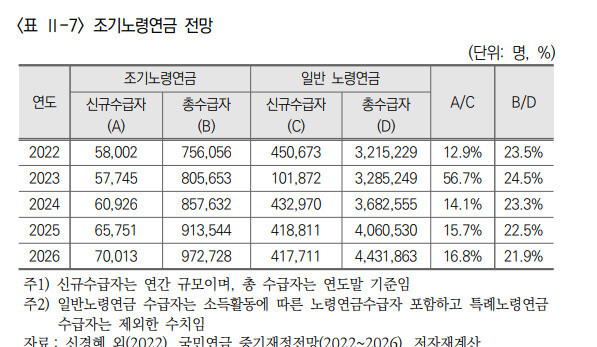
Many people are caught off guard by the long income gap of up to 5 years that occurs between retirement at age 60 and the National Pension eligibility age of 65. If there is no employment income or other revenue during this period, maintaining a livelihood can be daunting, leading many to seriously consider early receipt. However, you must be aware that if you re-enter the workforce and earn income while receiving the early old-age pension, the pension payment may be temporarily suspended. If income exceeds a certain threshold, all or part of the pension will not be paid, potentially placing you in an awkward situation. For example, if your average monthly income exceeds a specific benchmark, early pension payments will be suspended, so you must be particularly cautious if you are preparing to re-enter the workforce. Even if you take on government-supported senior jobs or short-term work to bridge the income gap, you must verify the criteria for pension reduction or payment suspension. If unexpected income arises after retirement and you fail to report it immediately to the National Pension Service, you may face the shock of a recovery action later. Therefore, it is essential to accurately record your bank balance at the time of retirement and any expected side income to map out your overall cash flow. Rather than applying simply because you have reached a certain age, you must comprehensively assess your current economic situation and potential for employment.
If income exceeds a certain level during early receipt, pension payments may be suspended, so re-employment plans must be considered together.
4. The Break-Even Point for Early National Pension Receipt and How to Calculate It
The criterion for determining whether early receipt is financially advantageous or if waiting for standard receipt is more beneficial is the break-even point. You must compare receiving a pension reduced by 30% starting 5 years early versus receiving the full, unreduced pension 5 years later. Generally, calculations show that the point where the total amount accumulated from early receipt is overtaken by the higher payments from delayed receipt is typically in the mid-to-late 70s. If you are in good health and confident in your longevity, receiving the full amount later is clearly more advantageous in the long run. Conversely, if you are unsure about your health or are struggling to make ends meet day by day, securing cash through early receipt becomes a realistic alternative. You should not compare your circumstances or health status with others but make judgments based solely on your own physical age and life expectancy. By using the estimated pension amount inquiry services provided by financial institutions or the National Pension Service website, you can directly see the specific numbers. Only after clearly confirming the numbers will you realize, with a sense of clarity, when receiving the pension minimizes your losses. Making a decision based on vague fear versus making a choice based on accurate profit and loss calculations can completely change the quality of your life in old age.
You should calculate the break-even point based on health status and life expectancy to weigh the pros and cons of receiving the pension early versus later.
5. Maintaining Health Insurance Dependent Status and Its Relationship with Pension Income
An important point that is easily overlooked when receiving the National Pension early is the issue of maintaining health insurance dependent status. A person who was registered as a dependent of a working child and did not pay health insurance premiums may lose this status upon starting to receive a pension. The moment your total income, including pension income, exceeds a certain threshold, you will be converted to a regional subscriber and must pay a significant amount in health insurance premiums every month. While the monthly pension amount received through early receipt may increase, if new health insurance premiums are imposed as a result, the actual amount of money you take home may decrease. There are many cases where, in an effort not to burden their children, retirees inadvertently lose their dependent status, creating a large hole in the household budget. Therefore, before applying for early receipt of the National Pension, you must carefully check the health insurance premium assessment criteria for your household. Since dependent status is determined based on income amount, you should run simulations in advance through tax experts or consultations with the National Pension Service. You must not just look at the number hitting your pension account but calculate the actual take-home amount considering all tax and health insurance expenses. Wise retirement planning is a comprehensive art that involves not only increasing income but also protecting against expenses.
If total income increases due to pension receipt, you may lose health insurance dependent status, so you must calculate your actual income.
6. The Path to Preventing Hasty Applications and Completing a Stable Retirement Plan
The age for early receipt of the National Pension and the reduction system are a double-edged sword; for some, it is a lifeline, while for others, it becomes a lifelong regret. Receiving the pension early without any preparation just because you fear the immediate income gap can lead to significant hardship in the later stages of old age. Considering future economic trends and inflation rates, living on a permanently reduced pension may be much more difficult than one might think. It is far wiser to utilize various asset allocation strategies, such as creating employment income through re-employment or utilizing retirement pensions and personal pensions. You must structure your portfolio based on the actual timing of fund usage, not just age, to endure the 100-year era peacefully. You must absolutely avoid the foolish choice of mortgaging your future financial security just because your wallet is empty right now. We recommend completing an accurate estimated receipt inquiry through the National Pension Service, consulting sufficiently with your family, and making a careful decision. Retirement is not an end but a starting point for a new life, so you should set aside your impatience and calmly build your own pension pipeline. Starting today, please re-check your enrollment period and estimated receipt amount to find the most advantageous timing for receipt.
You should discard impatience and combine various pension means with asset allocation to complete a stable retirement plan.
Frequently Asked Questions
=