Personal pension savings are the most reliable financial tool for supporting a stable life after retirement and an essential financial product for reducing tax burdens. Even if you struggle to save a lump sum in your early career due to student loan repayments, preparing a pension account early is crucial to securing comfortable assets at retirement. Many people wonder where to allocate their holiday bonuses or surplus funds, but from a long-term perspective, contributing to a pension account is the wisest choice. By actively utilizing the various tax benefits provided by the government, you can get a portion of your valuable income tax back while growing your future assets. In this article, we will thoroughly examine the specific tax deduction limits for personal pension savings, product comparisons, and practical enrollment strategies. The small habit of saving that you start today will completely transform the quality of your life in your senior years.
=
A Complete Guide to Personal Pension Savings Tax Deduction Limits and Secure Retirement Planning
1. What is Personal Pension Savings?
Personal pension savings is a voluntary savings system introduced by the government to ensure a stable life in old age for its citizens. It serves as the final pillar of the three-tier safety net, supporting the National Pension and retirement pensions that we are familiar with. Even if you work diligently every month while employed, living expenses often fall short of expectations when retirement arrives. To solve this problem, individuals open accounts through banks, securities firms, or insurance companies and accumulate funds on their own. In particular, this product is highly popular because it offers substantial tax reduction benefits on annual contributions, going beyond simple savings.
In your younger years, it is easy to postpone retirement savings because immediate needs like buying a house or funding a marriage take priority. However, the power of compound interest creates significant differences over time, so starting as early as possible is advantageous. Looking around, you can easily see retirees sighing over insufficient assets at retirement after struggling to pay off student loans in their 20s. On the other hand, those who have steadily built their portfolios through personal pension savings enjoy economic freedom and a leisurely life even after retirement. Therefore, rather than thinking it is too late, you need to take the initiative to check your pension account in your name right now.
Personal pension savings is an essential asset management account that allows you to prepare for retirement while enjoying tax reduction benefits.
2. Tax Deduction Limits and Tax-Saving Effects
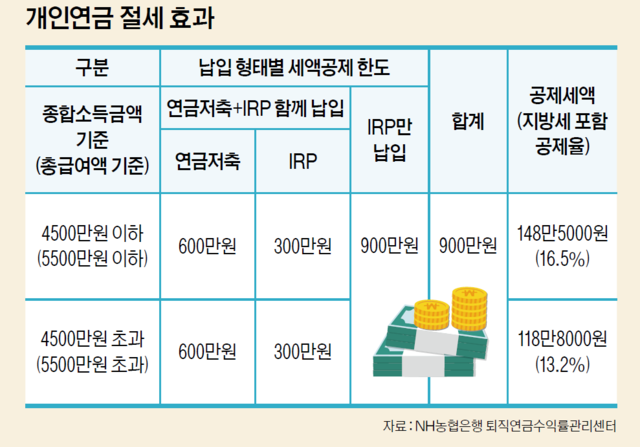
The most attractive feature of using a pension savings account is undoubtedly the tax deduction benefit you can receive during the year-end tax settlement. According to current laws, the annual contribution limit for tax-deductible pension savings is set at a maximum of 9 million won. Depending on your annual total salary or comprehensive income, you can benefit from a high deduction rate ranging from 13.2% to 16.5%. For example, if you max out the annual limit of 9 million won and qualify for the 16.5% deduction rate, you will receive a tax refund of over 1.48 million won.
This tax refund is not just free money; it is a magical resource that can be reinvested to maximize the effect of compound interest. Since it amounts to receiving over 130,000 won consistently every month, it is considered the ultimate year-end tax settlement cheat code among office workers. If you find it burdensome to fill the 9 million won limit with pension savings alone, you can also utilize an Individual Retirement Pension (IRP) account to cover the shortfall. People who used to sigh every year-end tax season often smile while checking their refund accounts after effectively utilizing pension accounts. Therefore, you must accurately understand your income bracket and set appropriate monthly contributions to maximize tax benefits.
You can receive a tax deduction of up to 16.5% within the annual contribution limit of 9 million won, allowing you to get back your valuable taxes.
3. Differences Between Pension Savings and IRP
When preparing for retirement, pension savings and Individual Retirement Pension (IRP) accounts are always mentioned together, so it is important to clearly understand the differences between them. Pension savings is divided into pension savings trusts at banks, pension savings insurance at insurance companies, and pension savings funds at securities firms. Among these, many investors recently prefer pension savings funds at securities firms because they allow direct investment in stocks or Exchange-Traded Funds (ETFs) to grow assets. In contrast, an IRP account has the nature of a comprehensive retirement account where employees can receive severance pay or voluntarily make additional contributions.
While both accounts offer tax deduction benefits, there are slight differences in investment autonomy and safety regulations. With a pension savings account, you can freely invest the entire 9 million won contribution limit in equity assets or various ETFs. However, an IRP account requires a mandatory allocation of at least 30% in safe assets, which may feel restrictive depending on your investment style. For early-career professionals or investors seeking aggressive asset growth, it is advantageous to first max out the pension savings fund limit and then utilize the IRP when there is extra room. You need the wisdom to carefully consider your investment style and asset size to adjust the ratio between the two accounts.
Pension savings offers high autonomy in asset management, while IRP has a mandatory safe asset ratio, so you should choose based on your personal preference.
4. Asset Growth Using Exchange-Traded Funds (ETFs)
If you have opened a personal pension savings account at a securities firm, you now need to consider which products to invest in. In the past, people often simply deposited money in bank savings or insurance products, earning low interest that could not even keep up with inflation. However, recently, it is possible to directly invest in domestic and international equity ETFs or bond products within the account, significantly broadening the scope for asset growth. For example, long-term systematic investing in ETFs tracking major US indices or dividend growth products can yield enormous synergistic effects.
Experts also actively recommend index-based products with low volatility and long-term upward trends over individual stocks when constructing a retirement asset portfolio. If you set up automatic purchases of ETFs for a fixed amount on your payday, you can naturally achieve the effect of buying at lower prices even during market downturns. When stock prices fall, you accumulate more units, and when they rise, your asset valuation grows, making the investment psychologically very stable. In the marathon toward the distant future of retirement, this automated investment system serves as a sturdy shield that protects your mental stability.
By utilizing ETFs within your pension savings account for long-term systematic investing, you can achieve asset growth that outpaces inflation.
5. Risks of Early Termination and How to Handle Them
As the name suggests, personal pension savings is a long-term product for saving money to use after retirement, so terminating it midway requires accepting significant losses. If you choose to terminate early due to a sudden need for a large sum of money or financial hardship, you must return all the tax deduction benefits you have received so far. Furthermore, a tax of 16.5% is imposed on investment returns as miscellaneous income tax, which can even result in a loss of principal. In reality, many young people regret breaking their hard-earned pension accounts because they urgently needed cash and later deeply regret their decision.
If you inevitably need emergency funds, rather than terminating the account immediately, you should consider taking out a loan secured by the account or checking if you qualify for exceptional withdrawal reasons allowed by law. In special situations such as purchasing a home or paying a deposit as a non-homeowner, or long-term medical treatment for yourself or a family member, there are ways to secure funds while minimizing penalties. Therefore, you should manage an emergency fund account completely separately and maintain the mindset that money in your pension account is a final treasure that you must never touch during your lifetime. Never forget that the success of long-term investing depends on not wavering in the middle and finishing the race to the end.
Early termination may result in returning received tax deductions and facing a miscellaneous income tax bomb, so it must be managed separately from your emergency fund.
6. Smart Enrollment Strategies to Change Your Retirement
To complete a successful retirement life, it is essential to first check your current financial situation and set a practical savings plan. Start by reducing your consumption from your monthly salary and setting up automatic transfers to your pension account. You need the wisdom to utilize holiday bonuses or unexpected dormant deposits as additional pension savings contributions rather than spending them on entertainment. Over time, small amounts will accumulate to form a mountain of assets, which will completely wash away the economic anxiety of your senior years.
As aging society deepens, the value of self-prepared retirement assets will become as precious as gold. While others rejoice and grieve over short-term fluctuations in the stock market, those who quietly fill their pension accounts will eventually take the winner’s seat. I recommend that, taking this article as an opportunity, you open your smartphone banking app to check the status of your pension account and your contribution limits. The small step you take today is the most certain investment that will completely change your bank balance and smile ten or twenty years from now.
Setting up automatic transfers and additional contribution plans immediately and practicing them consistently is the only shortcut to a prosperous retirement.
Frequently Asked Questions
=