The method of receiving your retirement pension is more than just a procedure for collecting money; it is a critical factor that determines the success or failure of your post-retirement assets. Upon leaving a job, companies are legally obligated to transfer employees’ severance pay into an Individual Retirement Pension (IRP) account. Many people regret making a tax bomb by either withdrawing the entire lump sum immediately after resignation or simply leaving it untouched without a plan. Consequently, the tax burden differs significantly depending on whether you receive the funds as a lump sum or split them into monthly annuity payments after the age of 55. To build a robust and controllable pipeline for your retirement income, in addition to the National Pension and Basic Pension, you must carefully compare the different payout methods now. Let’s go through step by step how you should withdraw your funds to ensure a stable living expense after retirement.
=
A Complete Guide to Receiving Your Retirement Pension: Tax Differences Between Lump-Sum and Annuity Payouts from IRP Accounts
1. Understanding the Basic Structure of Retirement Pension Payouts
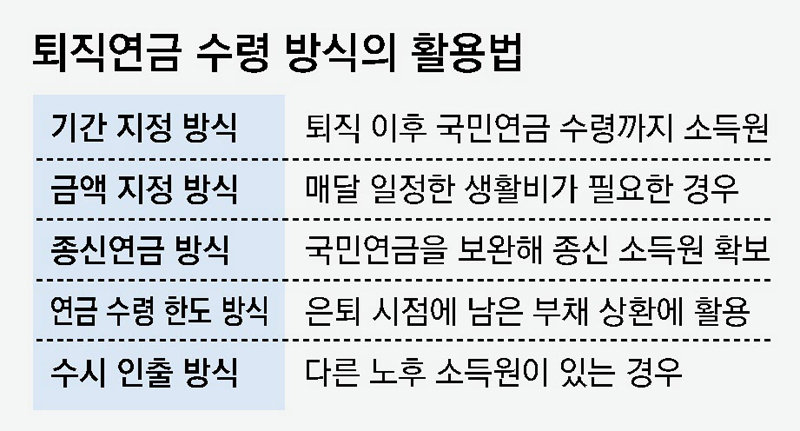
When you leave your company, the valuable retirement benefits you have accumulated do not go directly into your personal bank account. By law, the principle is that these funds must first be deposited into an Individual Retirement Pension (IRP) account in the employee’s name. This allows you to enjoy the benefit of tax deferral, meaning you can postpone paying taxes until later, whether you change jobs or retire. If you try to withdraw the cash immediately without going through this account, you will have to pay a substantial amount of retirement income tax all at once, resulting in a significant loss. Therefore, it is advantageous to leave the funds in the account and not rush to terminate it once they arrive. You should make it a habit to verify through your financial institution’s app or branch that your assets have been safely transferred.
Payment schedules can vary depending on the type of products being managed, so you must always consult with the relevant financial institution in advance. The speed at which funds are cashed out differs depending on whether you were investing in deposits, equity products, or other instruments. If you urgently need funds before a holiday or long weekend, you should calculate this time lag in advance to avoid panic. Retirement asset planning can lead to significant losses with just one moment of negligence, so you must approach it with caution. It is wise to frequently check the status of your account and formulate an appropriate strategy aligned with your retirement timeline.
Severance pay must be transferred to an Individual Retirement Pension (IRP) account first to fully enjoy tax benefits.
2. Criteria for Choosing Between Lump-Sum and Annuity Payouts
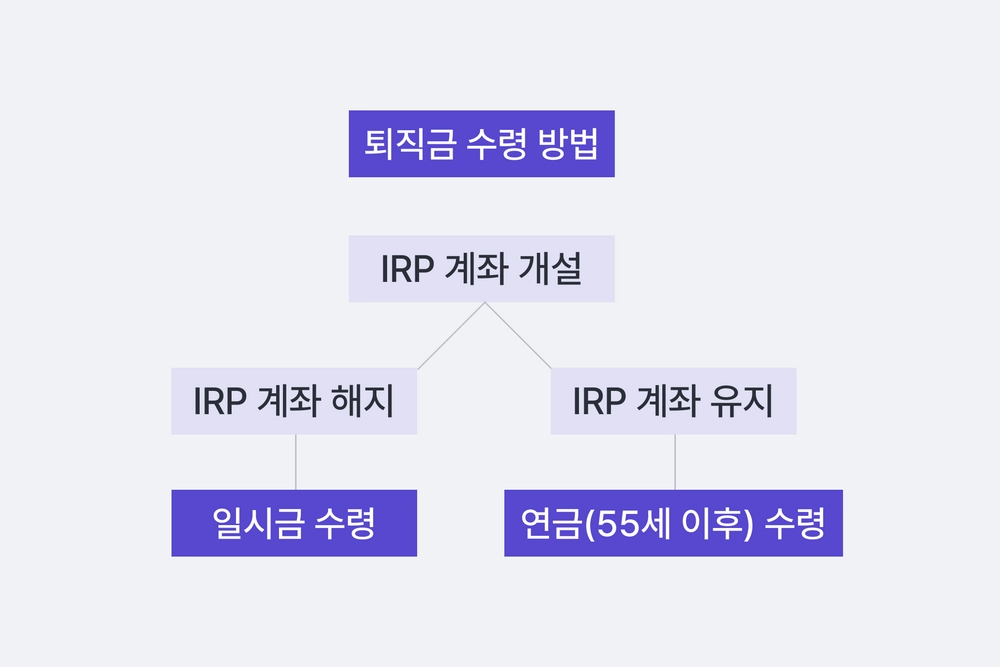
Deciding whether to withdraw your funds as a single lump sum or receive them as an annuity over several years is a critical fork in the road for retirement planning. Receiving a lump sum puts a large amount of money in your hands immediately, which can be used effectively for buying a house or paying off debts. However, when a large sum hits your account at once, retirement income tax is applied, potentially leaving you with less than you might expect. On the other hand, if you choose to receive the funds as an annuity after the age of 55, the government provides significant tax reductions. This creates a steady monthly pipeline for living expenses, making it much more advantageous for preserving your assets over the long term.
Looking at the experiences of colleagues, it is common to see people who received a lump sum and spent it all on a new car or entertainment, only to struggle in their old age. Conversely, friends who chose annuity payouts, creating a fixed monthly cash flow and saving on taxes, enjoy a much more comfortable life. It is advisable to carefully calculate your expected monthly living expenses after retirement and only take out an annuity for the shortfall. You must remember that restraining the urge to spend money all at once can completely change the quality of your retirement. You should assess your spending habits and future expenditure plans to choose the most suitable method.
Choosing annuity payouts after age 55 allows you to save significantly on taxes and secure a stable source of living expenses.
3. A Perfect Comparison of Tax Differences: Retirement Income Tax vs. Pension Income Tax

The method of receiving your retirement pension completely changes how taxes are calculated, so understanding this accurately is essential. When receiving a lump sum, you must pay retirement income tax on the entire accumulated severance pay. While the tax deduction benefit increases with longer years of service, the tax burden can feel heavy because it is applied to the entire lump sum at once. In contrast, if you receive the funds over 10 years or more through a pension account, you are subject to pension income tax, which has a relatively lower tax rate than retirement income tax. The tax reduction benefit can reach 30% to 40%, providing enormous tax-saving effects in the long run.
It is easy to hear laments from people who withdrew tens of millions of won in severance pay as a lump sum and had hundreds of thousands of won deducted as taxes. However, if they had converted this into an annuity and received it in monthly installments, they would have paid much less in taxes, and the remaining money could have continued to grow. Since tax laws change frequently, it is safe to check the latest standards, and seeking advice from experts is also a good approach. As the saying goes, “tax savings are profits,” saving on taxes is the most reliable shortcut to protecting your retirement assets. Small differences can create huge asset gaps years later, so you must carefully examine the tax structure.
Receiving funds as an annuity applies pension income tax, which is lower than retirement income tax, allowing for significant tax savings.
4. Application Procedures by Financial Institution: Hana Bank, KEB Hana Bank, etc.
To receive your retirement pension, you must use the app of your bank or securities firm or visit a branch in person. Using the mobile apps of major commercial banks like Hana Bank or KEB Hana Bank allows you to apply comfortably from home. For example, by logging into an app like Hana One and navigating to the retirement pension menu, you can check your accumulated balance at a glance. Following the on-screen instructions, you select whether you want a lump-sum or annuity payout, complete identity verification, and the process is finished simply. If you are not comfortable using mobile devices, you can visit a nearby branch with your ID and receive guidance from a staff member.
Mr. Kim, who visited a bank branch, carefully designed how to split his DC-type retirement pension assets through a consultation with a staff member. Thanks to the staff member’s kind explanations of unclear parts, he was able to complete the complex paperwork safely. After completing the application, he sighed in relief seeing the money deposited into his designated account within a few business days. If you confirm by phone in advance what documents are required, you can handle everything in one visit without having to make a second trip. Utilizing additional asset management programs or premium services offered by each financial institution can also be very helpful.
You can easily apply for a payout method suitable for your situation through mobile apps or bank branches.
5. Utilizing IRP Accounts and Precautions
The Individual Retirement Pension (IRP) account is more than just a container for severance pay; it is a powerful tool for growing your retirement assets. In addition to the funds received upon leaving a job, you can make additional contributions with your own spare funds to enjoy tax deduction benefits. Since you can get a tax refund during the annual tax settlement period, it is considered an essential financial management tool for employees. However, if you are forced to terminate the account midway before the age of 55, you must return all the tax benefits you have received. A heavy penalty in the form of miscellaneous income tax is applied, so it is an iron rule not to break the account unless it is a truly emergency situation.
I have seen people around me who terminated their retirement pension accounts because they suddenly needed a large sum of money, only to hit a tax bomb and regret it bitterly. You should avoid early withdrawal unless it falls under exceptional circumstances defined by law, such as purchasing a home for a non-homeowner, bankruptcy, or natural disasters. Assets grow with the effect of compound interest the longer they are left alone, so hasty termination is the main culprit that makes retirement insecure. Therefore, you need the wisdom to maintain the account and withdraw only the necessary portion in the form of an annuity. You must build a strong, self-controlled pipeline to ensure your life after retirement remains stable.
Midway termination before age 55 invites a heavy tax bomb, so it should be maintained unless it is an exceptional situation.
6. Completing a Pension Pipeline for a Successful Retirement
To live a comfortable and abundant life after retirement, you must bundle the National Pension, retirement pension, and personal pension together. Only by layering your self-prepared retirement pension and private pension on top of the public pension guaranteed by the state is the “three-tier pension” completed. You need a fixed income hitting your account every month to keep your cash flow smooth and maintain peace of mind. You must not be distracted by the lump sum right in front of you; instead, you should exercise the wisdom to look long-term to avoid economic difficulties in old age. As the financial environment becomes increasingly complex, only continuous learning and interest serve as a shield to protect your assets.
I recommend that you immediately calculate your expected retirement date and check how much you have currently accumulated. Turn on your mobile app, check your expected payout amount, and run a simulation to see how you would like to receive it. Small acts of interest and action accumulate to create the biggest difference in the quality of your life in old age. If you make a careful plan based on what you have learned today, anyone can welcome a stable retirement that others would envy. Do not delay any longer; start managing and checking your valuable pension assets directly from today.
The key to a successful retirement is harmoniously combining the three types of pensions to create a stable cash flow.
Frequently Asked Questions
=