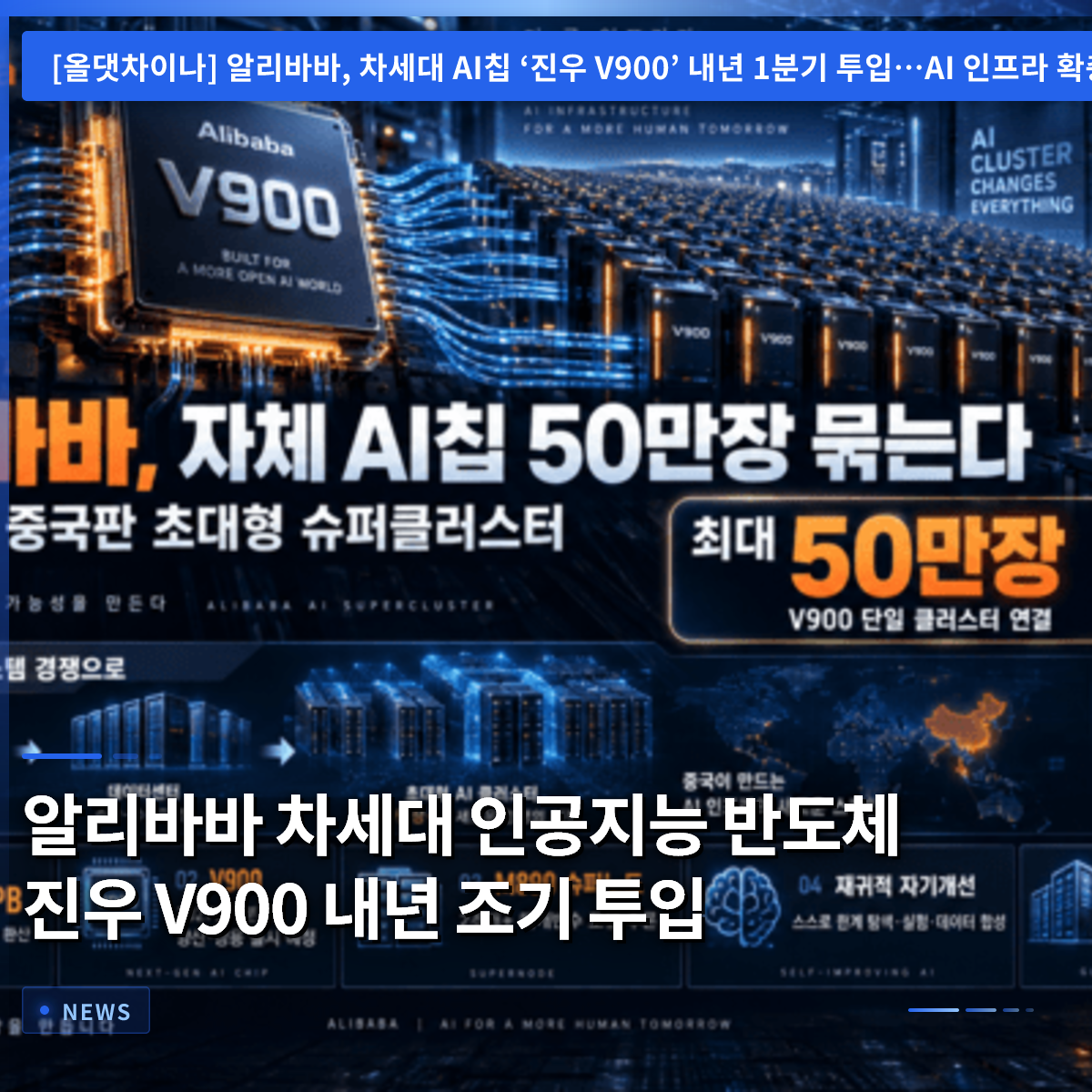
Alibaba, China’s largest e-commerce giant, has decided to accelerate the deployment of its next-generation semiconductor, the Zhenwu V900, to swiftly address the exploding demand for AI computing power. At a major developer conference in Hangzhou, the company’s CEO announced that the advanced chip will be put into practical use in Q1 2027, roughly six months ahead of the original schedule. As the global shortage of computing power for machine learning and training ultra-large models intensifies, the move to bolster in-house hardware capabilities is particularly noteworthy. Behind the intelligent assistants and translation tools we use daily, massive computing facilities operate non-stop, making semiconductor performance improvements an urgent priority. This strategic shift aims to closely chase competitor Huawei while further solidifying Alibaba’s proprietary ecosystem. If this semiconductor is successfully supplied to the market, it is expected to bring significant changes to the pace of technological development across the entire industry. In this article, we will explore Alibaba’s plans for expanding its AI infrastructure and the key features of the new semiconductor.
=
Alibaba Accelerates Deployment of Next-Gen AI Semiconductor Zhenwu V900 to Early Next Year
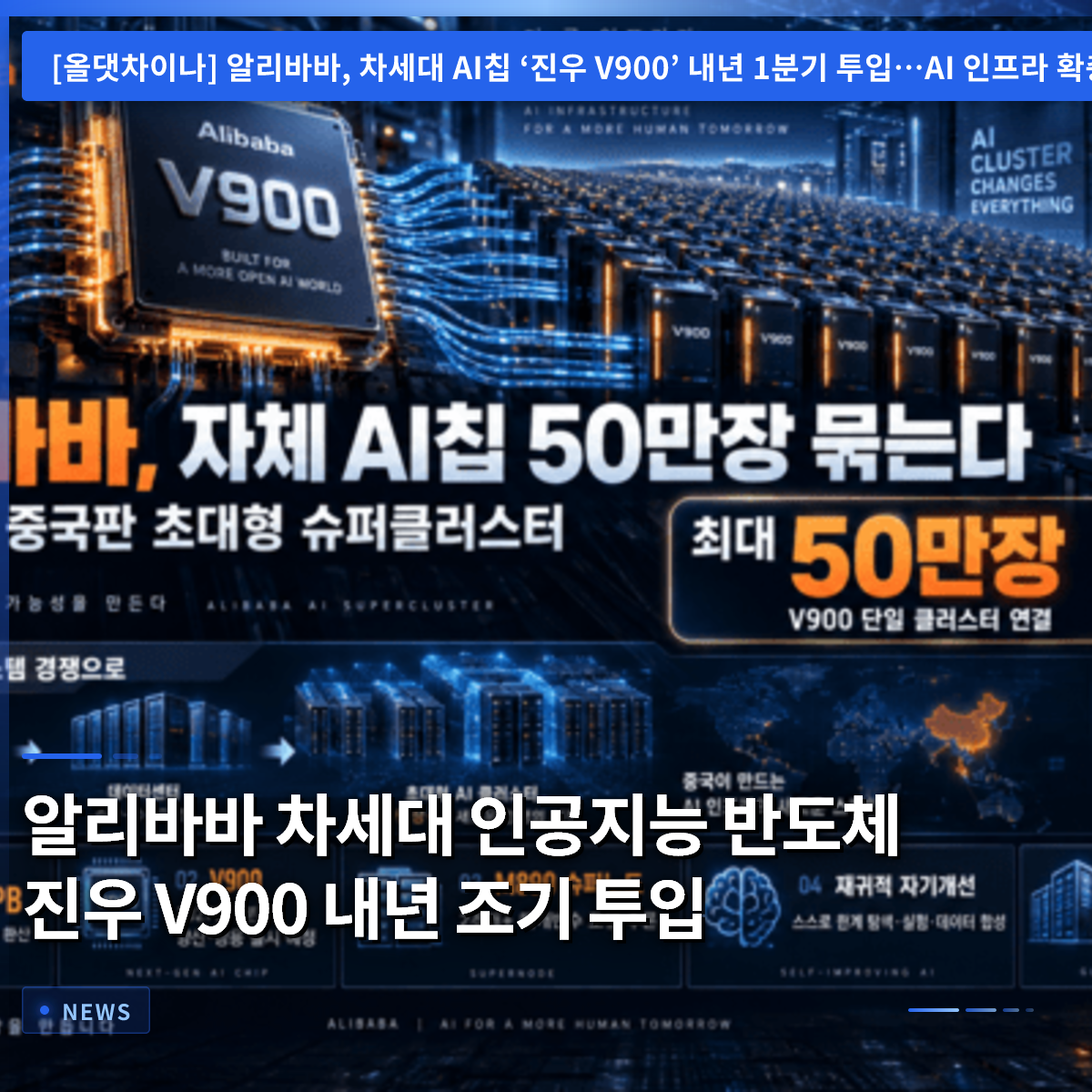
1. Background and Significance of the Early Zhenwu V900 Deployment
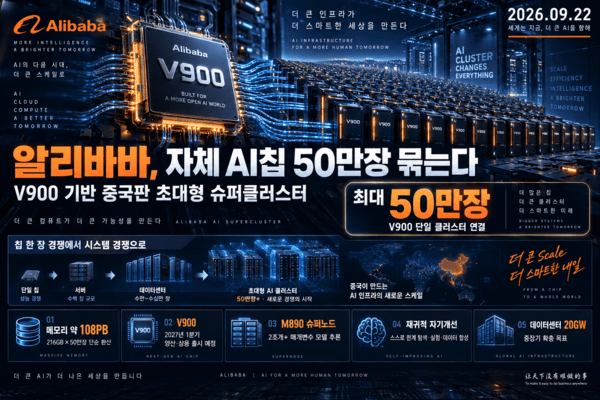
The primary reason for Alibaba accelerating the launch of its next-generation AI semiconductor, the Zhenwu V900, is the unprecedented surge in on-site computing demand. During a keynote speech, the CEO emphasized that customer demand for intelligent technologies is rising daily, making the stable supply of computing power the most urgent priority. Training state-of-the-art models requires linking numerous semiconductors into a massive cluster, a task that existing equipment cannot handle alone. To solve this, Pingtouge, Alibaba’s semiconductor development arm, has focused its resources to deliver a new product with maximized performance on schedule. The fact that processing capabilities have improved by more than three times compared to the previously top-performing product is creating significant ripples in the market. By rushing the finished product to the field, Alibaba aims to narrow the technological gap with competitors and secure a leading position. Readers will soon experience a dramatic increase in processing speeds when using intelligent features on their smartphones or computers. The new semiconductor boasts remarkable scalability, capable of connecting up to 500,000 chips to build a massive computing network. This technological leap is not just about speed; it serves as a decisive catalyst for elevating the pace at which AI learns and evolves.
Alibaba is moving up the deployment of its next-generation semiconductor, the Zhenwu V900, by six months to Q1 next year to meet the surging demand for intelligent computing.
2. Massive Expansion of Power Capacity and Infrastructure Investment
Alibaba is not just developing a semiconductor; it has unveiled an ambitious blueprint to significantly increase the power capacity of its global data centers to over 20 gigawatts by 2032. One gigawatt equals one billion watts, representing an astronomical scale that is ten times larger than a few years ago. Since large-scale computing equipment requires massive power supply and efficient thermal management, the company is staking its future on infrastructure construction. The CEO repeatedly expressed the will to invest heavily in preparation for an explosive increase in semiconductor shipments in the coming years. The plan to pour over 70 trillion won (approximately $50 billion USD) into intelligent hardware and infrastructure expansion over the next three years has stunned industry insiders. It is expected to become a common sight for data centers the size of large buildings to spring up across cities, constantly consuming power. The reason we can casually use intelligent services in our daily lives is due to this massive, invisible energy investment. This infrastructure expansion poses challenges beyond just installing more machines, including building stable power grids and utilizing eco-friendly energy. Alibaba is concurrently researching ways to maximize computing efficiency relative to power consumption through its own highly efficient design methods.
Alibaba plans to expand global data center power capacity to 20 gigawatts by 2032 and invest over 70 trillion won in infrastructure over the next three years.
3. Synergy with the Qwen Model and Building a Proprietary Ecosystem
Beyond semiconductor manufacturing, Alibaba is building a comprehensive ecosystem that directly oversees everything from its proprietary AI model, the Qwen series, to the various applications that utilize it. The company is accelerating the development of next-generation large models with parameters ranging from trillions to quadrillions, which are expected to be completed soon. As the number of parameters increases, machines can think more precisely and understand human language with near-perfect accuracy, playing a crucial role in enhancing technical completeness. High-performance models already on the market have proven their excellence, and subsequent versions are expected to be even more evolved. The semiconductor, the model, and the cloud computing service that hosts them form a trinity, achieving a perfect organic integration. The ability to handle all stages with in-house capabilities, without relying on external technologies, is a massive weapon for the company and enables sustainable growth. Readers will soon encounter more natural and intelligent chatbots and creative tools across various platforms. Because the in-house developed semiconductor is designed to work optimally with its dedicated model, it delivers faster processing speeds and dramatically reduced costs. This integrated strategy is likely to serve as a major benchmark for the business directions of other large enterprises in the future.
Alibaba is building a complete proprietary ecosystem covering everything from design to application by combining its semiconductors with its in-house AI model, Qwen.
4. Cloud as a Massive Power Grid and the Path to Superintelligence
In his speech, the CEO compared the semiconductors that inject computing power into machine intelligence and the clouds that house them to a massive power grid, emphasizing their importance. The path for AI to ultimately surpass humans and reach Artificial General Intelligence (AGI) is becoming increasingly clear, and Alibaba aims to play a pivotal role in this journey. The reason the company has designated the realization of AGI as its top development priority and is concentrating all resources on it is to lead this massive future change. The time is rapidly approaching when a massive web of combined hardware and software will connect the world and completely transform our way of life. A world where you control all home appliances with a flick of a finger and machines handle complex tasks is no longer just science fiction. In this great transition, the competition among companies to secure infrastructure will have a profound impact on our daily lives. Readers should pay attention to both the convenience technology brings and the accompanying social changes. As machines’ abilities to learn and judge autonomously advance, the relationship between humans and technology will become even closer, with cloud networks serving as a sturdy backbone at the center. Alibaba’s bold investment clearly shows that this future vision is moving from mere slogan to reality.
Alibaba is accelerating the era of AGI by treating semiconductors as the source of computation and the cloud as a massive power grid.
5. Fierce Competition with Huawei and Market Impact
Alibaba’s aggressive pursuit of Huawei, which leads the intelligent semiconductor market in China, is injecting tension into the entire industry. The decision to move up the deployment of the next-generation chip by half a year is a strong warning to competitors and an expression of will to seize market leadership. Once the new product, with three times the performance, is fully shipped, many companies that have struggled with performance limits are likely to flock to Alibaba’s ecosystem. With the company also steadily preparing follow-up products in the CPU field, the battle between these two giants is expected to become even more intense. This competition paradoxically acts as a catalyst that explosively accelerates the evolution of related technologies, ultimately benefiting consumers with better services. Readers can find it interesting to observe how domestic and other nearby companies are finding breakthroughs amidst these global changes. The struggle for survival in this full-scale war of massive capital will continue. The rivalry between the two companies to increase market dominance goes beyond a sales competition, touching on the battle for technological hegemony between nations, drawing global attention. Industry experts are pouring out analyses on what results Alibaba’s bold move will yield.
In the fierce battle for the lead against Huawei, Alibaba is aiming to solidify its market dominance through the early deployment of its next-generation semiconductor.
6. Future Outlook and Implications
Alibaba’s massive infrastructure investment and strategy for early semiconductor practicalization carry powerful impact capable of shaking the landscape of the global AI industry. No matter how much we emphasize the importance of hardware supporting technological advancement, it is never an overstatement; this case proves that truth once again. Behind the convenient intelligent services we enjoy lie invisible massive factories and the sweat and tears of countless technicians. In the coming years, the boundary between hardware and software will become increasingly blurred, and we will face a massive wave of all industries being restructured around intelligence. If readers keep a close eye on these technological trends, they will be able to actively adapt to the coming future society. While the speed of change may be daunting, it is time to find the wisdom to discover new opportunities within it. Let us all watch with interest how the massive future map Alibaba is drawing will ultimately take shape. Continuous investment and technological development will undoubtedly act as magical tools that make our lives more convenient and abundant. We conclude today’s story with anticipation for the changes of tomorrow.
Alibaba’s aggressive infrastructure expansion and semiconductor development are triggering massive changes across the global technology ecosystem.
Frequently Asked Questions
=