
Due to the ripple effects of consecutive base rate hikes this year, businesses and households are facing immense difficulties in repaying their debts, prompting warnings that a full-blown delinquency rate bomb could explode starting next spring. In fact, the proportion of so-called “zombie companies”—enterprises that cannot even cover their loan interest with their operating income—has surged to an all-time high, casting a dark cloud over the entire economy. In a structure where every rate hike adds trillions of won to interest burdens, not only businesses but also household debt is reaching its limits. In this situation, anxiety in the financial market has peaked, making proactive risk management by the government and financial authorities more urgent than ever. Let us carefully examine the warning signals currently indicated by economic metrics to see how our economy can navigate this high-interest wave.
=
Analysis of Record-High Crisis: Zombified Companies Unable to Pay Interest Amid High-Interest Cold Snap

1. Soaring Base Rate and the Approaching Delinquency Rate Bomb

The consecutive base rate hikes this summer have further tightened the noose around already struggling businesses and households. According to Bank of Korea analysis, the delinquency rate for principal and interest among small and medium-sized enterprises (SMEs) and vulnerable groups tends to rise sharply approximately nine months after a rate hike. In other words, the true impact of the summer rate hikes is expected to fully manifest around April and May next year.
In reality, when speaking with self-employed individuals or SME representatives, it is common to hear that while their operating profits have hit rock bottom, they are losing sleep over the monthly interest payments. It is estimated that for every 0.25 percentage point increase in interest rates, households and businesses face an additional interest burden of 7 trillion won, making the shockwave easy to imagine.
The impact of base rate hikes is typically reflected nine months later, posing a high risk of a sharp surge in delinquency rates starting next spring.
2. Zombified Companies Hit Record-High Proportion

Among all domestic companies subject to external audits, the proportion of zombie companies that cannot cover their interest costs with operating profits has reached 19.1%. This is the highest figure since related statistics began to be compiled, meaning that one in five companies is essentially surviving on debt. The smaller the company, the more fatal this financial blow becomes, threatening the survival of SMEs.
With interest rates rising twice over the summer and fall, the interest burden has snowballed, and the situation is further complicated by the possibility of additional hikes. SMEs are lining up to seek loans from second-tier financial institutions or emergency lenders, as issuing corporate bonds is out of the question.
19.1% of externally audited companies have fallen into the zombie category, marking a record high.
3. A Vicious Cycle Leading to Investment Contraction and Economic Downturn
When interest rates remain high, companies are forced to cancel or significantly scale back investments aimed at creating new growth drivers. By cutting R&D costs and freezing hiring, corporate health weakens, ultimately leading to a broader economic downturn.
As noted by Professor Kim Jung-sik, an emeritus professor of economics at Yonsei University, soaring interest burdens are not just a financial risk for individual companies but a primary culprit draining vitality from the entire South Korean economy. Since few executives can make bold investments for the future when their immediate survival is at stake, the economy’s potential growth rate is being eroded.
Investment contraction caused by high interest rates returns as a massive boomerang in the form of long-term economic stagnation.
4. Household Debt Exceeds Danger Levels; Vulnerable Groups Hit the Limit
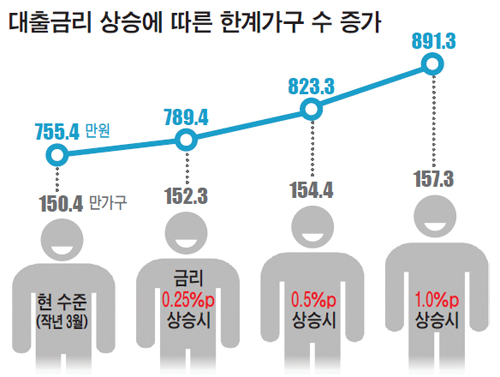
Not only businesses but also the weight of debt borne by ordinary households has reached a critical point that cannot be ignored. As loan interest rates continue to rise, the delinquency rate for principal and interest among vulnerable borrowers with low income or credit scores has already exceeded 10%.
Demand for home purchases, driven by expectations of rising housing prices, has not easily subsided, causing household loan balances at major commercial banks to already exceed annual targets. Although authorities are tightening the reins on management, concerns over household debt defaults are growing daily as more households fall into a vicious cycle of borrowing to repay debt.
Amidst an unbroken increase in household loans, the delinquency rate among vulnerable groups has already reached double digits.
5. Financial Instability Index Hits 15-Month High

The Financial Instability Index calculated by the Bank of Korea recorded 19.5 last month, surging to its highest level in about 15 months. This index reflects the magnitude of risk perceived by economic agents by synthesizing instability factors such as stock market volatility, exchange rates, and real estate prices.
This is clear evidence that the pressure felt by citizens and business owners who must repay loans has reached its peak. Tensions in the financial market are unlikely to ease easily, as global investment banks also forecast that interest rates may rise further until mid-next year.
The Financial Instability Index, reflecting volatility in stocks, exchange rates, and real estate, has hit a 15-month high.
6. Sorting the Wheat from the Chaff and Thorough Risk Management to Overcome the Crisis
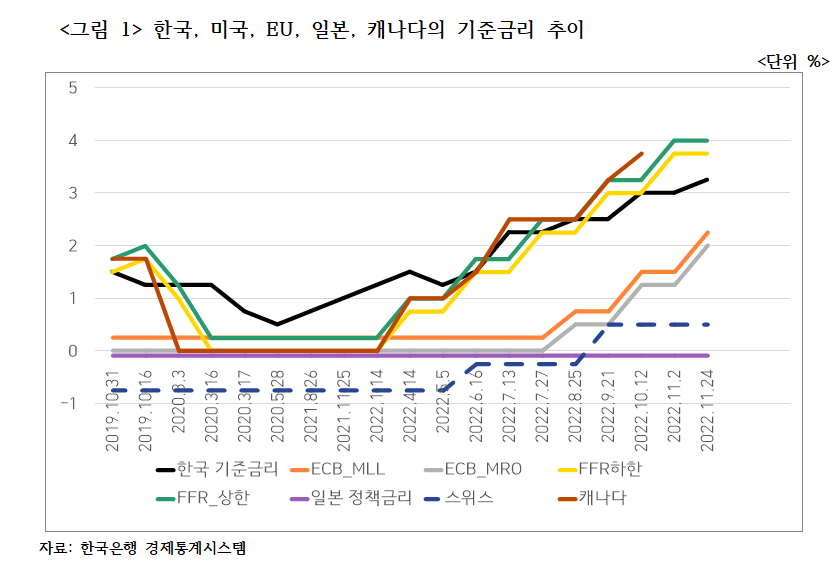
In the midst of a complex crisis where high interest rates and economic sluggishness overlap, it is urgent to accurately distinguish between viable and distressed companies rather than providing unconditional support. Competent companies must be saved, while restructuring of distressed companies with slim prospects for recovery is necessary to minimize market shocks.
The government, financial authorities, businesses, and households must all check their debt levels and activate emergency management systems to prepare for the wave of rising delinquency rates expected next spring. Only a conservative financial strategy that refrains from reckless expansion and secures cash assets will be the sole solution to safely weather this harsh high-interest cold snap.
Thorough sorting of viable and distressed companies and conservative financial management are needed to prepare for the sharp rise in delinquency rates next spring.
Frequently Asked Questions
=