Choosing the right method to receive your retirement pension can save you up to 70% in taxes and help secure a solid financial foundation for your retirement. One of the biggest challenges faced by those leaving their jobs or approaching retirement is deciding whether to receive a lump sum or monthly installments. In reality, Manager Kim, who retired in Seoul after 30 years of corporate life, received his pension as a lump sum without much thought and ended up paying a surprisingly large tax bill, leading to deep regret. Had he transferred the funds to an Individual Retirement Pension (IRP) account and received them as a pension, he would have kept a significantly larger amount. In this article, we will detail the specific procedures for receiving your valuable retirement funds wisely and strategies to minimize taxes. We will carefully examine everything from the types of pension systems to the actual application process, helping you prepare a robust plan for your post-retirement life.
=
A Complete Guide to Receiving Your Retirement Pension: How to Minimize Taxes and Secure Your Retirement Funds
1. Identifying Your Retirement Pension Type
Before diving into the methods of receiving your retirement pension, it is crucial to accurately determine whether your company participates in a Defined Benefit (DB) or a Defined Contribution (DC) plan. In a DB plan, the company manages the funds directly, and the amount you receive upon retirement is predetermined, similar in nature to a standard severance pay. In contrast, a DC plan involves the company depositing a fixed amount into your account annually, allowing you to select and manage financial products yourself. Consequently, your personal investment preferences play a significant role. While many employees prefer managing their assets directly, be cautious as investment losses can reduce your final payout. Therefore, it is advisable to regularly check your account status through the HomeTax portal or financial websites.
Manager Park, who retired from a large corporation, only learned near his retirement date that his company adopted a DC plan. Having little interest in investing, he was confused by the urgency of choosing products and ultimately opted for principal-and-interest guaranteed products to secure his assets safely. This highlights the importance of checking your pension type in advance to avoid panic and respond swiftly upon retirement. It is recommended to periodically review the scale and management status of your accumulated funds through your company’s HR department or the relevant financial institution.
The first step in receiving your retirement pension is to accurately identify whether you are enrolled in a Defined Benefit or Defined Contribution plan.
2. Differences Between Lump Sum and Pension Payments
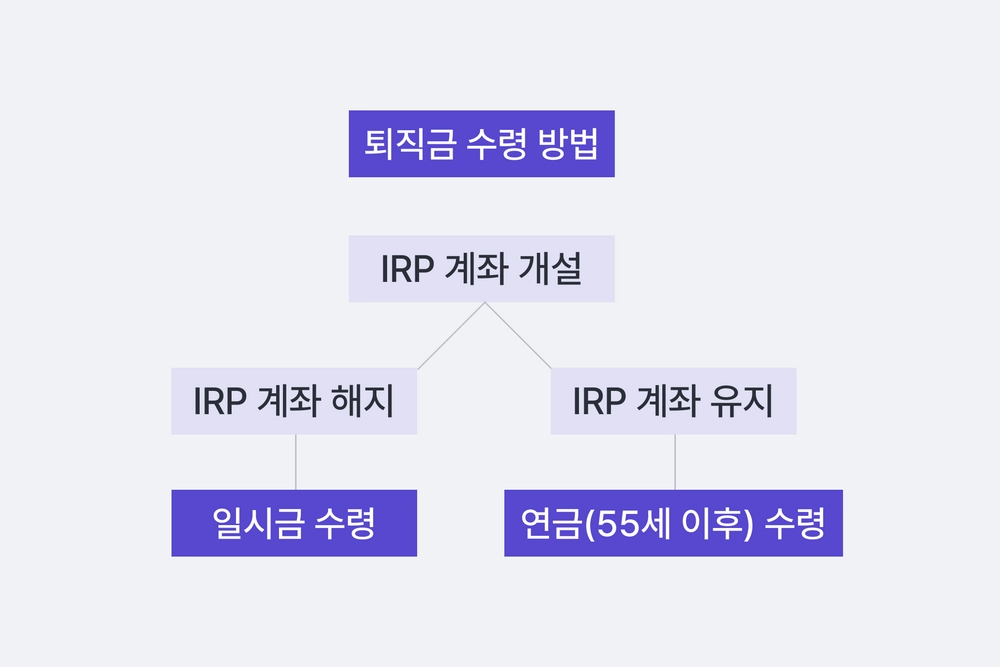
When deciding how to receive your retirement pension, you must carefully choose between a lump sum and monthly pension payments. A lump sum offers the advantage of immediate access to a large amount of cash, which is useful for buying a house or covering urgent large expenses. However, a significant drawback is that retirement income tax is deducted all at once, resulting in a heavy tax burden. On the other hand, receiving it as a pension allows you to receive a fixed amount monthly after the age of 55, benefiting from substantial tax reductions.
Team Leader Lee, who left public service in a local area, transferred his severance pay to a pension account on the advice of others and now uses the monthly payments for living expenses. Had he taken the lump sum, he would have had to pay several million won in taxes upfront. By receiving it as a pension, the tax rate was significantly lowered, increasing his net take-home amount. Experts advise prioritizing pension payments, given the increasing life expectancy after retirement, unless there is an immediate need for the funds. A steady monthly cash flow is essential for maintaining a stable retirement lifestyle and preventing unnecessary spending.
While a lump sum is convenient for large expenses, receiving a pension significantly reduces taxes and ensures a stable source of living expenses.
3. Utilizing an Individual Retirement Pension (IRP) Account

The key to saving taxes on your retirement pension is actively utilizing an Individual Retirement Pension (IRP) account. The retirement benefits paid by your company must be transferred to this personal account to follow the standard pension receipt procedure. Once funds enter this account, you receive the significant benefit of continuing to invest your assets without immediate tax deduction. When you eventually withdraw the funds as a pension after the age of 55, a reduced tax rate of 30% to 50% is applied compared to the standard retirement income tax rate.
Mr. Choi, who retired after working at a small-to-medium enterprise for many years, safely transferred his severance pay to the designated personal account and completed the pension initiation application by visiting a securities firm. Although the process of opening a new account and filling out documents initially seemed complex, he successfully completed the procedure thanks to the helpful guidance of the staff. This account is not just a storage vault for money but a magical safe that helps save on taxes while potentially earning investment returns. Anyone changing jobs or preparing for retirement must fully understand the purpose and usage of this account.
Transferring your severance pay to an IRP account and receiving it as a pension can significantly reduce your tax burden.
4. Application Procedures and Required Documents
Before visiting a bank or securities firm to execute your retirement pension receipt, you must carefully prepare the necessary documents. Your company is required to deposit your severance pay into the pension account within a specified period after your retirement date, so close communication with the HR team is essential. When visiting a financial institution in person, you must bring your ID, proof of retirement, and a copy of your pension account passbook in your name. Recently, it has become very convenient to handle account opening and receipt applications simultaneously via mobile applications without a physical visit.
President Jung, who was organizing his severance pay to start a self-employed business in Incheon, used a mobile app to open a pension account and complete the receipt application non-face-to-face in just a few minutes. In the past, people had to carry stacks of documents, pick up a number ticket, and wait for hours at branches, but now everything can be handled with a tap on your phone from home. However, the timing of cashing out varies depending on the type of products held, so if you need funds urgently, check the schedule in advance. It is safe to call the financial institution’s customer service center to confirm when your products will be liquidated and deposited into your account.
You can easily complete the receipt application by visiting a branch or using a mobile app with your ID and supporting documents.
5. Tax-Saving Strategies and Additional Contribution Benefits
While researching methods to receive your retirement pension, implementing a strategy that combines additional contributions with pension savings can help you enjoy tax deduction benefits. If individuals voluntarily add more money to prepare for retirement, they can receive a tax refund during the year-end tax settlement, making it very popular among employees. These accumulated assets also benefit from lower tax rates when received as a pension later, resulting in a double tax-saving effect. However, be cautious: if you withdraw funds prematurely, you may face a heavy tax penalty. Therefore, adjust your contribution amount according to your income level.
Mr. and Mrs. Kang, a dual-income couple, max out their individual pension account contributions every year during the year-end tax settlement season to avoid a tax burden. The amounts they contribute not only serve as retirement funds but also significantly reduce their immediate tax liability, providing a two-fold benefit. Preparing for retirement is not just about saving money; success depends on how well you defend against the hidden enemy of taxes. Consistent additional contributions and wise account management are the most reliable shortcuts to a prosperous and comfortable retirement.
You need a strategy that utilizes additional contributions to receive year-end tax deductions and later enjoy low-tax-rate benefits.
6. Formulating a Receipt Plan for a Successful Retirement
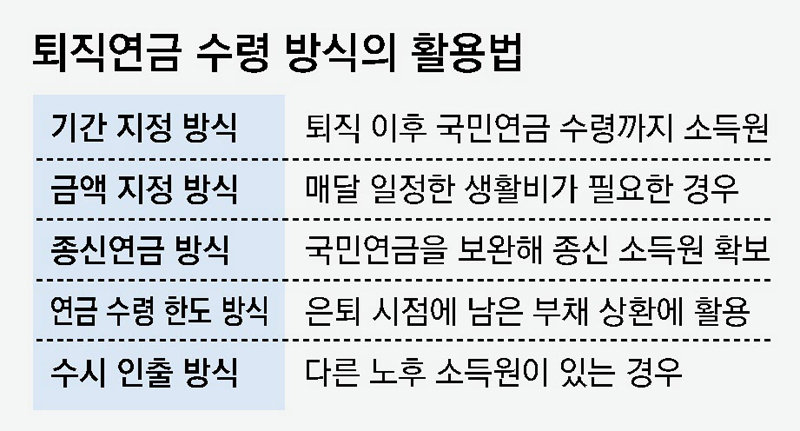
When making the final decision on how to receive your retirement pension, you must comprehensively calculate your expected lifespan and monthly living expenses after retirement. First, assess how much fixed income you will receive from other sources such as the National Pension or reverse mortgages, and then create a scenario where your retirement pension covers the shortfall. Once you apply to start receiving the pension, it is often difficult to change the duration or method of receipt, so it is crucial to plan carefully from the start. Do not be swayed by hearsay; make objective judgments based on expert consultations or official financial information to avoid regret.
Mr. and Mrs. Oh, who are approaching their sixties, worked with a retirement planning expert to carefully calculate their monthly living expenses and set their retirement pension receipt period to more than ten years. Although they were tempted to access a lump sum immediately, they realized that a steady monthly cash flow is far more valuable for enduring a longer retirement period. In the future, the ability to manage your retirement pension directly and monitor returns will become even more important, making continuous interest and learning essential. Please seriously consider how to manage and receive the valuable pension assets currently sleeping in your account.
You should design your post-retirement living expenses considering your expected lifespan and fixed income, and carefully finalize your receipt plan.
Frequently Asked Questions
=