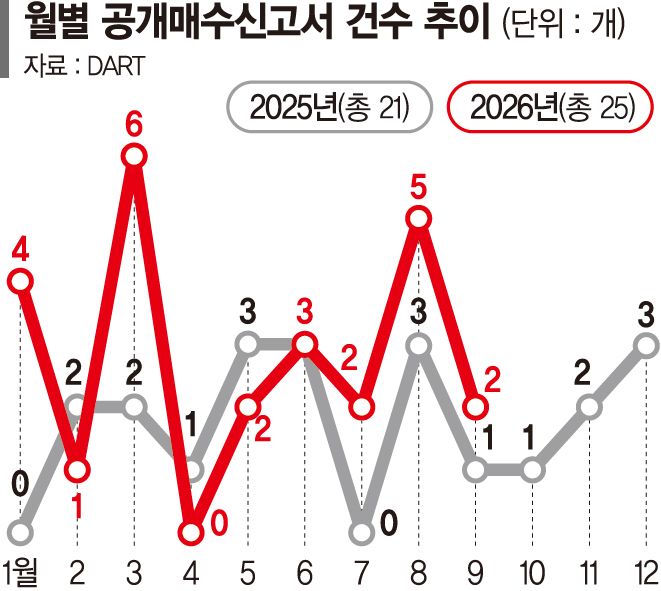
Tender offers, traditionally used by companies as a means to defend control or voluntarily delist, have recently emerged as a powerful tool for boosting stock prices. This method, where the largest shareholder directly purchases shares at a price significantly higher than the market rate, exerts a much stronger effect on stimulating stock prices than simple treasury stock buybacks. According to disclosures from the Financial Supervisory Service, the number of companies launching tender offers with the stated purpose of enhancing shareholder value has more than doubled compared to last year. Investors are closely watching whether this will become a robust defense mechanism for low-priced stocks, especially in conjunction with the introduction of delisting criteria for penny stocks. In this article, we will examine the precise background behind this phenomenon and the key points investors should note. If you want to grasp the new trends in the stock market, please stay with us until the end.
=
Analysis of the Trend: Samchuly Bicycle and SeAH Holdings’ Tender Offers to Boost Stock Prices
1. The Rising Trend of Tender Offers Aimed at Enhancing Shareholder Value
Since the beginning of this year, the number of companies where the largest shareholder is directly purchasing shares to return value to shareholders has been rapidly increasing. According to the Financial Supervisory Service’s electronic disclosure system, a total of eight companies have submitted tender offer reports stating the purpose of enhancing shareholder value from the start of the year until the 10th. This figure represents a doubling compared to the same period last year, indicating a shift in corporate management practices. Companies such as Dongil Steel, Refine, Saramin, Samchuly Bicycle, SeAH Holdings, Anam Electronics, Ice Cream Edu, and KPTU have joined this trend. The reason these diverse companies are choosing tender offers is to appease shareholder dissatisfaction and ensure their corporate value is properly recognized in the market. A mechanism once used solely for defensive purposes is now transforming into a core tool for proactive shareholder return policies. A prime example of a successful stock price boost through a tender offer for treasury shares is Samchuly Bicycle. Last month, the company announced an aggressive plan to cancel all shares acquired after conducting a tender offer for 2.408 million common shares at 5,000 won per share. The estimated amount to be invested at the time was a massive 12.04 billion won. Samchuly Bicycle’s stock price, which had been stagnant and dropped to the 3,000 won range, began a steep upward trend after this news. As buying pressure from investors surged, the stock price recovered instantly and ultimately closed in the high 4,000 won range.
Tender offers aimed at enhancing shareholder value have more than doubled compared to last year, establishing themselves as a powerful means of boosting stock prices for low-priced stocks.
2. Stock Price Defense Strategies of SeAH Holdings and Ice Cream Edu
SeAH Holdings is also a model case of successfully utilizing a tender offer to achieve shareholder returns and corporate value re-evaluation. In May, the company conducted a tender offer for 187,000 common shares at a high price of 160,000 won per share. Subsequently, on the 25th of last month, it fully completed the cancellation of these shares, faithfully fulfilling its promise to the market. This move by SeAH Holdings went beyond simple treasury stock acquisition, delivering a definite effect of reducing the number of outstanding shares. As a result, existing shareholders enjoyed the positive experience of increased equity value, and the company’s image was significantly improved. The fact that a major corporate group is actively utilizing this method has given a fresh shock to the entire market. In the case of Ice Cream Edu, it is a very special instance where the largest shareholder directly stepped in to defend the company’s stock price. The parent company, Sigongtech, abruptly announced on the 10th that it would conduct a tender offer for 3.6 million shares of Ice Cream Edu at 1,200 won per share. The total purchase amount of 4.32 billion won was more than 30 percent higher than the closing price of 918 won just before the announcement. Although this was not a method where the company directly acquired its own shares, the high purchase price offered by the largest shareholder immediately stimulated a rise in the stock price. In fact, after the announcement, investment sentiment revived, and the stock price showed a strong trend, soaring well above the 1,100 won mark.
Major shareholders, such as those of SeAH Holdings and Sigongtech, have simultaneously achieved stock price defense and trust recovery by purchasing shares at high prices.
3. The Magic of Premium Purchases and the Effect of Stock Price Re-evaluation
The biggest reason tender offers are gaining attention in the market is that they win over shareholders by presenting a clear price, period, and volume. The general method of on-exchange treasury stock buybacks, which focuses on quantity, can be frustrating because it is unclear when the company will buy shares. However, tender offers allow for the secure acquisition of a definite volume within a set price and period, conveying a strong will to the market. In particular, because a premium is added on top of the market price, it becomes an event that investors cannot help but welcome. These exceptional conditions serve as a powerful catalyst to return the stock price of undervalued companies to their intrinsic value. During the stock price re-evaluation process, investors are prompted to seriously reconsider the company’s future growth potential. The fact that a major shareholder is using their own funds to buy shares at a high price is interpreted as a signal of confidence in the company’s future. Consequently, an environment is naturally created where general shareholders can invest with peace of mind. As the circulating supply in the market decreases, the potential for further stock price increases also grows. This is why it is evaluated as one of the most exemplary capital policies that allows corporate management and minority shareholders to coexist. It is highly likely that many companies wishing to boost their stock prices will adopt this method in the future.
The method of purchasing shares with a premium over the market price drives short-term stock price increases and leads to a re-evaluation of corporate value.
4. Hidden Risks of Tender Offers and the Barrier of Tax Burdens
Tender offers do not always succeed, and it is difficult to definitively say they are always more advantageous than treasury stock buybacks. If a limited budget is used to invest the same amount, offering a high premium inevitably reduces the number of shares actually acquired. Additionally, because tender offers are legally classified as off-exchange transactions, individual investors participating in them face tax issues. The fact that a heavy tax rate of up to 22 percent is applied to capital gains, including local income tax, is a significant burden. If the on-exchange stock price rises higher than the tender offer price, individuals will naturally choose to sell on the market rather than pay taxes to subscribe. In fact, Anam Electronics pushed for a large-scale tender offer at 1,560 won per share from March to April but met with a bitter result. It managed to acquire only about 5 percent of the originally targeted volume, effectively ending in failure. The decisive reason for such a low subscription rate was that the stock price hit the daily limit up immediately after the tender offer disclosure, easily surpassing the purchase price. Combined with the heavy tax burden, investors chose to sell on the market instead of subscribing to the tender offer. This illustrates that companies can suffer the setback of spending money without securing the desired amount of shares.
High taxes imposed on off-exchange transactions and the phenomenon of on-exchange stock prices reversing are major obstacles to the success of tender offers.
5. The Wave of Commercial Act Revisions and Shareholder-Interest-Centered Capital Policies
Recent changes in the institutional environment surrounding the stock market are also firmly supporting the trend of tender offers by companies. Along with recent moves to revise the Commercial Act, companies must actively consider the interests of general shareholders, not just management for the benefit of major shareholders. As social pressure to protect shareholder rights and improve capital efficiency intensifies, corporate policies are changing rapidly. Accordingly, tender offers accompanied by share consolidation or cancellation are being highlighted as the most sophisticated means of boosting stock prices. The era of ignoring shareholders and insisting on owner-family-centric management, as in the past, is now definitively fading away. Securities industry experts predict that this trend will not be temporary but will intensify in the future. As the nature of the stock market improves, a structure is being formed where companies that damage shareholder value find it difficult to survive in the market. It is a very encouraging change that companies are voluntarily making efforts to manage their stock prices and return profits to shareholders. For general investors, it has become necessary to have the wisdom to carefully examine various capital policy disclosures released by companies. Only those who accurately read institutional changes can achieve successful investment results in the stock market.
Driven by Commercial Act revisions and the strengthening of shareholder rights protection, capital policies prioritizing shareholder interests are becoming the mainstream.
6. Smart Response Strategies and Outlook for Successful Investment
The wave of tender offers by companies like Samchuly Bicycle and SeAH Holdings that hit this year offers many implications for the domestic stock market. The act of the largest shareholder directly purchasing shares with a premium signifies not just stock price defense but an improvement in the company’s fundamental nature. However, rather than viewing it unconditionally positively, one must also consider realistic constraints such as the gap with the on-exchange stock price and tax issues. One must recognize that subscription rates may be low due to tax burdens and coldly analyze the company’s actual intentions and financial condition. In the future, such shareholder return policies are likely to continue, centered on companies holding undervalued stocks. Investors should carefully read the conditions in the tender offer reports disclosed by the company and formulate the most advantageous trading strategy. Instead of blindly chasing with follow-on buying, it is essential to first confirm the company’s substance and the sincerity of its shareholder-friendly policies. If you can capture opportunities and thoroughly manage risks in the changing market environment, you can achieve sufficient returns. Please remember the pros and cons of tender offers examined today and create successful investment results.
To invest successfully amidst the tender offer trend, a cautious approach involving detailed analysis of taxes and on-exchange stock price trends is required.
Frequently Asked Questions
=