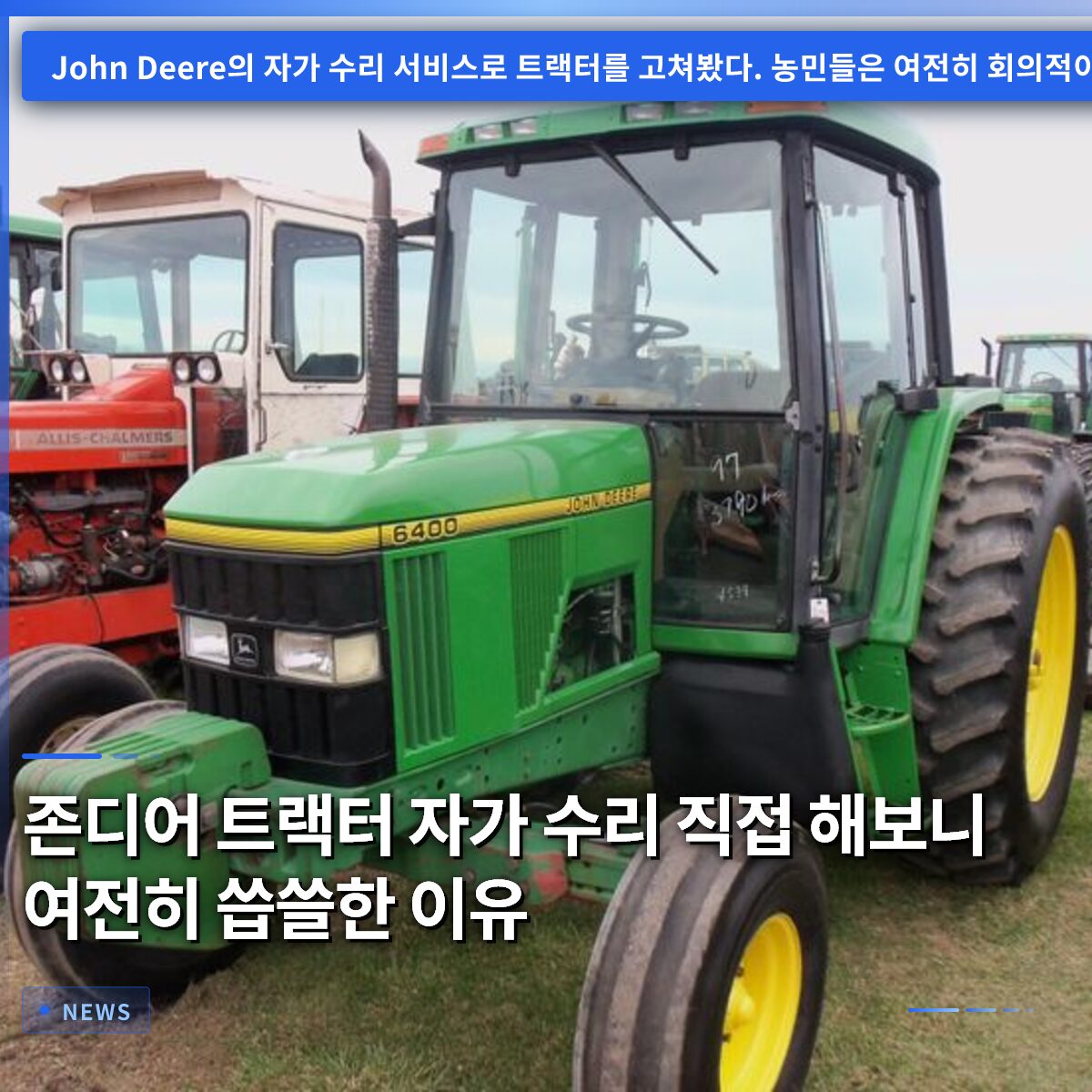
After personally experiencing the self-repair subscription program introduced by John Deere, a global agricultural machinery manufacturer, I found that while simple malfunctions could be resolved in minutes, the reaction from farmers in the field remains cold. Although the program was designed to help equipment owners diagnose and fix issues themselves, significant barriers to entry still exist in complex failure scenarios and real-world field conditions. Despite massive lawsuit settlements and regulatory pressure, we will delve into the details of why farmers do not fully trust the company’s policies. As modern agricultural machinery equipped with advanced technology becomes more prevalent, the conflict between manufacturers and users over repairs appears to be deepening. We will examine in detail whether this newly revealed self-repair program can quell long-standing conflicts or if it is merely a superficial measure. Through this article, you will be able to accurately grasp the core issues of the right-to-repair controversy facing the high-tech agricultural machinery industry and the voices from the actual field.
=
I Tried John Deere’s Self-Repair Program: Why It Still Leaves a Bitter Taste
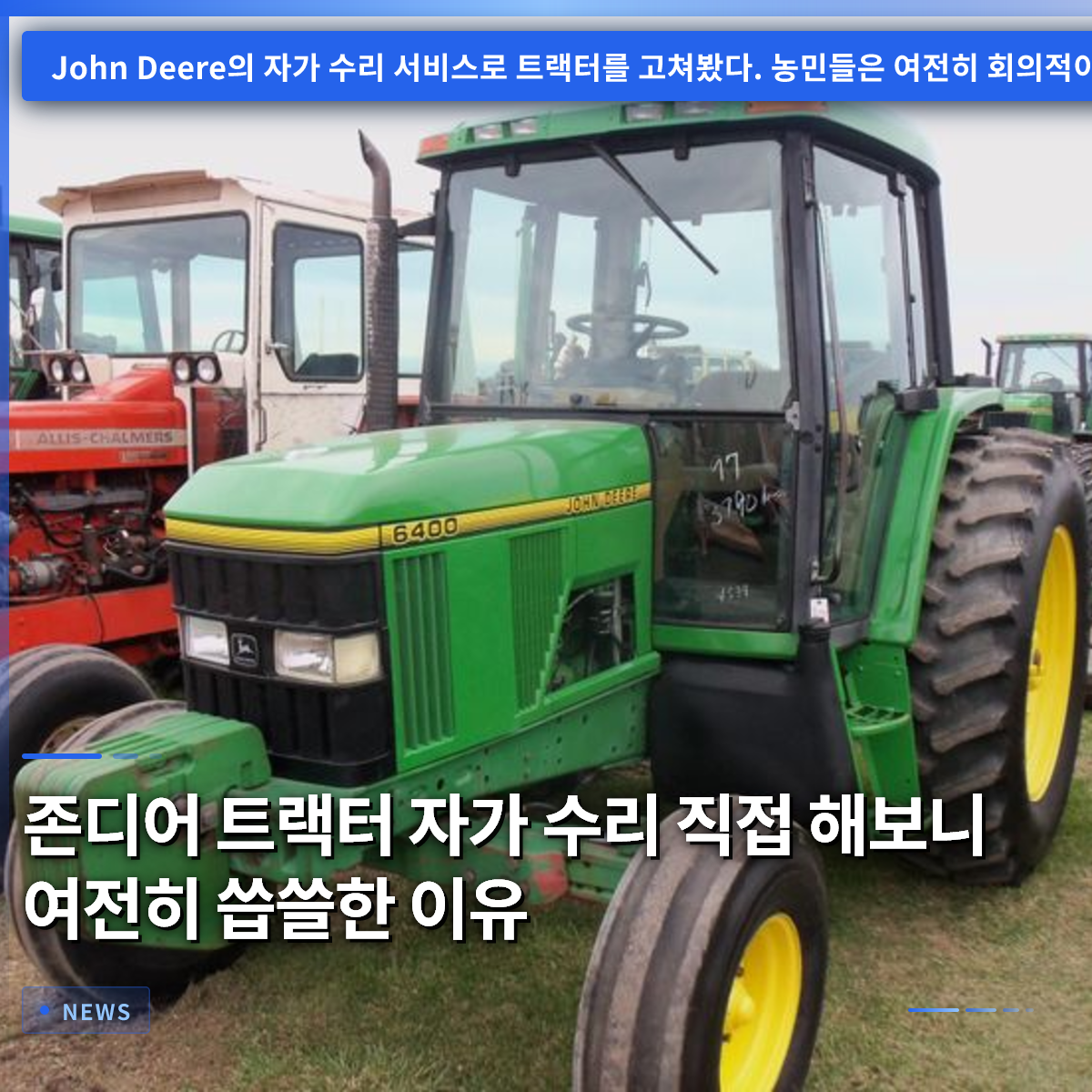
1. A Sensor Repair Demo Completed in Minutes
At a live demonstration held at a John Deere office in California, USA, the connection of the fuel water detection sensor on a 5130ML model tractor was restored. When the technician connected a laptop to the machine, a fault alert immediately appeared on the screen, along with a customized manual and detailed instructional images tailored to the equipment’s serial number. Even without being a maintenance expert, following the on-screen guidance to reconnect two broken wires caused the warning light to disappear instantly, and the entire process was completed in just a few minutes. In such simple fault situations where the issue can be visually confirmed and easily repaired by hand, the program demonstrated surprisingly smooth operation. Jamie Hindman, the company’s Chief Technology Officer, explained that the newly introduced Operation Center Expert Repair feature is fully integrated with almost all of the company’s electronics-equipped machines. He repeatedly emphasized that the company’s fundamental intention was to make it easy for customers who own the equipment from the start to handle it themselves.
In simple fault situations, repairs could be completed in minutes thanks to customized manuals and guidance.
2. Advanced Agricultural Machinery and Digital Locks
Equipment manufactured by John Deere, the largest agricultural machinery maker in the US, has evolved into an incredibly complex structure over the past few decades by incorporating controllers, wireless communication devices, and numerous sensors. Most of the latest equipment is equipped with the ability to collect precise location information and various real-time measurements via wireless network connections and transmit them to the company’s servers. Some large tractors even perform the remarkable feat of driving autonomously along pre-set paths, with built-in software making independent judgments. However, hidden within this advanced software are powerful digital locks that require only official dealership approval, blocking users’ free access. As a result, if a farmer attempts to work on the machine themselves or replace a faulty part with aftermarket parts available on the market, they are immediately blocked by the security system. Due to these repair restrictions, John Deere has become a primary target of fierce criticism and pressure from right-to-repair advocates and farmers worldwide over the past decade.
Digital locks introduced as agricultural machinery became more advanced have become a barrier to users’ free repair efforts.
3. Ongoing Lawsuits and Unresolved Distrust
As conflicts over repair restrictions intensified, large-scale legal battles have continued for several years, recently resulting in two major lawsuit settlements. Early this year, a decision was made to pay a substantial settlement amount to compensate for the excessive repair costs experienced by equipment owners, and in the summer, the company accepted demands to make product repairs easier. However, the company did not admit any fault during the settlement process, and all settlement terms are still awaiting final court judgment. Activists who strongly advocate for the right to repair point out that the scale of the compensation and the conditions for actual behavioral change offered by the company are still far from sufficient, maintaining a skeptical stance. It is frequently pointed out in the field that without class-action lawsuits and strong measures from regulatory agencies, even the small changes seen today would not have been achieved. Therefore, even if the company says it now provides all necessary repair tools, farmers do not take it at face value and remain suspicious.
Despite massive lawsuit settlements, right-to-repair advocates and farmers do not fully trust the company’s change in attitude.
4. The Reality of Subscription Fees and Program Features
The Expert Repair program, introduced and operational since last year, charges significant annual subscription fees based on the scope of use and the number of equipment units. For individual equipment, a fixed cost is charged per unit, while large-scale agricultural operators or independent repair shops managing an entire fleet face much higher costs. When equipment is connected via wireless internet or wired cable, the system retrieves necessary maintenance information from the company’s database based on the unique serial number and guides the repair process. Some modern tractors have such complex structures, with over 50 internal controllers, that expert assistance is desperately needed. Some diagnostic functions can be downloaded to a computer and used offline, and screen layouts can be changed, and software update history can be checked at a glance. If new replacement parts are required during the repair process, a link is provided that directly connects to the product page in the official online store, adding convenience.
While offering various diagnostic functions and manuals, users must bear significant annual subscription fees depending on the number of equipment units and scope.
5. Cold Assessments from Farmers in the Field
According to John Deere, even one year after the program’s launch, the number of actual daily users remains at only about 1,000. Compared to the massive scale of millions of farms across the US, this user base is very small and has not yet taken deep root in the field. A veteran farmer who directly cultivates a vast agricultural area in Missouri evaluated that the program is somewhat helpful for fixing simple faults. However, in actual farming situations, multiple faults often occur simultaneously, resulting in complex scenarios where several diagnostic codes appear on the screen. In such cases, it is very difficult to determine where to start tracking and resolving the problem, leading to complaints that it is not helpful when it is truly needed. Even surrounding farmers rarely know about this program properly, and the tendency to seek cracked version software from unofficial markets rather than paying the official fee remains strong.
Due to difficulty handling complex fault situations and high cost burdens, actual farmers’ usage rates and trust levels remain low.
6. Future Outlook and Farmers’ Choices
The tug-of-war between manufacturers and users over the right to repair advanced agricultural machinery is not expected to end easily and is projected to become more intense with technological advancements. The company continues to hold experience events to raise awareness and increase communication with customers, but it appears there is still a long way to go to erase the deep distrust in the field. Farmers want diagnostic permissions at a level perfectly identical to that of dealerships and an independent repair environment, going beyond simple manual provision. Farmers who own complex agricultural machinery need the wisdom to carefully consider their farming scale and actual maintenance capabilities rather than unconditionally subscribing to the service. Additionally, it is wise to accurately recognize the limitations of the manufacturer’s official support program and closely monitor future legal rulings and additional institutional improvements. We must continue to watch closely whether the agricultural machinery industry will move in the direction of guaranteeing true freedom of repair or erect another form of barrier.
To guarantee true right to repair, equal-level diagnostic permissions and transparent communication are essential beyond simple manual provision.
Frequently Asked Questions
=