If you are considering switching your medical expense insurance because the monthly premiums deducted from your bank account feel like a burden, you must carefully evaluate the coverage scope and out-of-pocket expenses before canceling your current contract. Many people have impulsively canceled their existing policies after hearing that premiums had dropped, only to regret it bitterly when they later fell seriously ill and faced a massive medical bill. Specifically, when organizing long-standing insurance policies, it is essential to calmly compare the benefits you already possess with the coverage you will inevitably need as you age. Recently, with the rapid increase in the use of obesity management injections and non-critical non-covered treatments, insurance companies’ loss ratios have risen, leading to continuous changes in product structures. In this article, we will accurately outline the characteristics of medical expense insurance by generation and explain in an easy-to-understand manner what the best choice is for your financial situation and health status.
=
Comparing Medical Expense Insurance: Generational Differences and a Guide to Switching to the Right Plan
1. History and Key Features of Medical Expense Insurance by Generation

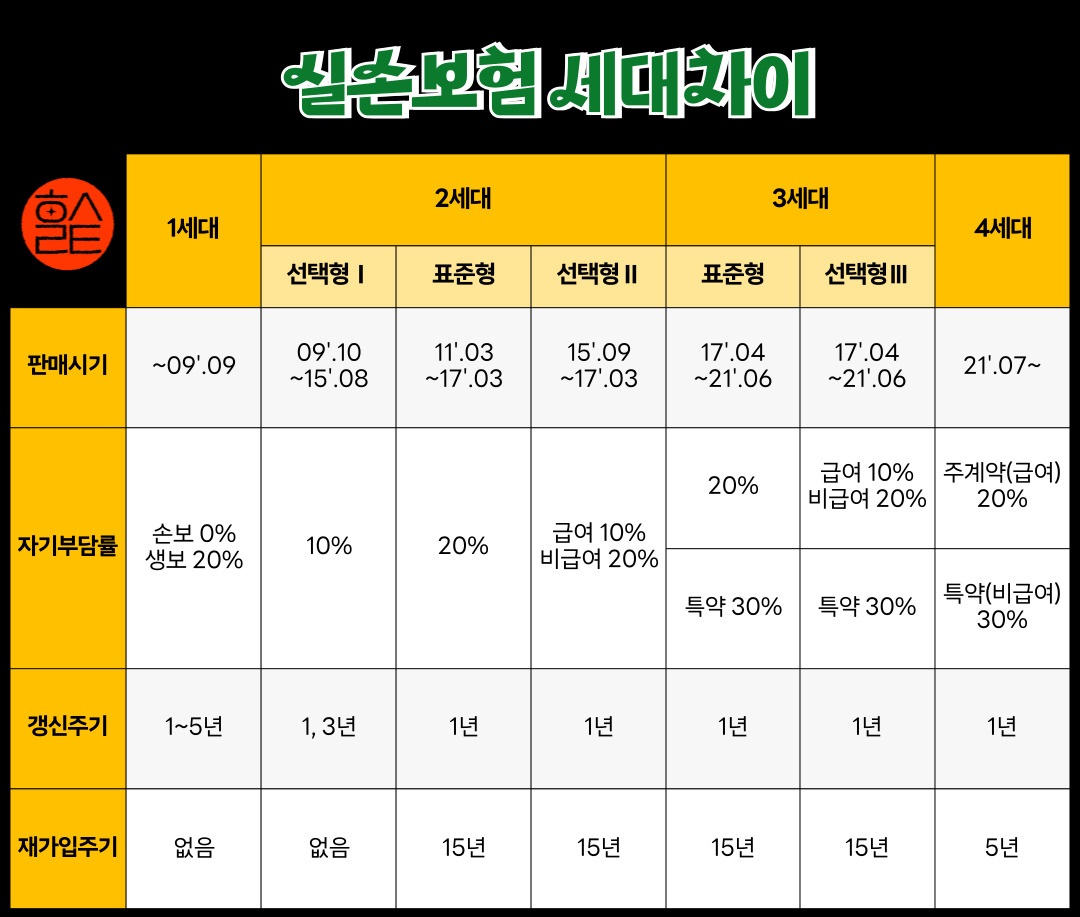
Medical expense insurance is categorized into four generations, from the first to the current fourth, with significant differences in coverage details and out-of-pocket conditions for each period. So-called first-generation products, purchased before October 2009, offered little to no out-of-pocket costs for hospital bills, providing the best benefits for frequent hospital visitors but becoming the main cause of losses for insurance companies. Subsequently, as the government and insurance companies reformed the system to control loss ratios by gradually increasing out-of-pocket costs, the system evolved through the second and third generations to its current form. Older policies have the advantage of broadly covering non-covered items, but they suffer from the fatal drawback of premiums skyrocketing sharply at each renewal period. In contrast, recent products adopt a practical structure that adjusts the scope of coverage to prevent moral hazard while keeping base premiums low. Therefore, it is not wise to stubbornly insist that older policies are always better, nor is it safe to switch simply because they are cheaper; you must coldly assess your ability to pay. The difference in premium increases and coverage scope between past enrollment periods is vast, so you must first check your policy documents. You must discard the prejudice that older policies are always better to prevent financial ruin.
Understanding the characteristics of each generation based on enrollment timing helps prevent unnecessary premium expenditures.
2. Advantages and Realistic Disadvantages of 4th Generation Medical Expense Insurance
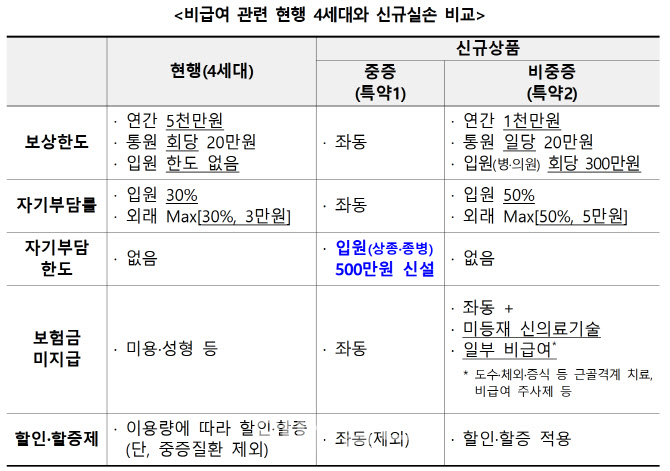
The 4th generation medical expense insurance, which is currently being sold, features a structure where premiums are discounted or surcharged based on medical utilization, making it advantageous for those who rarely visit hospitals. In fact, if you are a policyholder who rarely seeks medical attention and manages their health well, you can enjoy the benefit of a noticeably lower monthly premium compared to previous generations. However, conversely, it can be detrimental for those with chronic conditions or those who consistently require regular non-covered injection treatments or physical therapy. For those who frequently use non-critical non-covered treatments, switching to the 4th generation can actually inflict a significant blow to their household economy due to increased out-of-pocket costs and surcharges. There are numerous cases where people impulsively switched to reduce premium burdens, only to be shocked by reduced coverage when they actually needed hospital care. Therefore, you must honestly assess your usual frequency of hospital visits and health status before carefully deciding whether to switch. A representative example is the story of housewives who switched because a friend recommended a cheaper option, only to find that their monthly treatment support was abruptly cut off, leaving them in a predicament. You must know your physical condition before touching your insurance.
4th generation medical expense insurance is favorable for those with low hospital visit frequency, but it may result in a loss for those who require frequent treatment.
3. Essential Checkpoints Before Switching Your Existing Insurance
When canceling a long-standing existing contract to switch to a new product, you must never simply compare the immediate premium amount. You must carefully note down and compare the specific out-of-pocket ratio, renewal cycle, and rider details of your current contract. If you have suffered from a serious illness in the past or currently have a condition requiring medication, there is a risk of being rejected during the underwriting process for a new product. To increase the approval rate, you must accurately fulfill your duty of disclosure before enrollment and check for any overlapping unnecessary coverage. When remodeling your insurance, you should not look at just one product but must consider the proportion of insurance premiums in your overall household expenditure structure. Be careful not to blindly stamp cancellation documents based solely on the agent’s words, as this can lead to irreversible financial losses. Situations where a coverage gap occurs after switching insurance, or where coverage limits decrease compared to before, forcing you to pay for surgery out of pocket, actually happen. Carefully examine the detailed conditions with the caution of tapping a stone bridge before crossing it.
Switching insurance carries risks of coverage gaps and underwriting rejection, so you must first analyze the conditions of your current contract.
4. Convenient Medical Expense Insurance Claim Methods Without Documents
Many people still give up on claiming medical expense insurance because the documents required from the hospital are too complex and cumbersome. Because there are many paper documents to collect, such as medical receipts and detailed itemized statements, office workers have suffered the pain of having to revisit hospitals while worrying about their employers’ perceptions. Fortunately, recently, with well-linked computer systems centered around major hospitals, a path has opened for easy claims without carrying documents directly. Large hospitals participated relatively early, making the process convenient, but it remains disappointing that the linkage process is not yet fully established at local clinics or pharmacies. You should actively utilize mobile apps or dedicated websites, which allow you to easily apply for insurance payouts with just a few touches, rather than putting it off. If you delay due to inconvenience, the statute of limitations for claims will expire, and you will lose your valuable money; thus, it is good to develop the habit of processing hospital receipts immediately. Everyone has likely experienced the awkwardness of waiting behind others at the hospital counter while getting paper documents issued. Now, process it easily with your smartphone and retrieve your dormant money.
Actively utilizing the document-free simple claim method can reduce the hassle of receiving insurance payouts and cases of giving up.
5. Preparing for Critical Illnesses and the Limitations of Medical Expense Insurance
While medical expense insurance reliably protects our medical costs, it may be difficult to rely solely on it when facing serious illnesses like cancer or heart disease. The government operates social safety nets, such as the Special Calculation System for Critical Illnesses, to alleviate the economic burden on patients with severe diseases, and the registration process is relatively simple. If diagnosed with a disease eligible for the Special Calculation System, out-of-pocket treatment costs are drastically reduced, but hidden costs such as non-covered medications and nursing care fees are still substantial. People with financial means use private medical expense insurance in conjunction to prepare for these medical bill bombs, but for low-income groups, it remains a high barrier. In particular, caution is needed as high-priced obesity treatment injections and new anti-cancer drugs that are currently trending are often excluded from the scope of health insurance or medical expense insurance. Therefore, rather than relying entirely on medical expense insurance, a wise attitude is required to combine it with diagnostic fee insurance or national systems. It is heartbreaking to see acquaintances who fell seriously ill struggling in place because medical expense insurance alone could not even cover the cost of a caregiver. Comprehensive preparation to diversify risk is necessary.
Medical expense insurance is an excellent defense against medical costs, but it cannot cover all costs for critical illnesses, so supplementary measures are needed.
6. Tips for Managing Medical Expense Insurance During Holidays and Daily Life
When going on overseas trips during long holidays like Lunar New Year or Chuseok, you must carefully examine the detailed coverage of travel insurance while also checking for any overlap with your existing medical expense insurance. Rather than simply comparing products with low premiums, a wise policyholder’s attitude is to comprehensively check everything, including family daily life liability insurance and the status of older policies. It is necessary to take out the insurance policies you have neglected under the excuse of being busy and boldly organize unnecessary riders. Insurance is not a static product that ends once you enroll; it is like a living organism that must be constantly adjusted to match changes in your age and health status. As medical prices rise further and new treatments are developed, the importance of medical expense insurance will grow, and individual wise management will determine success or failure. The small practice of turning on your smartphone right now to check the generation and coverage details of your enrolled product will bring great economic stability in the future. It is common to see at family gatherings where insurance becomes a topic of conversation, with some benefiting from old policies and others regretting their choices. Do not be swayed by others’ stories; manage it smartly according to your own financial situation.
The habit of regularly checking and remodeling your insurance status during holidays and daily life protects your household economy.
Frequently Asked Questions
=