By enrolling in a personal pension savings plan and making consistent monthly contributions, you can receive a tax deduction of up to 9 million won during year-end tax settlement, resulting in a refund of several hundred thousand won. Many office workers worry about hitting a tax bomb every year during the year-end settlement season, but actively utilizing this financial product can significantly reduce your tax burden. Mr. Kim, an office worker, felt regret over the taxes deducted from his salary last year and, after researching various products, discovered pension savings plans. He has now resolved to fully utilize the limit and enroll this year. Looking at his colleagues, many have already been enrolled in pension savings funds or Individual Retirement Pension (IRP) accounts for a long time, automatically transferring a fixed amount each month to secure their retirement while saving on taxes. In this article, we will detail various account management methods offered by banks and securities firms, as well as tips for maximizing tax deductions. We will explain these concepts in an easy-to-understand manner based on real-life examples of office workers, so anyone can understand them without needing complex tax law knowledge.
=
Comprehensive Guide to Personal Pension Savings Tax Deduction Limits and Strategies to Maximize Year-End Tax Refunds
1. Basic Concepts and Necessity of Personal Pension Savings
Personal pension savings is a representative savings product that provides tax incentives for individuals to voluntarily prepare for their retirement. As retirement approaches, it becomes difficult to cover living expenses with the National Pension alone, so office workers must secure separate personal funding methods. In the past, people often just deposited money in bank savings or fixed-term deposits, but with the continuation of low interest rates, it has become difficult to defend against inflation. Therefore, nowadays, many prefer to actively grow their assets by investing in funds or Exchange-Traded Funds (ETFs) through securities accounts. The attitude of not neglecting savings for the future, even amidst fixed monthly expenses, is a key element in determining the quality of life after retirement. You should start setting contribution amounts suitable for your income level and cultivating the habit of consistently saving money from now on.
The earlier you start preparing for retirement, the more advantageous it is, and starting in your 20s or 30s is the shortcut to enjoying compound interest effects. If you open a pension account and make small monthly contributions from the beginning of your career, the scale of assets accumulated at retirement will be noticeably different. Mr. Park, an office worker at a small company in Seoul, said that he has felt a great sense of pride seeing the balance in his account after contributing 200,000 won monthly to pension savings since he was thirty. It is very important to approach this with the mindset of investing in your future self by slightly reducing immediate consumption. Since the expected retirement period can last several decades, utilizing tax-saving accounts supported by the state is not an option but a necessity. Rather than vaguely thinking you will earn and spend later, you need the wisdom to separate a portion of your salary into pension assets right now.
Personal pension savings is an essential financial product that must be enrolled in to secure stable living expenses after retirement and prepare for an uncertain future.
2. Understanding Tax Deduction Limits and Calculation Structure
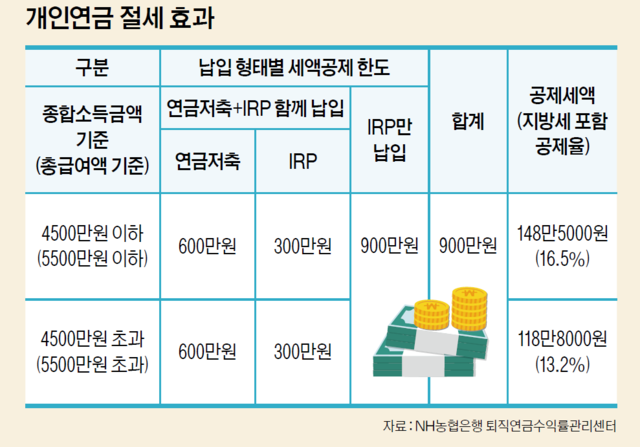
By combining personal pension savings and the Individual Retirement Pension (IRP), you can fully utilize the annual tax-deductible contribution limit of up to 9 million won. Specifically, you can receive a deduction of up to 6 million won with pension savings alone, and the most common method is to add an IRP account to contribute an additional 3 million won. For employees with a total salary of 55 million won or less, a high deduction rate of 16.5% is applied, allowing them to receive a substantial tax refund of up to 1.485 million won. Conversely, for office workers with a total salary exceeding 55 million won, a deduction rate of 13.2% is applied, providing a refund benefit of up to 1.188 million won. This is why office workers who used to pay out taxes every year during the year-end settlement season now enjoy the pleasure of getting money back after utilizing this account. Therefore, it is wise to carefully consider your salary level and financial capacity, and calculate in advance how much you will contribute each month.
For example, let’s assume Mr. Lee, an office worker with an annual salary of 40 million won, contributes 500,000 won monthly to pension savings, filling the 6 million won annual limit, and additionally contributes 3 million won to the IRP. In this case, 16.5% of the total 9 million won contribution, approximately 1.48 million won, will be deposited into his account as a year-end tax refund. Compared to going to great lengths to save 100,000 won, choosing the right account yields a much greater economic benefit. Many people worry about not being able to fill the limit due to a lack of lump-sum funds, but you can also fill the remaining amount all at once before the end of the year, so there is no need to be overly burdened. The important thing is to accurately recognize the total amount you have contributed during the year and verify the deduction limit through National Tax Service HomeTax materials. Because there is a definite reward in the form of a tax refund, it creates a strong motivation to continue saving.
By filling the total limit of 9 million won (6 million won in pension savings and 3 million won in IRP), you can receive a tax refund of up to 1.48 million won or more, depending on your salary.
3. Differences Between Pension Savings Funds and IRP, and Linked Management
While pension savings can be enrolled in as trust or insurance products at banks, choosing a pension savings fund at a securities firm is advantageous if you want to actively grow your assets. Pension savings funds have the advantage of being able to invest 100% in various risky assets such as stocks, bonds, and ETFs, allowing for higher expected returns. On the other hand, IRP accounts are legally restricted to investing only up to 70% of the total amount in risky assets like equity funds, with the remainder required to be in safe assets. Therefore, for aggressive investors, it is much more effective to first fill the pension savings fund limit to the maximum and then distribute the remaining surplus funds into the IRP. Although both accounts aim to accumulate retirement funds, there are slight differences in the specific investable products and the autonomy in asset management. You must understand these differences accurately before enrolling to avoid difficulties in managing your funds later and to grow your assets efficiently.
In reality, many investment experts recommend managing tax-saving accounts not as independent products but as a single organic system. For example, office workers in their 40s simultaneously utilize pension savings funds, IRP, and the Individual Comprehensive Asset Management Account (ISA) as the core of their asset management. If you transfer the lump sum accumulated in the ISA, which enjoyed tax-exempt benefits, to a pension account immediately after maturity, you can additionally secure tax deduction benefits. By combining the strengths of these accounts, you can enjoy the double benefit of saving on taxes while maximizing investment returns. Utilizing AI-based asset management services or portfolio diagnosis functions provided by financial institutions allows even beginners to easily practice risk diversification. The key to successful asset management is establishing your own clear philosophy for retirement preparation without being swayed by the complex trends of the financial market.
Pension savings funds allow 100% investment in risky assets, while IRP allows only up to 70%. Therefore, you should harmoniously manage both accounts according to your investment style.
4. Precautions for Early Termination and Pension Receipt Requirements
Be careful, as enrolling solely for the tax deduction benefit and then terminating the account early due to an urgent need for funds can result in significant losses. If you terminate a personal pension savings account before the agreed period or withdraw funds for purposes other than receiving a pension, you must return all the tax deduction benefits you have received. Furthermore, since other income tax is imposed on investment gains, you could face a tax bomb even larger than the principal loss. Therefore, you should consider the money in this account as funds that must absolutely not be used until retirement and compose it only with surplus funds that can be kept long-term. Mr. Choi, an office worker, confessed that he deeply regretted breaking his pension account a few years ago when he needed cash urgently and ended up facing unexpected additional tax charges. This is a case illustrating the lesson that you can never succeed if you ignore the characteristics of long-term products and approach them as a means to solve short-term financial difficulties.
If you are in a situation where you inevitably need cash, you should consider withdrawing only a portion of the amount within the account instead of terminating it, or check if you qualify for exceptional reasons allowed by law. In special situations such as purchasing a home as a non-homeowner or incurring medical expenses for long-term treatment, there are ways to withdraw funds while minimizing disadvantages. When it is time to receive the pension at the designated age, it is much more advantageous from a tax perspective to receive a fixed amount annually rather than taking it all at once. This is because when receiving a pension after retirement, pension income tax is applied, and you only need to pay a much lower tax rate of 3.3% to 5.5% compared to general interest income tax. As you age, the tax rate gradually decreases, so there is no better means than a pension account to preserve the real value of your retirement living expenses. To make your post-retirement life comfortable, you need the foresight to look not only at the immediate tax deduction benefits but also at the long-term receipt stage.
Since you must return the tax deductions received upon early termination, you should only contribute amounts you can maintain until retirement, and ensure you receive the lower pension income tax upon receipt.
5. Age-Specific Strategies for Utilizing Pension Savings
For young professionals in their 20s and 30s, it is important to cultivate the habit of opening a pension savings account and contributing consistently, even if it is a small amount, as it may be difficult to save large sums immediately. During this period, the tax deduction benefit may not feel significant due to relatively low income, but you have the advantage of having the longest time to enjoy the magic of compound interest. If you consistently accumulate small amounts like 100,000 or 200,000 won monthly in equity funds via automatic transfer, you will face surprising asset growth results in 10 or 20 years. When you enter your 40s and 50s, as your seniority and income increase, you should adopt a strategy to raise the annual contribution limit to the maximum. This is the golden time to maximize the tax-saving effect through pension accounts, as the tax burden is most severe due to children’s education and living expenses. You must exercise the wisdom to defend your actual household income by receiving refunds of several hundred thousand to over one million won every year during year-end settlement.
For those in their late 50s with retirement just around the corner, a final sprint strategy is needed to maximize tax benefits by contributing as much as possible during the remaining period. Recently, you can periodically diagnose and check your portfolio using various asset management helper services provided by financial companies. Convenience has greatly improved as you can check your account status and perform rebalancing anytime through non-face-to-face channels, in addition to products enrolled directly at branches. As you age, it is easy to focus on principal preservation, but maintaining an appropriate ratio of investment assets is essential to endure the long retirement period. Since the financial situation and goals differ by age group, you should make a plan tailored to your own income and expenditure structure rather than blindly following others. You must not forget that people who consistently accumulate money in their pension accounts right now will reap the fruit of economic freedom after retirement.
In your 20s and 30s, start small savings aiming for long-term compound interest, and in your 40s and 50s, fill the limit to the maximum to maximize tax-saving effects with a tailored strategy.
6. Practical Measures for Successful Retirement Preparation
Personal pension savings is not just a simple savings product but the most powerful and certain legal tax-saving means that every office worker in Korea should secure. If you want to avoid a tax bomb and receive a generous refund in the annual year-end settlement, you must open an account at a securities firm or bank app today. Rather than wasting time waiting for the perfect timing, the practice of consistently contributing via automatic transfer, even if it is a small amount, is most important. No matter how much good investment information people around you talk about, no change will occur unless you create an account and put money in with your own hands. Life after retirement may feel like a distant future story, but from the moment you start preparing, our future becomes slightly safer and more abundant. Please start saving with the mindset of reducing unnecessary consumption and building a sturdy shield for your future self, one by one.
You must cultivate the attitude of regularly checking and managing your pension portfolio in line with changes in the financial market and directions for tax law revisions. According to expert analysis, as aging society deepens, the quality of life after retirement is highly likely to be extremely divided depending on individual preparation. Therefore, cultivating the ability to protect and grow assets by actively utilizing various tax incentive systems provided by the state is an essential survival wisdom for modern office workers. Let this article be the occasion to conclude the pension account opening you have been postponing, and start a healthy financial life of saving consistently as if breathing. Small practices will accumulate to build a massive, unshakeable economic safety net years later, and at the center of it will always be a wisely managed personal pension savings. A happy retirement life in the future depends on your decision to smartly open an account and make your first contribution today.
Rather than waiting for the perfect timing, setting up automatic transfers and consistently practicing savings right now is the only way to achieve economic freedom after retirement.
Frequently Asked Questions
=