If you are an adult aged 19 or older, you can receive dental scaling covered by insurance once a year. If you haven’t had this treatment yet this year, you should visit a dental clinic before the year ends. Many people postpone scaling because they find the process of removing tartar at the dentist cumbersome or the cost burdensome. However, by utilizing national health insurance benefits, you can maintain your dental health for a reasonable fee of around 10,000 KRW. It is crucial to remember that this benefit applies strictly within the period from January 1 to December 31 of each year, and any unused visits cannot be carried over to the following year. For instance, Mr. Kim, an office worker, often advises his acquaintances to take advantage of this benefit, having regretted last year when he missed his chance due to a busy schedule and let the benefit expire at the start of this year. In this article, we will examine in detail the specific conditions for receiving health insurance benefits, the out-of-pocket costs, and how to check if you have already used your benefit this year. Let’s explore smart ways to carefully manage this valuable medical benefit, which is easy to overlook in a busy daily life, to protect both your household economy and oral health.
=
Dental Scaling Insurance Coverage and Costs: Key Criteria to Check Before Year-End
1. Eligibility and Basic Conditions for Dental Scaling Insurance

Any National Health Insurance subscriber or dependent aged 19 or older can receive tartar removal treatment once a year at a low cost. Eligibility begins on January 1 of the year an individual turns 19, based on their date of birth. Therefore, it is a right that anyone can enjoy once they transition from adolescence to adulthood. It is common to see college students or early-career professionals hesitate to visit the dentist due to cost concerns, but utilizing this system can significantly reduce that burden.
Sometimes, people find themselves confused because they cannot remember if they have already used this benefit this year. In such cases, you can directly inquire at the dental clinic’s reception or easily check your recent treatment history through the National Health Insurance Service website or app. Since it is occasionally possible to get confused while trying to manage benefits for family members as well, it is advisable to develop the habit of accurately verifying individual medical records.
All adults aged 19 or older are eligible for this benefit once a year, and eligibility can be easily verified through the inquiry system.
2. Differences in Dental Scaling Costs and Out-of-Pocket Expenses

There is a significant difference in cost between receiving treatment without insurance and applying for health insurance benefits, so it is advantageous to check this in advance. At a typical dental clinic, full-mouth tartar removal without insurance costs approximately 50,000 to 60,000 KRW, but with insurance, the cost drops to around 10,000 KRW. Mr. Park, a 30-something office worker, recalls being surprised by the high cost when he was registered for a general visit a few years ago without knowing about the benefit. Since then, he always asks about insurance application before registration.
The reason for this significant cost difference is that the government provides financial support to encourage the prevention and early treatment of oral diseases among citizens. Therefore, it is important to clearly express your intent to the medical staff or receptionist to proceed with the treatment under health insurance before sitting in the dental chair. Although it is rare, there are occasional cases where treatment is processed as non-insured without specific guidance, so it is necessary to carefully review receipts or medical expense statements.
With health insurance, treatment can be received for around 10,000 KRW, significantly reducing the financial burden compared to non-insured treatment.
3. Regulations on Application Period and Non-Carryover of Unused Visits
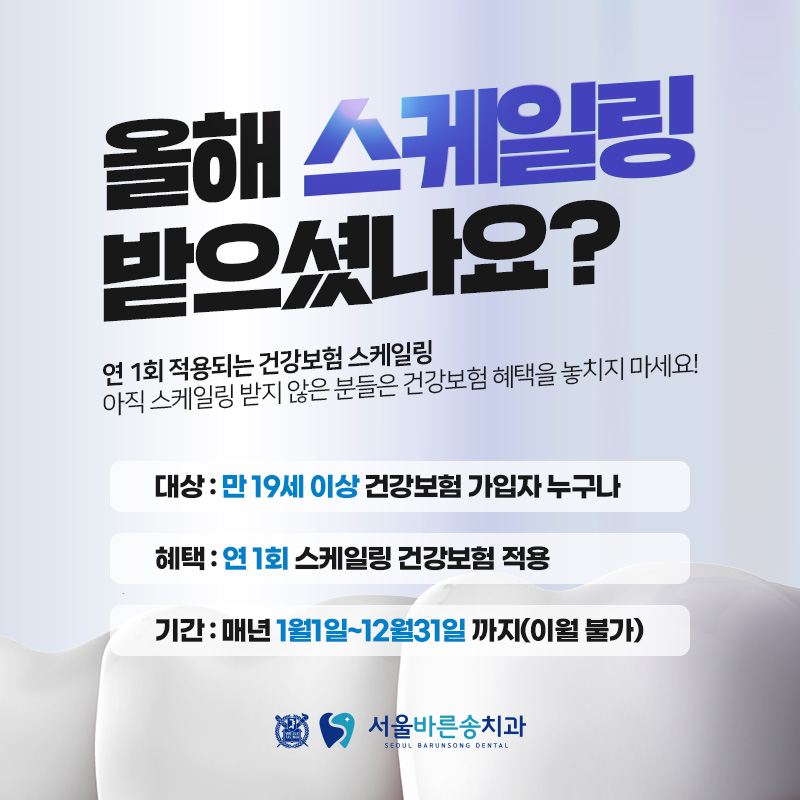
The annual benefit of one visit is strictly managed based on the calendar year from January 1 to December 31. Even if you have not used the benefit at all this year, the remaining visits do not carry over to the next year, so you must use it before the year ends. Mrs. Lee, a housewife, shared a close call where she forgot that dental appointments become crowded as the year ends and tried to book an appointment just before December 31, only to find no slots available, nearly losing the benefit.
Due to these regulations, dental clinics across the country are often packed with patients seeking scaling in November and December. Rushing to the dentist at the end of the year can make it as difficult as shooting stars to book an appointment at your preferred time, so it is wise to visit during the autumn or a less busy period in advance. Since the right to the benefit is permanently lost if not used within the designated period, setting a reminder in your smartphone calendar is a good method.
The application period ends at the end of each year, and unused visits do not carry over, so they must be used before year-end.
4. Differences Between Dental Scaling and Oral Care Devices
Recently, various high-end home care devices, such as AI-powered electric toothbrushes and oral irrigators, have been released and are attracting attention. However, no matter how advanced these devices are or how helpful they are for daily oral care, they cannot completely replace professional scaling performed by a dental specialist. Mr. Jung, an office worker, thought he didn’t need to visit the dentist after purchasing an expensive oral irrigator, but he immediately sought dental care after being told during a regular check-up that tartar had accumulated.
Tools used at home are excellent for removing food debris or light plaque from the tooth surface, but they cannot physically remove hardened tartar. The process of removing tartar that has deeply settled inside the gums using medical equipment at a dental clinic is an essential treatment for preventing periodontitis and gum bleeding. Therefore, the most ideal oral health management method is to maintain cleanliness with daily brushing and home care devices while regularly visiting the dentist for professional procedures.
Home oral care devices and professional dental procedures serve different purposes and functions, so they should be used complementarily.
5. The Scaling Treatment Process and Precautions
When you visit the dental clinic and treatment begins, the medical staff first conduct a thorough examination of your current gum condition and the extent of tartar accumulation. If your gums are significantly swollen or show signs of inflammation, you may experience slight sensitivity or bleeding during the tartar removal process, but this is a very natural phenomenon. Mr. Han, a freelancer who has a fear of dental treatment, was initially scared when he saw blood during his first scaling, but thanks to the doctor’s kind explanation, he now feels at ease and maintains regular care.
Immediately after the procedure, your gums may be sensitive, so it is helpful to avoid very hot or irritating foods for about a day to aid gum recovery. Additionally, temporary tooth sensitivity may occur as the tooth roots are exposed when tartar is removed, but this will naturally disappear over time. It is important to continue brushing diligently after treatment and to maintain the habit of using interdental brushes or dental floss to keep the spaces between your teeth clean.
Temporary sensitivity or bleeding may occur after the procedure, but this is a normal process, and irritating foods should be avoided.
6. The Importance of Regular Check-ups for Dental Health
It is most important to develop the habit of regular check-ups to assess your overall oral condition, rather than simply removing tartar once a year. Cavities and gum diseases are difficult to detect on your own in the early stages because they often cause no specific pain, so it is wise to have your overall condition checked when visiting the dentist. It is not uncommon to see cases where people incur significant costs for implants or major treatments due to periodontal disease discovered late.
Ultimately, the annual health insurance benefit is more than just a way to save money; it serves as a solid starting point for maintaining your precious natural teeth healthily for a lifetime. The small efforts of developing proper brushing habits and visiting the dentist at the designated times accumulate to become the secret to enjoying strong teeth even in old age. If you have not yet received this benefit this year, we recommend contacting a nearby dental clinic today to schedule an appointment and take the first step toward better oral health.
Actively utilizing the annual benefit and combining it with regular check-ups is the most reliable way to maintain lifelong dental health.
Frequently Asked Questions
=