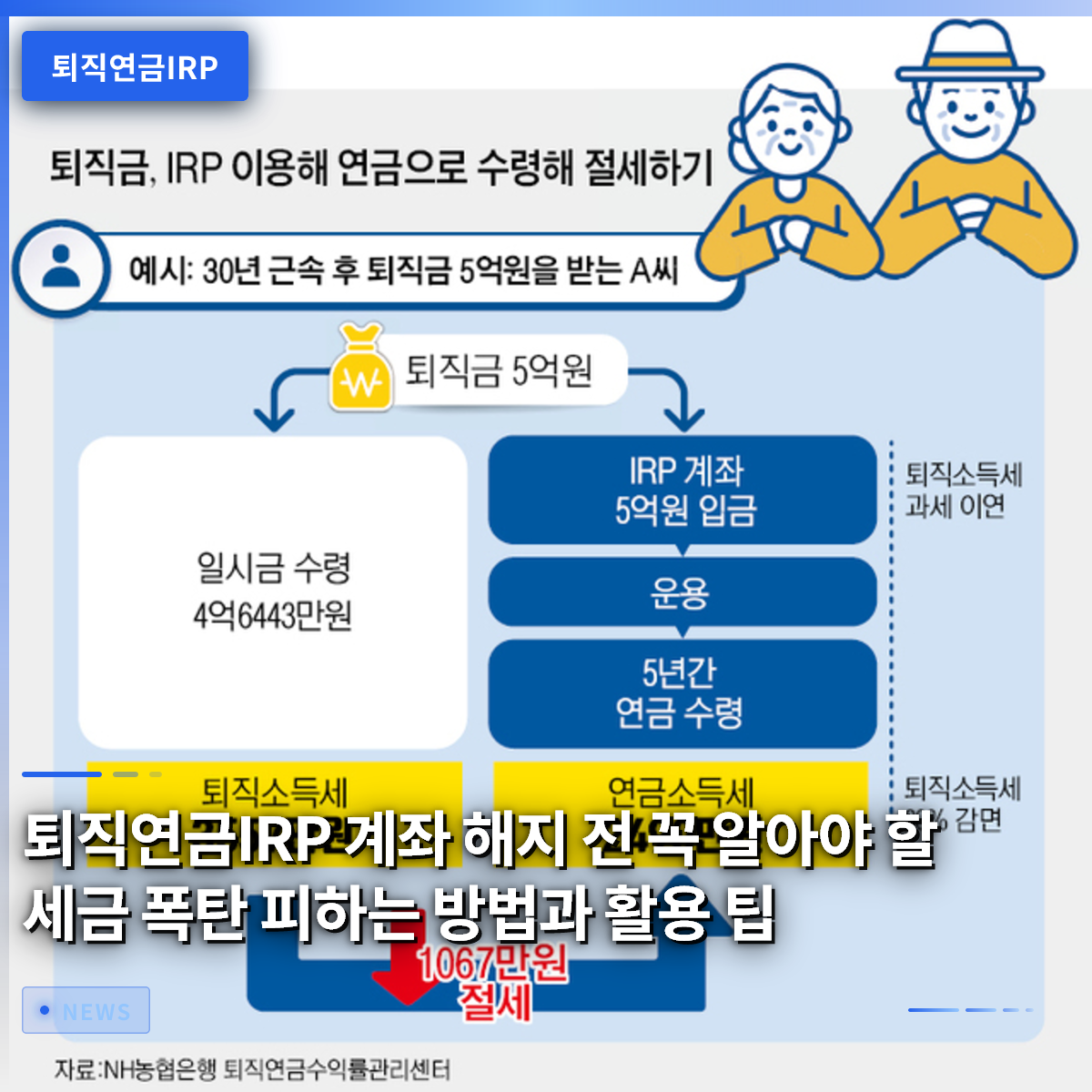
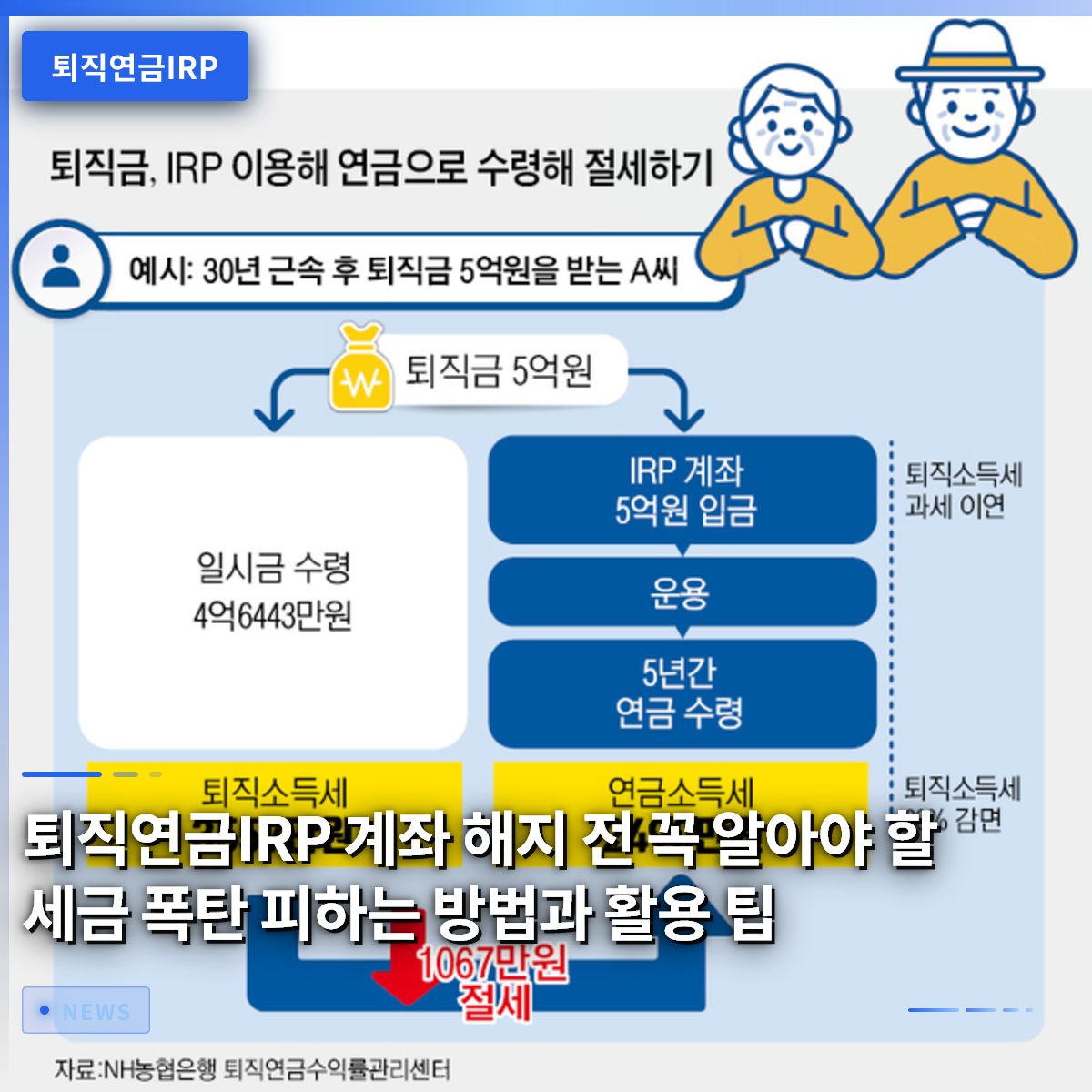
If you arbitrarily close your Retirement Pension (IRP) account, you will be required to pay substantial withholding taxes under the names of income tax and miscellaneous income tax. Therefore, you must never terminate the account mid-term; instead, you should convert it into a pension form. Many employees feel overwhelmed about how to manage their funds when changing jobs or approaching retirement, leading them to hastily close their accounts. However, if you ignore the legally prescribed procedures and receive your funds as a lump sum, you will be hit with severance income tax or miscellaneous income tax amounting to millions of won. In reality, it is common to see cases where people closed their IRP accounts due to a lack of deposit funds for a lease and later suffered a comprehensive income tax bomb, ending up in tears. In this article, we will examine in detail practical strategies to smartly protect your Retirement Pension IRP account, save on taxes, and grow your retirement funds.
=
Essential Tax Avoidance Strategies and Tips Before Closing Your Retirement Pension (IRP) Account
1. Understanding the Basic Concepts and Structure of Retirement Pension IRP Accounts

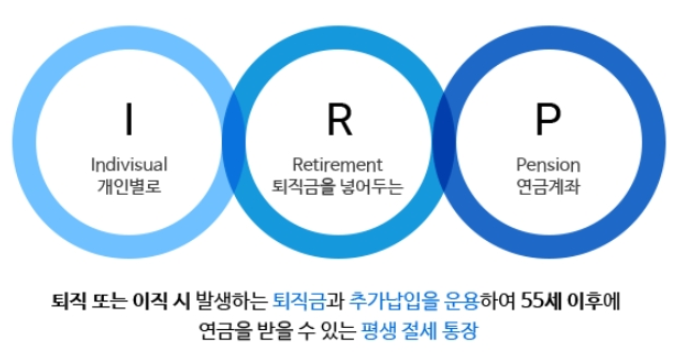
The Individual Retirement Pension (IRP) is a personal asset management pocket where employees can make additional contributions or accumulate severance pay from their employers while working, and then receive it as a pension after the age of 55. In the past, funds were often locked in according to methods determined by the company, or severance pay was settled and scattered every time an employee changed jobs. However, due to legal changes, it is now mandatory for funds to be automatically transferred to an IRP account in the individual’s name upon changing jobs. This is a powerful mechanism designed by the state to prevent people from easily using their severance pay like a trap and to encourage them to accumulate it in pension form until the end, thereby ensuring a stable retirement life. Anyone can easily open an account through financial institutions such as banks or securities firms and can generate returns by investing in various financial products such as stocks, bonds, and funds. Since this is an essential financial product that no employee can avoid, accurately understanding its structure and operating mechanism is the first step in wealth management.
This account is not merely a warehouse for storing money but also serves as a dedicated investment space for growing your assets independently. If you simply deposit the funds in regular savings accounts, they may not keep up with inflation, causing your real asset value to decrease. Therefore, you must build a portfolio that matches your investment style.
The Retirement Pension IRP is a personal asset management pocket designed to safely accumulate severance pay and carry it through to retirement.
2. A 4-Step Practical Process to Prevent Severance Pay Mistakes When Changing Jobs
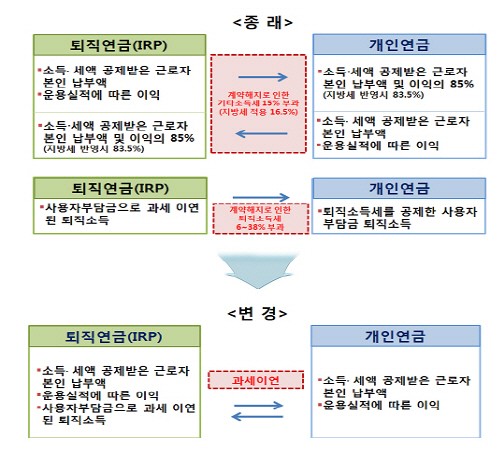
When changing companies, it is crucial to maintain continuity by ensuring that the severance pay generated at your previous job is safely transferred to your own Retirement Pension IRP account. If the company directly deposits the severance pay into your personal bank account during the job change process, severance income tax will be withheld, resulting in a significant reduction in the tax deduction amount. Therefore, once a job change is decided, you should first visit a securities firm or bank to open an Individual Retirement Pension account in your name and accurately inform the responsible department of your previous company of the account number. The company will transfer the severance pay to this account, at which point the previous tenure and tax deferral benefits are carried over, allowing you to avoid a tax bomb. If you mistakenly receive the money in your personal account, you must deposit it back into the Retirement Pension IRP account within 60 days to get a tax refund, so you must never miss this deadline.
Many employees find the complex documentation procedures annoying when changing jobs and simply cash out their funds, but this is an action that causes enormous long-term losses. You must maintain account continuity when changing jobs to fully enjoy the tax deferral effect, which allows you to postpone taxes until you receive the pension.
When changing jobs, severance pay must be directly transferred to the Individual Retirement Pension account to maintain the continuity of tax benefits.
3. Strategy to Maximize Tax Deductions by Filling the Annual 9 Million Won Limit
If you are an employee with income, you should contribute up to a maximum of 9 million won annually by combining pension savings and Retirement Pension IRP to secure substantial tax deduction benefits. Employees with a total salary of 55 million won or less can receive a refund of 16.5% of their contributions, while those earning more can still receive a tax refund of up to 13.2%. For employees who worry about tax bombs every year-end settlement season, this system is considered the best and most legitimate means of saving on taxes. For example, if you consistently contribute monthly to fill the annual limit, you can experience the surprise of receiving hundreds of thousands to over a million won back in your account each year. Since pension savings alone can only be deducted up to 6 million won, you must additionally contribute the remaining 3 million won to the Retirement Pension IRP to fully utilize the 9 million won limit.
For employees in their 40s and 50s who want to quickly grow their retirement funds, strategically utilizing this annual tax deduction limit is an essential wealth management technique. If you lack surplus funds, setting up automatic monthly transfers is the most advantageous long-term strategy as it reduces the burden while ensuring consistent contributions.
Contributing a total of 9 million won annually to pension savings and Retirement Pension IRP allows you to receive a powerful tax deduction during year-end settlement.
4. The Truth About the Fearsome Tax Bomb When Terminating Mid-Term
If you arbitrarily close your Retirement Pension IRP account because you need urgent cash, you will not only have to return the tax deduction benefits you have received but also face a bomb of miscellaneous income tax and severance income tax. Unless it is for an exceptional reason permitted by law, such as purchasing a house or securing a deposit for a lease as a non-homeowner, a high miscellaneous income tax of 16.5% is imposed upon mid-term termination, significantly reducing your principal. The severance income tax imposed when receiving severance pay as a lump sum is also subject to a much higher tax rate than when received as a pension over a long period, dealing a major blow to asset formation. In reality, many people regret closing their accounts due to a lack of lease funds, only to have a large amount of tax deducted, which is a fatal mistake that erodes your retirement assets. If you are in a situation where you urgently need money, it is much wiser to utilize the pension collateral loan system, which allows you to borrow up to 50% of your accumulated balance at a low interest rate, rather than closing the account.
To protect your hard-earned money and get through a crisis, you need the wisdom to first explore various legally guaranteed relief measures instead of making the extreme choice of closing the account. To avoid the scary barrier of taxes, you must strictly maintain this account without closing it until retirement.
Mid-term termination leads to huge losses due to high taxes and the clawback of deduction benefits, so you should first consider alternative means such as loans.
5. The 70% Limit on Risky Assets and Tips for Equity Investment
To safely protect retirement assets, the Retirement Pension IRP account is restricted to investing only up to 70% of the total accumulated balance in risky assets such as equity index funds. The remaining 30% must be filled with safe assets such as deposits or bond-type products, which may feel somewhat restrictive for those seeking aggressive investments. However, recently, various investment techniques have gained popularity that cleverly combine products like bond-hybrid funds to effectively raise the actual equity investment ratio beyond the limit. For example, by utilizing specific bond-hybrid products that fall under the safe asset classification, you can bypass the risky asset limit, maximize your equity ratio, and increase returns. Carefully examining the composition of various products through securities firm apps and building a customized portfolio that matches your investment style and retirement timing is the key to successful retirement asset management.
Given the nature of retirement funds, which require both safety and profitability, adhering to the principle of diversification is far more important than engaging in excessive high-risk investments. Utilizing Target Date Funds (TDFs) recommended by experts can make management much easier, as they automatically adjust the ratio of stocks and bonds according to the subscriber’s age.
The 70% investment limit on risky assets can be flexibly overcome by utilizing bond-hybrid products or TDFs.
6. Receiving Pensions After Age 55 and Prospects for Successful Retirement Planning
Once you reach retirement age and become 55 or older, you can receive the funds accumulated in your Retirement Pension IRP account as a monthly pension rather than a lump sum, perfectly filling the income gap after retirement. When received as a pension, you can enjoy a tax reduction of up to 30% on severance income tax compared to receiving it as a lump sum, resulting in a dramatic reduction in tax burden and the best tax-saving effect. The pension that comes in steadily each month serves as a fixed source of income after retirement, acting as a sturdy pillar that supports a stable retirement life along with the National Pension. Only those who have shown interest early in their 40s and 50s and consistently grown this account over a long period can enjoy economic freedom and a leisurely life in their retirement. As related tax benefits and financial products will continue to evolve, you should not miss the latest trends and actively manage your account according to your asset situation.
If you neglect or close your Retirement Pension IRP account due to immediate benefits or inconvenience, it is no different from inflicting a great wound on your future self. Starting today, please check your account balance, gradually increase your monthly contributions, and steadily prepare for a confident and abundant retirement.
Choosing to receive a pension after age 55 allows you to enjoy stable retirement income for life along with tax reduction benefits.
Frequently Asked Questions
=