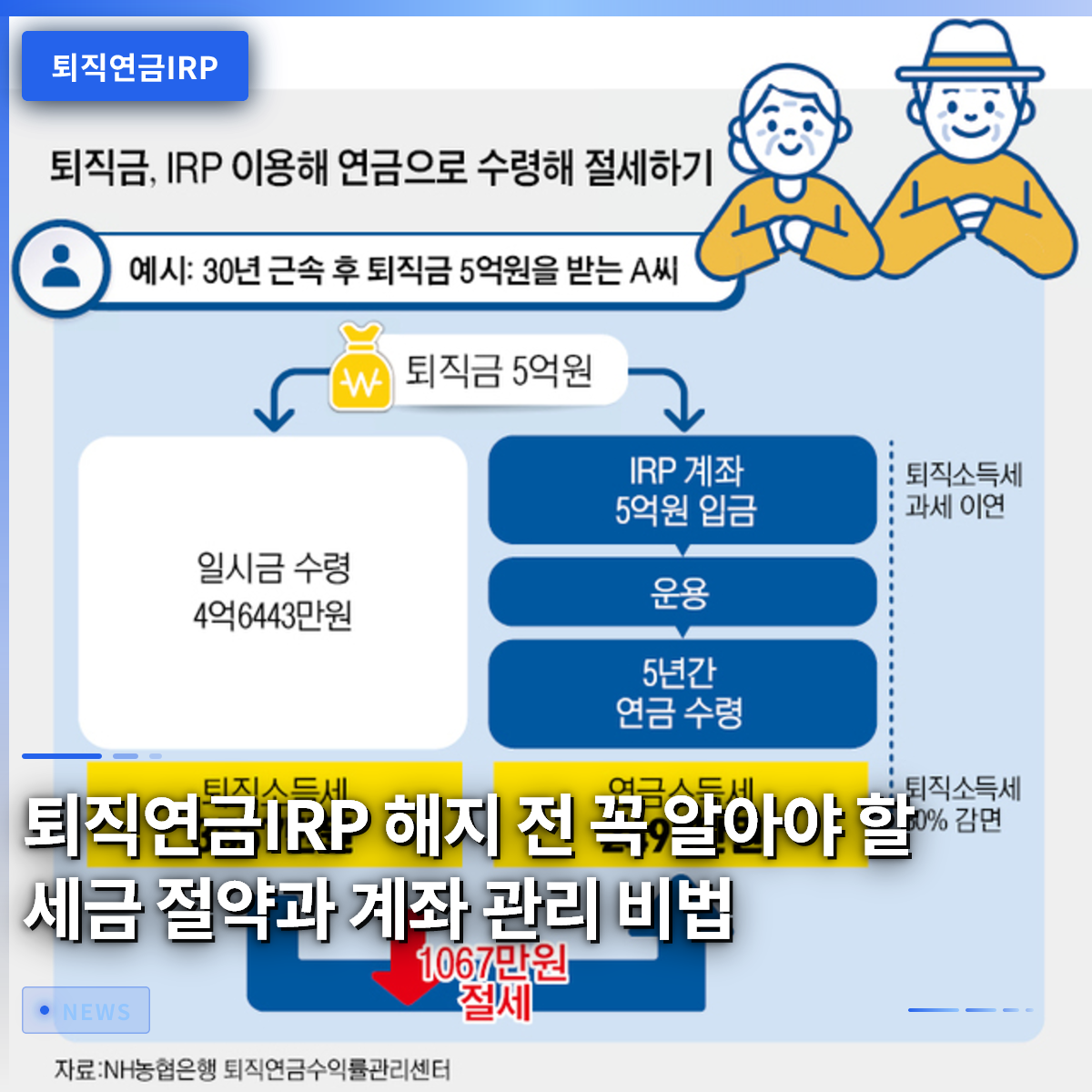
The Individual Retirement Pension (IRP) account is the most reliable financial product for significantly saving on taxes while preparing for retirement. Many employees receive a lump sum when they change jobs or retire, and unfortunately, many regret it later after carelessly terminating their account and facing a “tax bomb.” For example, Kim, a corporate clerk, immediately cashed out his 30 million won severance pay for immediate needs, only to miss out on the severance income tax exemption and end up paying several million won in taxes. As interest grows in tax law revisions and various tax-saving financial products, it is more important than ever to properly understand the structure of the IRP, which is the core of retirement funds. In this article, we will carefully examine everything from the exact eligibility requirements for joining an IRP to tax deduction benefits and methods for safely growing your assets while saving on taxes.
=
Essential Tax-Saving and Account Management Tips to Know Before Terminating Your IRP
1. The Concept and Necessity of the IRP

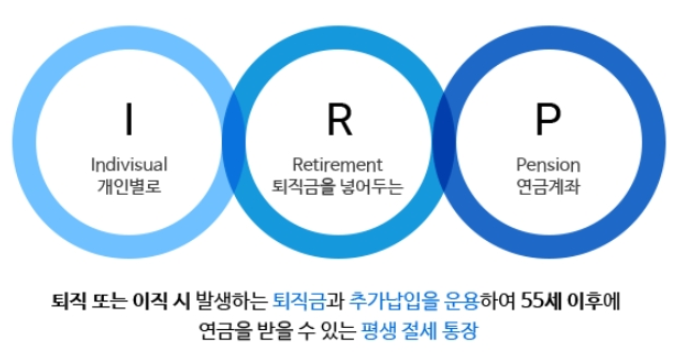
The IRP is a dedicated account designed to allow employees to voluntarily enroll during their employment or to consolidate severance pay received upon job changes into a single account, ensuring safe management until retirement. In the past, severance pay was often deposited directly into regular bank accounts and quickly spent on daily living expenses. However, following regulatory changes, the system now legally encourages these funds to be preserved entirely for retirement. This account has evolved beyond a mere storage place for severance pay into a powerful wealth management tool that allows individuals to make additional contributions and receive tax deductions. For many employees, this pension account is one of the essential items they check first during the annual year-end tax settlement season. In modern society, where the retirement age is gradually decreasing, it is a mandatory financial asset that every employee must have to ensure a stable lifetime income.
Eligibility has also expanded significantly. While it was previously limited to Defined Contribution (DC) pension participants and self-employed individuals, it now covers almost all employed individuals with income. Even those enrolled in the Private School Pension or Military Pension, such as civil servants and military personnel, can participate, making it accessible to the vast majority of South Korean citizens. Through this account, individuals can directly select and manage various products, such as funds or deposits, actively managing returns rather than leaving them untouched. The barrier to entry is very low, as accounts can be easily opened non-face-to-face via mobile apps or by visiting financial institutions like banks or securities firms. The IRP is the infrastructure that provides the most systematic and realistic solution to the daunting task of retirement preparation.
The IRP is an essential financial account that allows you to save severance pay, prepare for retirement, and enjoy tax benefits.
2. Utilizing Tax Deferral Instead of Termination Upon Receiving Severance Pay
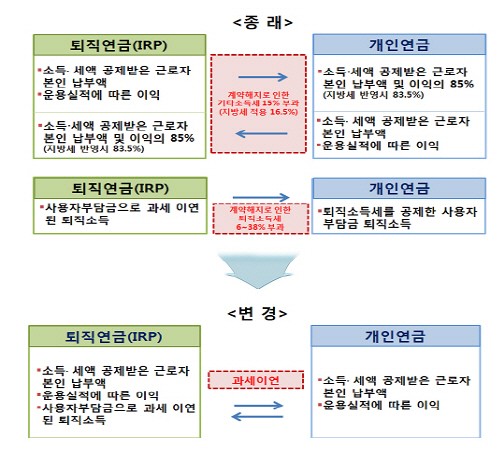
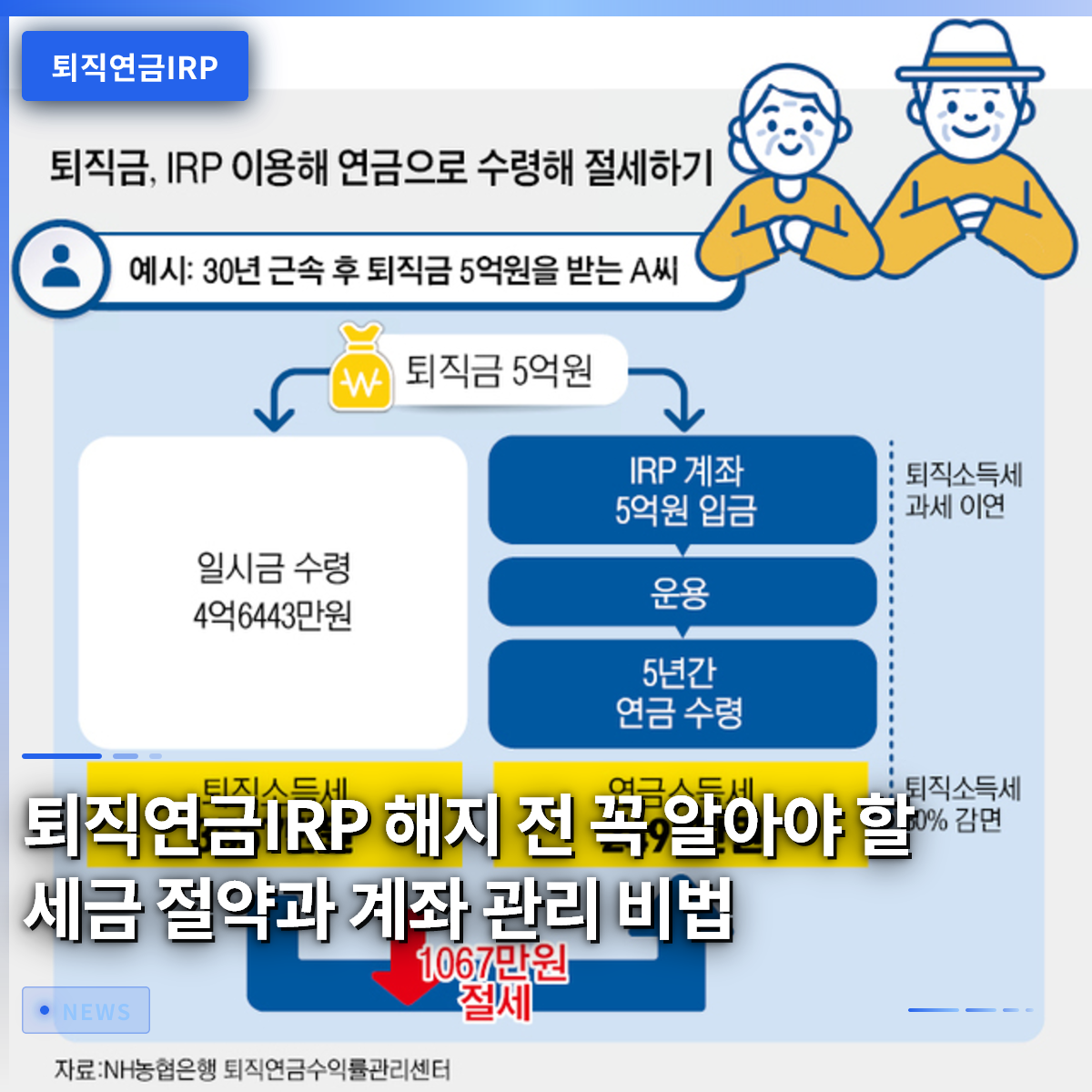
The most critical point to note when leaving a company and receiving severance pay is that you should never rashly cash it out into a regular account and terminate the pension account. If you transfer your severance pay to an IRP account and receive it there, you can defer paying the severance income tax until you actually start receiving the pension in your later years. This is known as tax deferral. For example, if the tax on a 50 million won severance pay is 5 million won, receiving it in a regular account means having that tax deducted immediately. However, transferring it to a pension account allows the full 50 million won to continue growing. If you later receive it as a pension after the age of 55, you can receive a tax reduction of 30% to 40% on the original tax amount, resulting in a significant tax-saving effect. If you terminate the account simply because you need a lump sum immediately, you lose all tax benefits and are subject to a heavy punitive tax called miscellaneous income tax.
Many people make the mistake of choosing early termination and accepting the “tax bomb” because they need a lump sum after retirement. However, utilizing the tax deferral system allows both the principal and the money that would have gone to taxes to grow together, maximizing the compound interest effect. If you inevitably need to use the funds, it is wise to consider early withdrawal only if it falls under statutory grounds such as home purchase, deposit for a jeonse (long-term lease), bankruptcy, or natural disaster. For employees who change jobs frequently, severance pay accumulates in a single account with each move, maintaining the continuity of asset management. Therefore, when you receive the severance pay notification, do not panic; the first step is to submit the account number of your personal pension account to your company.
When receiving severance pay, it is advantageous to transfer it to a pension account to enjoy tax deferral benefits rather than terminating it in a regular account.
3. Annual Tax Deduction Limits and Benefits
The IRP is not only for managing severance pay but also exerts tremendous power in increasing your year-end tax settlement refund by making regular contributions. You can receive tax deductions on annual contributions up to the limit when combined with pension savings products, with the deduction rate varying based on total income. Employees with a total income of 55 million won or less can receive a refund of 16.5% of their contributions, while those with higher incomes can receive a 13.9% refund during year-end tax settlement. For example, if you contribute the maximum limit amount throughout the year, you are essentially receiving the largest possible tax refund gift available to employees. For this reason, as the year-end approaches every year, many people make additional contributions to their accounts to fill the remaining deduction limit.
Since pension savings alone often do not cover the entire deduction limit, it is common to structure your portfolio by filling the remaining limit with an IRP. Manager Park, an office worker, used to worry about the “tax bomb” every year-end tax settlement but started consistently contributing to his pension account a few years ago, now receiving refunds of several hundred thousand won annually. A point to note is that you should adjust your contribution amount according to your cash flow, as forcing in large amounts can lead to financial difficulties due to locked funds. Additionally, since the annual contribution limit is adjusted slightly according to laws, it is necessary to habitually check the latest tax law revisions. This account is so powerful that one could say that simply managing tax benefits efficiently accounts for half of an employee’s wealth management success.
Consistently contributing to a pension account allows you to enjoy tax deduction benefits ranging from several hundred thousand to over one million won during year-end tax settlement.
4. Asset Management Methods and Utilizing Default Options
The most common mistake after opening an IRP account is leaving the money untouched or depositing it solely in safe deposits. Considering inflation, it is difficult to sufficiently grow the assets needed for retirement with deposit interest rates alone, so you must diversify investments into various products such as equity funds or Exchange-Traded Funds (ETFs). Recently, the “Default Option” system has been introduced, where financial institutions manage assets according to pre-set methods if the subscriber does not provide direct investment instructions, increasing its utility. By selecting a portfolio suitable for your investment style, such as a risk-neutral or aggressive investment type, you can have your returns and asset status checked periodically. The advantage is that even if employees cannot monitor the stock market daily due to busy schedules, they can pursue stable returns through product structures designed by experts.
However, due to the nature of tax-benefited accounts, there are some restrictions on the types of investable products and the allocation ratio of safe assets. A certain percentage of the total accumulated funds must be invested in safe assets, so it is impossible to allocate 100% to stocks due to system limitations. Therefore, you must appropriately balance the ratio of safe assets like deposits or bond funds and high-growth equity funds according to your age and retirement timing. Since asset management fees and fund expense ratios vary slightly among financial institutions, comparing them before joining is a small but useful saving tip. Given the long-term nature of pension investments, remember that small fee differences can result in enormous amount differences decades later.
You should increase long-term asset returns by appropriately combining default options and various fund products.
5. Utilizing ISA Maturity Funds in Connection with IRP
If you have joined the Individual Savings Account (ISA) and enjoyed substantial profits, you will likely wonder where to move the funds upon maturity. This is when an amazing opportunity arises: transferring ISA maturity funds to an IRP account allows you to receive additional tax benefits. After enjoying tax-exempt and separately taxed benefits on profits and dividend income from the ISA account, you can transfer the remaining principal and earnings entirely to the pension account. Additional tax deduction limits are provided for these transferred amounts, allowing you to enjoy the dual benefit of growing a lump sum at once while saving on taxes. Mr. Choi, an employee, transferred his ISA maturity funds to his pension account, safely managing tens of millions of won while also securing an additional tax deduction bonus.
This inter-account transfer path is an institutional channel created by the government to actively support citizens’ retirement asset formation, so utilizing it actively is a wise financial practice. Instead of simply withdrawing to a regular bank deposit account to spend, choosing to switch to a pension account prevents tax leakage and maximizes the compound interest effect. However, you must accurately calculate the dates, as the funds must be deposited into the pension account within 12 days after ISA maturity termination to fully receive these tax benefits. The funds are safely transferred without complex paperwork by simply following a brief application procedure at a financial institution branch or via a mobile app. Only those who understand these inter-account linkages well can preserve more assets in the process of growing their retirement funds.
Transferring ISA maturity funds to a pension account allows you to secure both additional tax deductions and tax-saving benefits simultaneously.
6. Checks and Prospects for a Successful Retirement
The government continues to refine the retirement pension system to strengthen income security for citizens in old age, and various changes, such as mandatory enrollment or the introduction of default options, are anticipated. In this policy trend, periodically checking how your pension account is managed is not a choice but an essential condition for retirement survival. Using official websites like the Integrated Pension Portal allows you to compare the scale of accumulated funds, long-term returns, and various fees for all your enrolled pensions at a glance. It is necessary to adopt an attitude of actively utilizing experts’ webinars or financial institutions’ asset management services in line with the changing tax law revisions each year. Retirement preparation is not achieved overnight but is the result of small habits consistently built up over decades.
Retirement may feel like a distant future event right now, but you must not forget that the magic of compound interest supports our lives more powerfully the earlier you start. Do not view the IRP account as a mere annoying mandatory product, but as the most reliable shield protecting your assets and a treasure trove for tax savings. When changing jobs or receiving severance pay, never terminate impulsively; instead, exercise wisdom in saving taxes by utilizing the tax deferral system. If you want to receive your refund with a smile every year-end tax settlement season, why not check your pension account balance and managed products today? Thorough preparation and wise account management will promise you a comfortable and abundant retirement life.
You must periodically check and manage your pension assets using tools like the Integrated Pension Portal to keep up with the constantly changing system.
Frequently Asked Questions
=