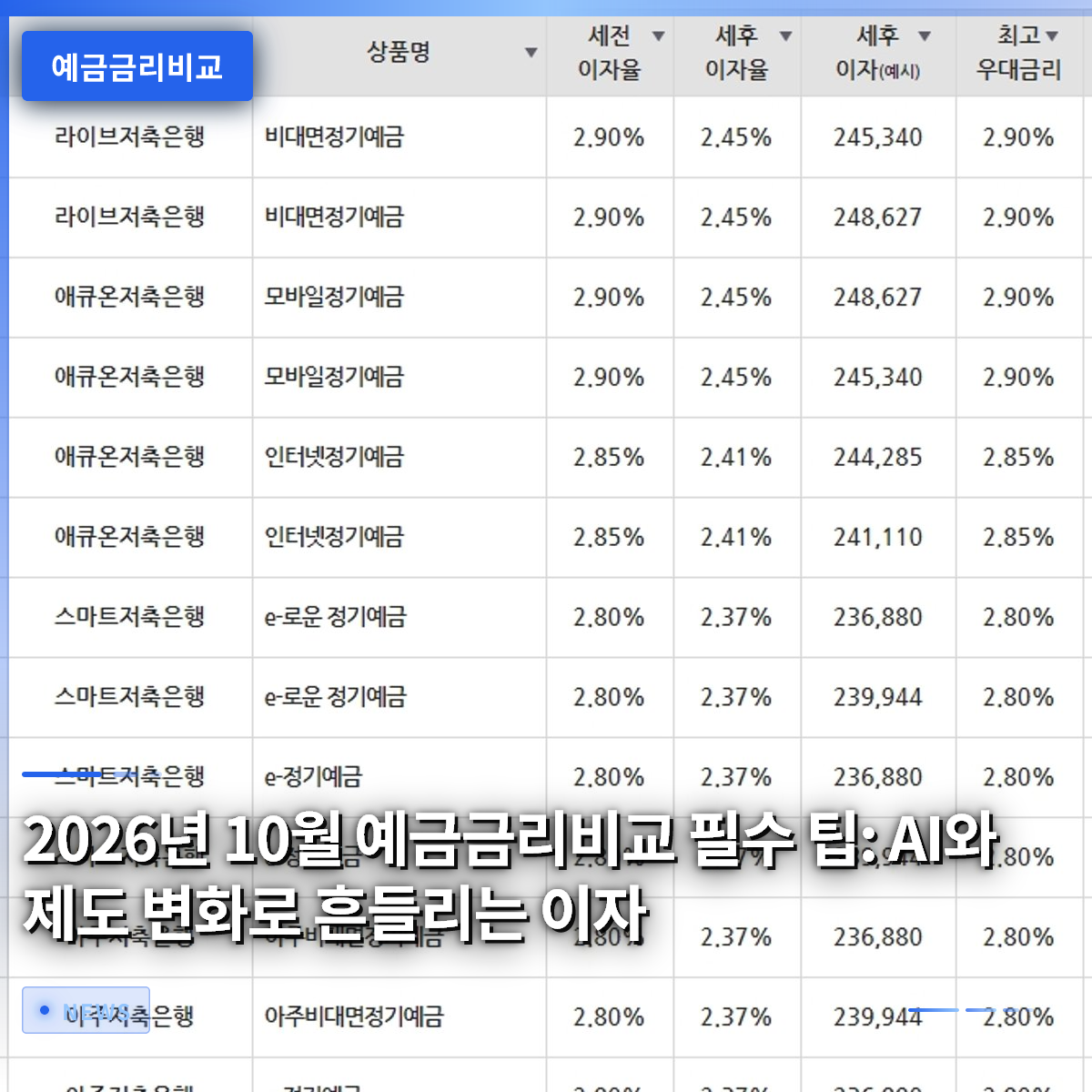
In the future, the effort to manually search for and compare deposit rates or transfer accounts will become increasingly meaningless, as an era dawns where artificial intelligence, rather than financial consumers, can move our money. As of October 2026, with the base rate reduction cycle nearing its end, competition for non-interest income between major commercial banks and second-tier financial institutions is intensifying. However, the perceived interest rate differences for general depositors now require more sophisticated calculations than in the past. Previously, people would visit bank branches or open mobile banking apps to check rates, but now the use of AI asset management assistants is becoming the norm. Consequently, it is no longer just about which bank holds your assets, but rather under what conditions they are tied up. In particular, the Financial Services Commission’s push to formalize the agency or brokerage system for deposit-like products is set to fundamentally change how comparison platforms make recommendations, meaning current comparison criteria may soon lose their validity. However, before these institutional changes are fully established, understanding the actual interest rates of each institution remains essential to maximize the safety and yield of your cash. In this article, we will analyze the actual interest rate trends in the banking and savings bank sectors as of October 2026, and also examine the risks of mechanical fund movements that could signal AI-driven market disruptions.
=
Essential Tips for Comparing Deposit Rates in October 2026: Interest Rates Shaken by AI and Regulatory Changes
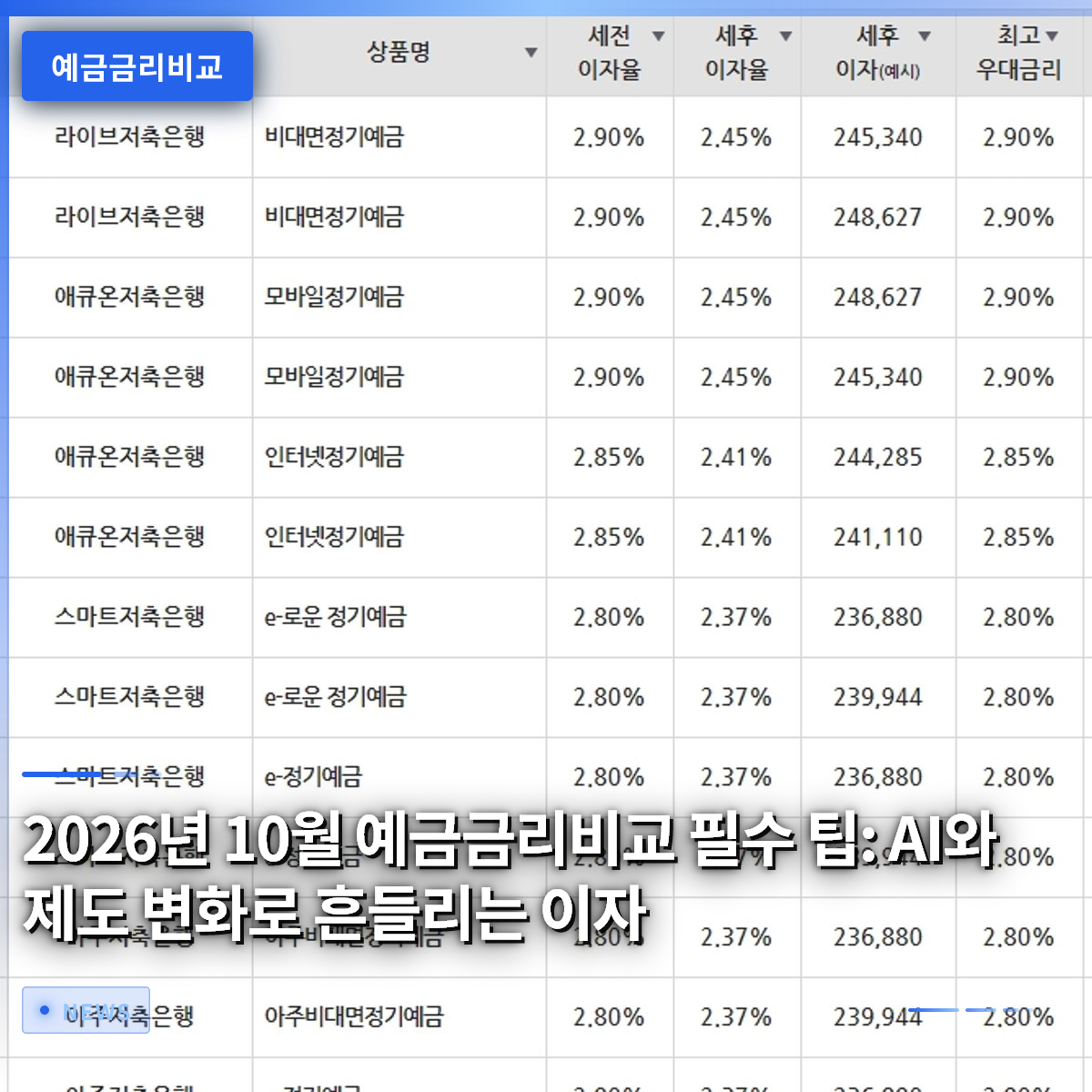
1. The October 2026 Interest Rate Freeze: How Significant Are the Perceived Rate Differences?
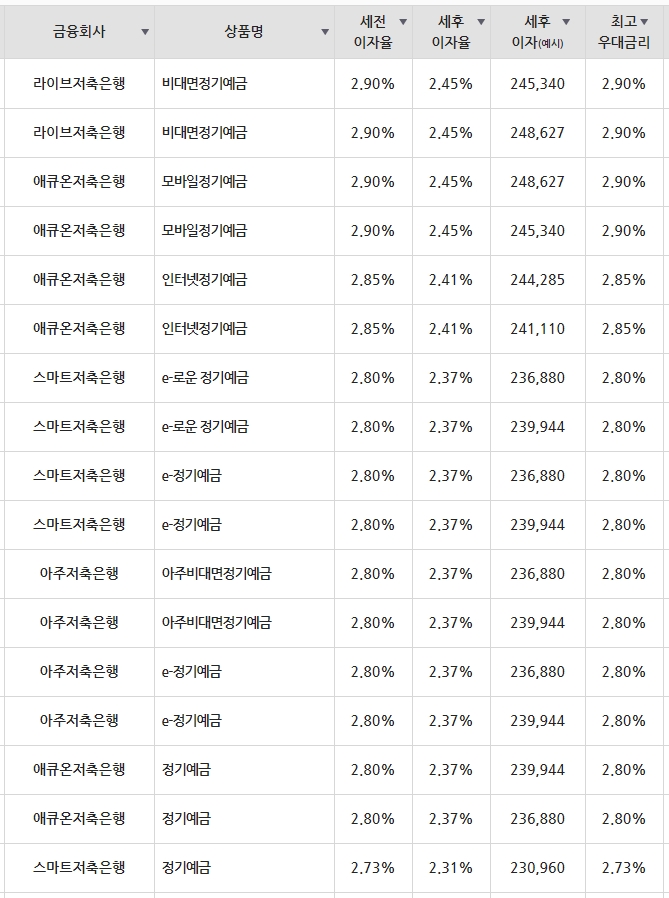
As the cycle of declining base rates nears its end this year, banks are not forcibly raising deposit rates but are instead retaining customers through various fees and ancillary benefits. According to news reports, the average interest rate gap between the two sectors has recently narrowed to just 0.21 to 0.36 percentage points, a much sharper decline compared to the 1.02 percentage point difference seen in July of last year. Simply put, if you deposit 10 million won, the interest difference over one month would be between 2,100 and 3,600 won. This amount is less than the cost of one or two coffees, making it easy for many people to dismiss it as insignificant. However, the issue is that these small differences accumulate over time due to the compound interest effect when accounts are switched over periods of one or three years. For example, if you deposit 50 million won for a three-year term, the difference can grow into a significant amount. Therefore, while high-interest special sales products offering 5-6% are flooding the market, there are many hidden pitfalls behind them, such as how interest rates are applied upon early repayment or conditional rate adjustments. It is wise not to look only at the surface numbers. In other words, banks are focusing on profit defense rather than external growth, leading to a trend where favorable interest rates are concentrated in core deposit tiers or long-term funds.
Although interest rate differences are shrinking, they still impact actual returns for those planning long-term investments. It is crucial to examine the pitfalls of conditional interest rates.
2. The Risk of AI-Driven Fund Movements: The Era When Your Deposits Move Automatically
Previously, even if people knew that deposit rates were low, the hassle of installing and comparing multiple bank apps and performing due diligence meant that a significant portion of funds remained in low-interest accounts. However, the situation has changed completely with the spread of AI agents that manage personal financial assets. These systems detect the balance in your bank account and higher deposit rates elsewhere in real-time. Warnings are emerging that if you leave a large sum in an account you are indifferent to, an “AI-driven bank run” could occur, where AI automatically moves funds to institutions offering higher interest. For banks, this poses a risk of sudden deposit outflows. For consumers, it means deposit conditions (maturity dates, early termination penalties, etc.) could change at times you do not want. For example, if you need to liquidate funds urgently in a month, but the AI mistakenly transfers them to a long-term deposit with a higher rate, it could lead to significant losses. Therefore, before using AI for asset management, it is becoming a common safety rule to designate specific accounts as “no automatic transfer” accounts or to set conditional restrictions. If such mechanical movements become widespread, interest rate competition between banks will inevitably intensify, and short-term volatility will increase.
AI’s automatic fund transfer feature helps maximize returns but carries risks such as penalties or errors in liquidation timing. A strategy of separating management accounts is necessary.
3. Savings Banks and Credit Cooperatives: How to Verify the Real Rate Behind Advertising Copy

If you directly check the comparison disclosures from the Savings Bank Central Association or the inquiry screens of Credit Cooperatives, you will see a clear distinction between basic rates available without conditions and special rates that are not. Recently, high rates such as “4.31% annual” are advertised, but these are usually special sales products that require meeting specific conditions during the period to be applied. For example, the high rate is maintained only if you subscribe to specific asset insurance or make a certain number of overseas remittances; otherwise, it can drop to the basic rate at any time. There are many blogs and news articles promoting the highest fixed deposit rates for October, but if the conditions do not match your lifestyle pattern, you will ultimately be subject to the lowest rate and incur a loss. Therefore, it is essential to review the detailed terms to understand how standard business conditions and preferential rate limits are set before signing up. It is more economical to choose the option that offers the highest yield within a level of inconvenience you can tolerate, rather than simply looking for the largest number.
High interest rates are mostly tied to conditions. If the conditions do not match your lifestyle, you will end up with the lowest rate, so comparisons should be based on the basic rate.
4. Formalization of Deposit Comparison Platforms: Controversy Over the Fairness of Recommendation Algorithms
With the Financial Services Commission announcing supervisory regulations on agency and brokerage for deposit-like products from September 28 to November 9, 2026, the way deposits are recommended in apps is expected to be organized within legal boundaries. Until now, when users signed up, platforms often prioritized products from partner banks that benefited the platform or used non-reversible priorities based on fee incentives. However, with formalization, deep considerations are arising regarding whether companies offering higher rates must always be at the top, or whether a fair comparison system independent of fee revenue will be introduced. This could provide practical benefits to us, but it may also be a period of confusion as the user experience changes temporarily. For example, in the past, opening a specific account was more advantageous than logging into a deposit comparison app, but in the future, as data from both platforms integrates, we are expected to receive more precise customized suggestions. We will now approach the “maximum value shown in this app” with a skeptical eye, questioning whether it is truly the maximum among all banks, and we will develop the habit of cross-verifying with at least 2-3 independent platforms.
The formalization of deposit brokerage is strengthening the fairness and transparency of recommendation methods. We are entering a period where cross-verification is required rather than blindly trusting a single platform.
5. CD-Linked Derivative-Linked Products: Is It Possible to Pursue Returns Beyond Principal Guarantee?
Products like Hanwha Investment Securities’ recently launched “Plus DLB No. 2,” which is linked to Certificate of Deposit (CD) rates, offer return opportunities that exceed ordinary fixed deposits. These products are derivative-linked bonds designed to pay returns linked to the 91-day CD rate while guaranteeing 100% principal repayment at maturity or early redemption. Unlike regular deposits where interest is paid all at once at maturity, these products allow for annual cash flow management and are considered advantageous for comprehensive financial income tax management. For example, while you may aim for a 7.5% annual return opportunity, this is a disclosed value, and actual yields may vary with market interest rate fluctuations, so one should not be overly reassured by the principal guarantee. These products have a more complex structure than regular fixed deposits, so one must understand the possibility of losses upon early termination and the method of interest rate linkage. Therefore, this is a suitable option only for those with ample surplus funds and at least basic knowledge of financial products; it carries significant risks for general beginners who follow blindly.
CD-linked derivative products have high return potential, but their complex structure and yield variability due to market volatility require expert analysis or sufficient understanding before approaching them.
6. Future Outlook and Strategies for Wise Consumer Behavior
Moving past October 2026, the ecosystem between the banking sector and financial platforms is changing along two axes: technology and regulation. As AI moves our assets on our behalf, we must no longer be “searchers” but “designers.” In other words, we need a portfolio approach where we leave a certain percentage of assets in dormant accounts, entrust another percentage to AI automatic transfers, and separate a portion into manual accounts that we strictly control. Additionally, as deposit rate comparison platforms are incorporated into the regulatory framework, it is important to strategically time our sign-ups by understanding the cycles of customary preferential rate changes, rather than blindly trusting the recommendation results. If you currently have 30 million won in cash, I recommend also considering the simple calculation that prioritizing loan repayment might be more advantageous than putting it into a 3% annual deposit. In unstable market environments, a balanced perspective is needed that adheres to the basic principle of safeguarding asset safety while not missing out on the benefits of new financial technologies and systems. Let us keep a close eye on the moves of financial companies entering cost-cutting management ahead of the coming winter and consider our own optimal deposit combination.
In the midst of AI and regulatory changes, assets should be separated into areas suitable for automation and areas for manual management. A comprehensive interest rate strategy, including comparative analysis with loan repayment, is required.
Frequently Asked Questions
=