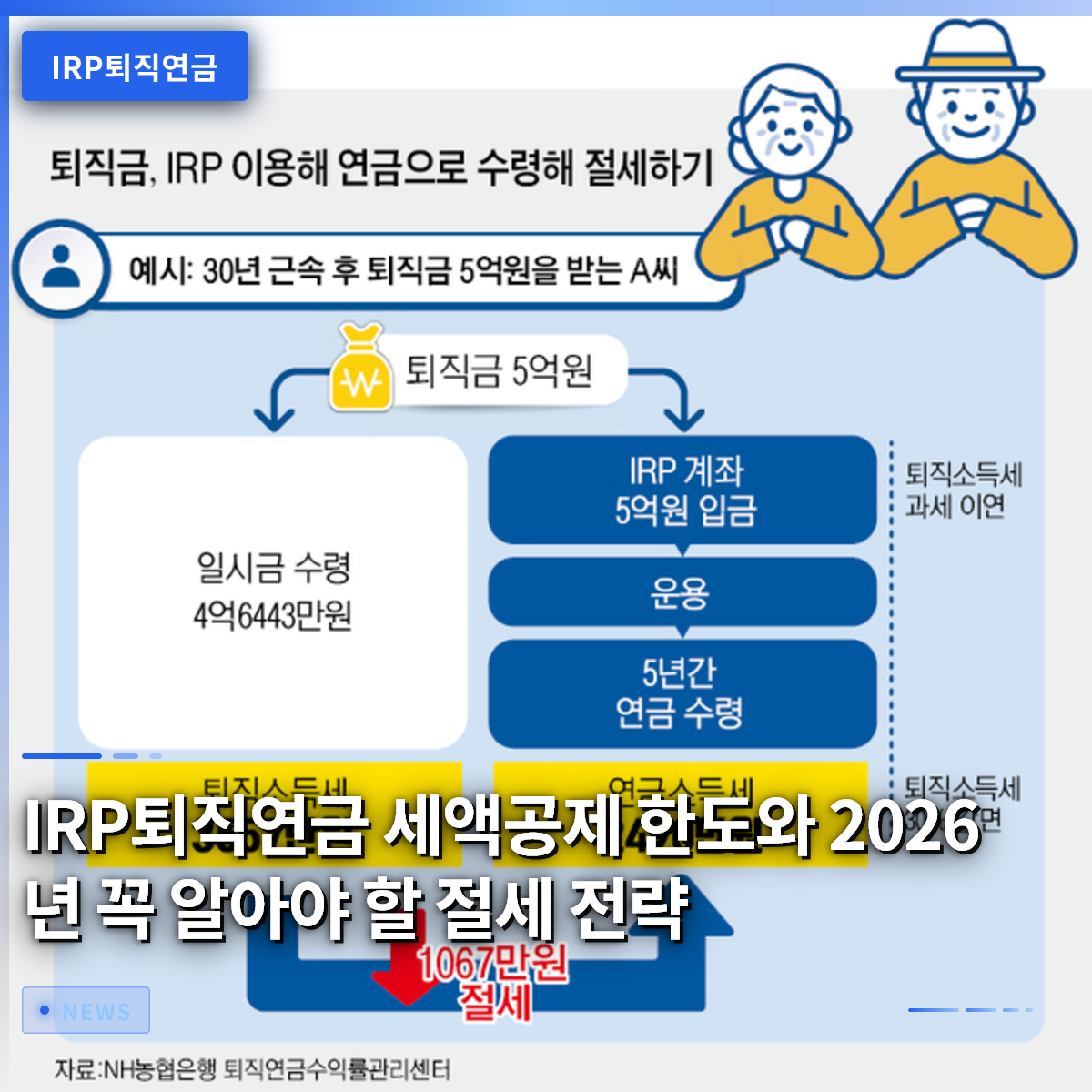
The IRP (Individual Retirement Pension) account is an essential financial product for employees, allowing them to receive tax refunds ranging from several hundred thousand to over a million won during the annual year-end tax settlement. Last year, my colleague Kim was shocked when he received his year-end tax refund statement. He had made additional contributions to his IRP, which he had been keeping an eye on, and as a result, he received an unexpected lump sum. While many people view it simply as savings for old age, it actually serves as a reliable shield against the annual tax burden. Recently, the financial sector has been actively promoting the utilization of these accounts by hosting various tax-saving workshops and webinars tailored to recent tax law amendments. In this article, we will take a detailed look at the exact tax deduction benefits and limits of the IRP, as well as the management tips that employees must know. If you want to secure both your post-retirement life and immediate tax savings, please read on to the end.
=
IRP Pension Tax Deduction Limits and Essential Tax-Saving Strategies for 2026
1. What is an IRP Pension?

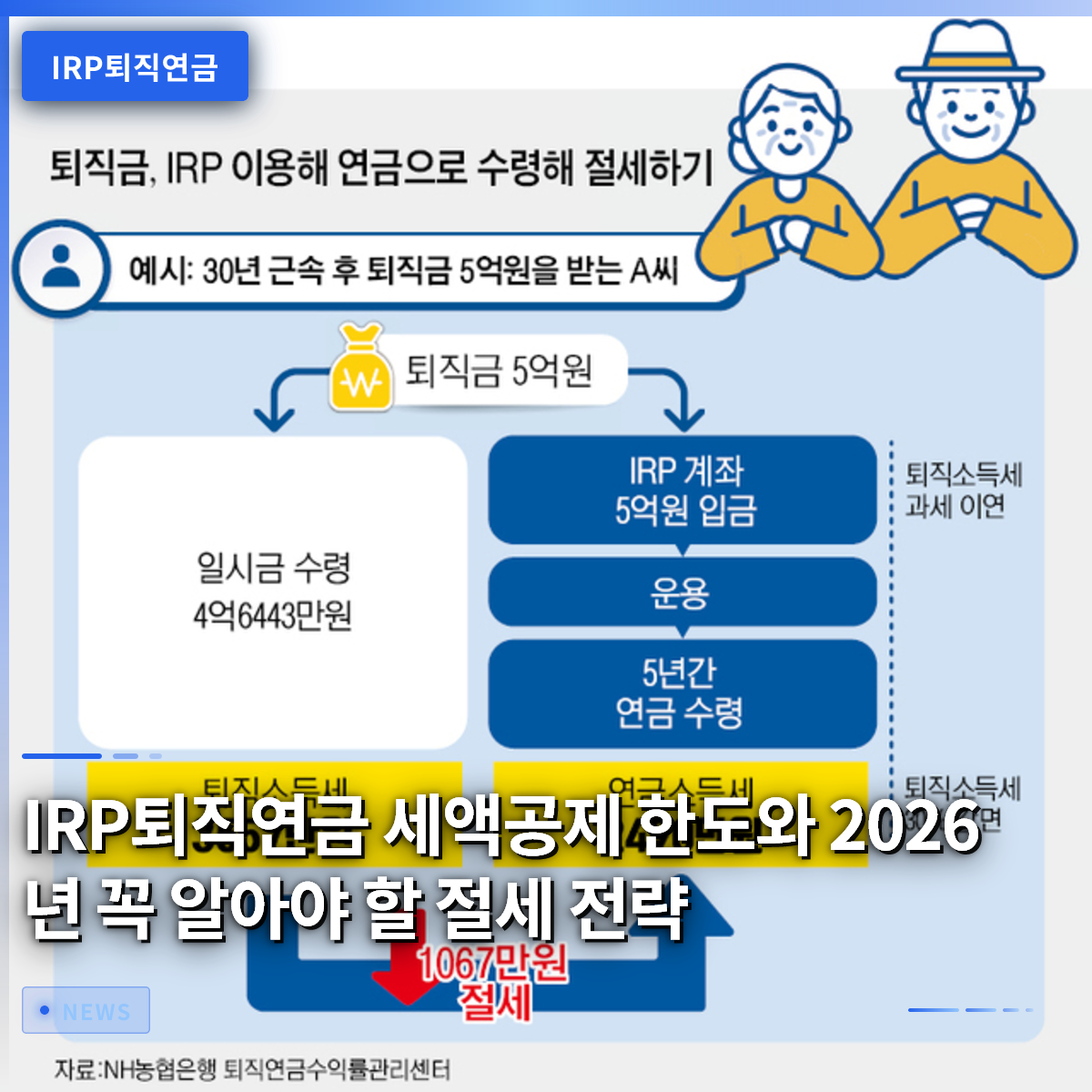
The IRP, or Individual Retirement Pension, is a system that helps employees accumulate their severance pay in a personal account when they change jobs or retire, allowing them to receive it as a pension after the age of 55. In the past, only those receiving severance pay were required to have one, but now, employed individuals with income and self-employed workers can freely join to grow their assets. During one’s working life, it is easy to receive severance pay as a lump sum when leaving a company and spend it on living expenses. However, transferring this amount to an IRP account allows for tax deferral while preserving the funds entirely for retirement. Legally classified as a safe, dedicated pension portfolio asset managed by financial institutions, it benefits from a robust safety net provided by the state. You often see acquaintances who regret having spent all their severance pay upon changing jobs, leaving them with little for retirement. Therefore, actively utilizing this system to lock in valuable retirement funds and enjoy compound interest is the first step in wise asset management.
The IRP is not just for storing severance pay; it is an essential account for securing funds for old age.
2. Overview of Tax Deduction Benefits and Limits
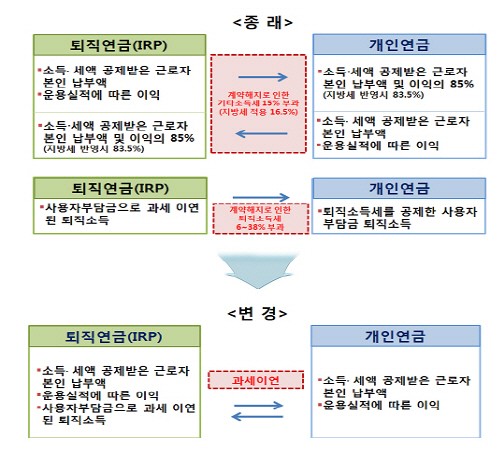
Combining pension savings and IRP contributions, employees can receive tax deduction benefits of up to 9 million won annually, which has generated significant interest among workers. Employees with a total annual income of 55 million won or less are subject to a 16.5% deduction rate, allowing them to receive a substantial tax refund of up to 1,485,000 won. Even for those with higher incomes, a 13.2% deduction rate applies, providing a refund benefit of up to 1,188,000 won, making it an excellent wealth management tool for employees. For example, an employee who consistently contributes a fixed amount monthly to reach the 9 million won limit by year-end can feel like they are receiving a much-needed bonus in an era where “everything goes up except salaries.” Various tax-related webinars hosted by financial institutions also cite maximizing these tax-saving accounts as the top wealth management tip for the end of the year. Increasing contributions to this account is far more advantageous for tax savings than saving the cost of your daily morning coffee at your regular cafe.
You can enjoy tax deduction benefits of up to 9 million won when combined with pension savings.
3. Default Options and Asset Management Methods
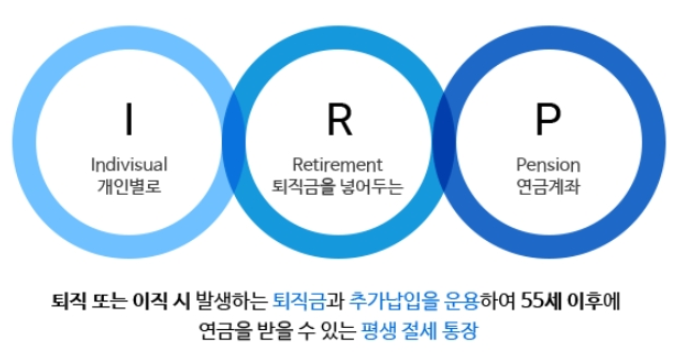
The default option system, where funds are automatically invested in pre-designated products if the subscriber does not actively select or manage investments, has become established, making return management much easier. In the past, many busy employees would deposit money into their accounts and leave it untouched, resulting in only low interest rates comparable to savings accounts. Now, if no management instructions are given for a certain period, financial institutions automatically manage the assets in funds or portfolios that match the subscriber’s profile, which is a great help for passive investors. Through the Integrated Pension Portal, you can easily compare the long-term returns and various fee costs of your subscribed products, enabling transparent asset management. Appropriately allocating assets according to your investment style, from stable principal-guaranteed products to performance-linked funds, is the key to increasing long-term returns. Observing senior colleagues who manage their assets well, you can see that they do not just put everything into savings but regularly review their portfolios and carefully monitor their returns.
Utilizing default options allows even neglected funds to be managed efficiently.
4. Cautions and Penalties for Early Termination
Just because you have enjoyed substantial tax deduction benefits does not mean you should rashly terminate the account early if you need urgent cash; doing so could result in a massive tax bill. A 16.5% miscellaneous income tax is immediately levied on the tax deductions received and the investment returns, which can lead to a situation where you gain little but lose much. Unless it is for legally defined unavoidable reasons such as bankruptcy, natural disasters, or death, it is beneficial to avoid termination. If you absolutely need a lump sum, it is wiser to carefully consider withdrawal conditions allowed by law, such as home purchases or long-term care, rather than terminating the entire account. One of my colleagues had a painful memory of terminating his account to urgently buy a new car, only to cough up a large amount in taxes and let out a deep sigh. Overcoming immediate temptations and consistently maintaining the account until the pension receipt age of 55 is ultimately the winning wealth management strategy.
Early termination can result in a heavy tax burden, so it is important to maintain the account until the end.
5. Linked Utilization with ISA Maturity Funds
Transferring funds from a matured Individual Savings Account (ISA) to an IRP provides additional tax deduction benefits, making it a highly popular strategy among savvy investors. If you have accumulated a lump sum in your ISA account over three years while enjoying tax-exempt benefits, transferring it directly to a pension account immediately after maturity allows you to enjoy a double benefit. In this case, 10% of the transferred amount (up to a limit of 3 million won) is additionally included in the tax deduction base, maximizing the tax-saving effect. If you build your initial capital using an ISA from the beginning of your career and use this method upon maturity, you can grow your retirement assets much faster than others. This linked approach is so popular that bank and securities firm employees actively recommend it to customers visiting their branches. By organically linking the advantages of both accounts, you can prepare for the future securely without worrying about taxes every year.
Transferring ISA maturity funds to a pension account allows for additional deductions and tax savings.
6. Changing Tax Laws and Outlook for 2026
With the upcoming tax law amendments for next year, the financial market is becoming increasingly active in securing tax-saving accounts, and related webinars and seminars are being held successfully. As the government and financial authorities continue to push policies to activate private pensions for old-age security, the benefits and importance of these accounts are expected to grow further. While there is more information that individuals need to manage themselves, utilizing platforms like the Integrated Pension Portal allows anyone to easily grasp their contribution status. Open your smartphone app right now to check how much of this year’s tax deduction limit you have filled and consider making additional contributions for the shortfall. Small interests and actions will accumulate to become a sturdy pillar that enables a comfortable life at retirement. Starting today, let’s become wise employees who slightly increase their automatic transfer amounts on payday to catch both tax savings and retirement preparation.
Consistently contributing and managing your account in line with changing tax laws is the key to success.
Frequently Asked Questions
=