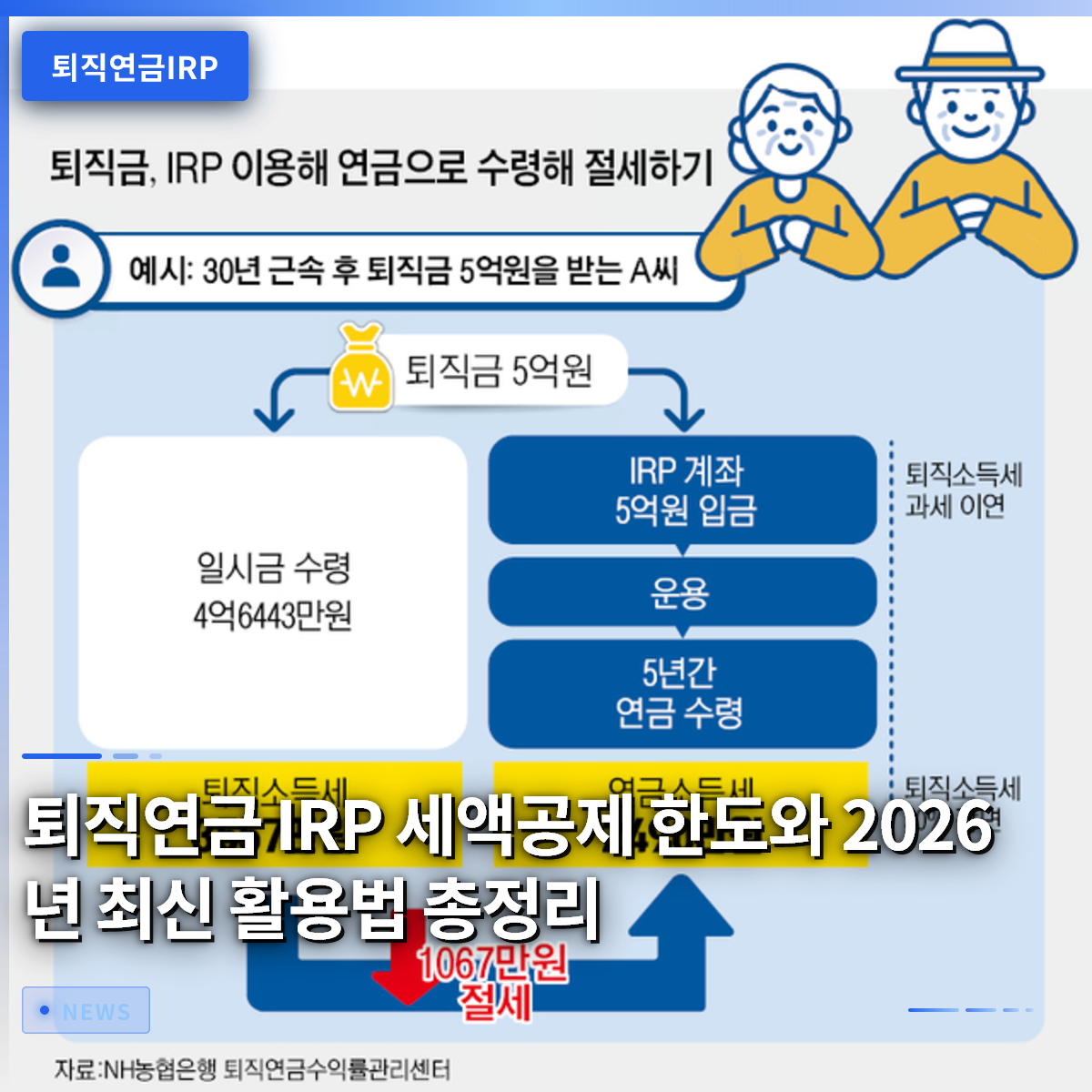
The IRP (Individual Retirement Pension) account is an essential financial product for employees, offering tax deductions on annual contributions of up to 9 million KRW. For employees in their 40s and 50s preparing for retirement, it is the most reliable way to secure both tax benefits and retirement funds. While it was once viewed merely as a place to store severance pay, it has evolved into a versatile account capable of holding a wide variety of investment products. Notably, starting this year, you can directly purchase 10-year and 20-year government bonds through Defined Contribution (DC) retirement pensions and IRPs. In this article, we will explore specific strategies for saving on taxes and growing your retirement assets using an IRP account.
=
IRP Retirement Pension: Tax Deduction Limits and Latest 2026 Usage Guide
1. The Power of the 9 Million KRW Annual Tax Deduction

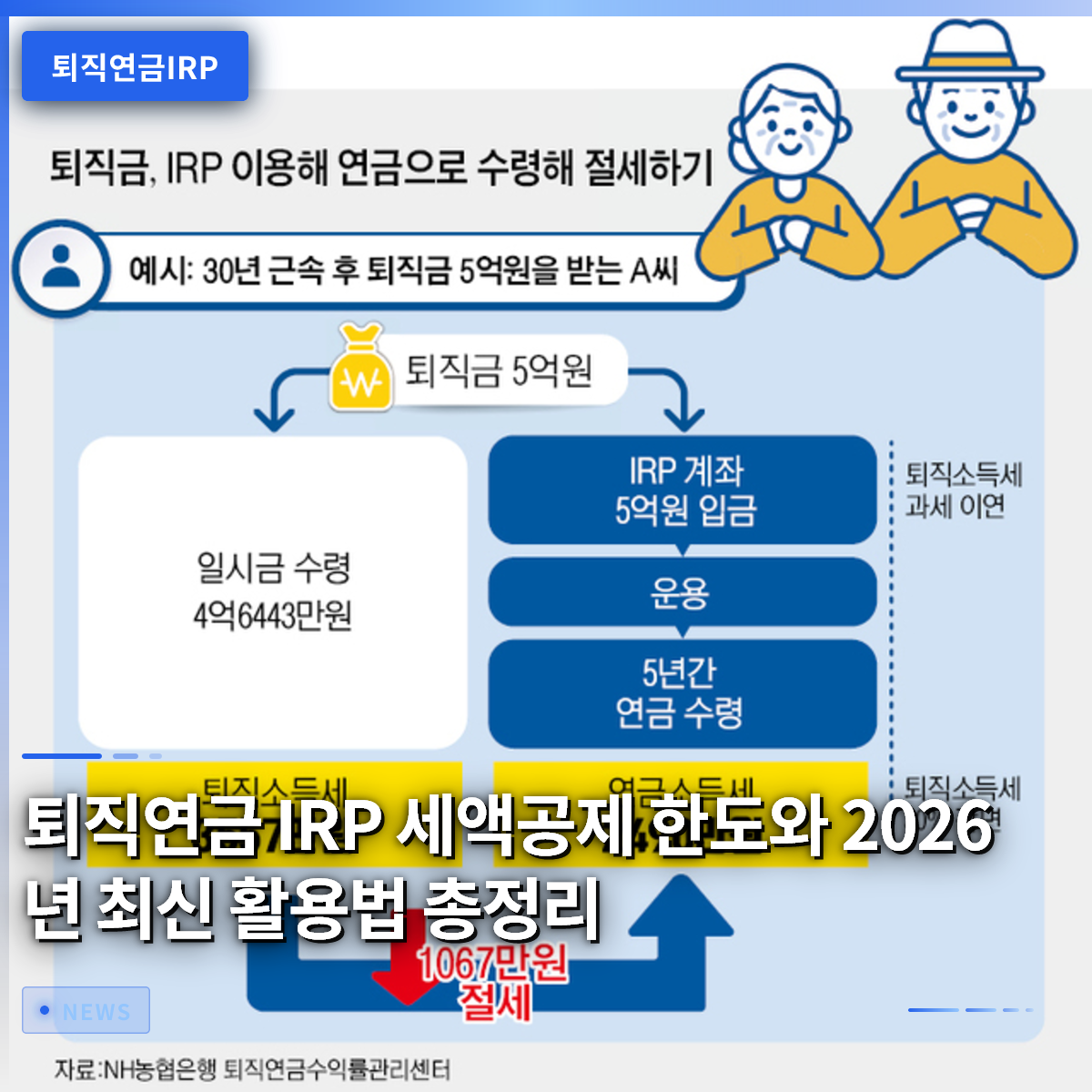
Mr. Kim, an office worker, used to dread the year-end tax settlement season, fearing a massive tax bill. This year, he decided to enroll in both a pension savings plan and an IRP simultaneously. By contributing 6 million KRW to pension savings and an additional 3 million KRW to his IRP, he can exactly meet the combined limit of 9 million KRW. Employees with a total annual salary of 55 million KRW or less can benefit from a tax deduction rate of up to 16.5%, resulting in a maximum refund of 1.485 million KRW. Even employees earning more than 55 million KRW can receive a significant refund with a 13.2% deduction rate. This approach effectively reduces annual taxes while simultaneously forcing savings for retirement, providing a two-for-one benefit.
Many employees claim they cannot afford to save due to low salaries, but this amount is easily achievable with slight adjustments to spending habits. By cutting unnecessary subscription fees or dining out expenses and setting up an automatic transfer of just 250,000 KRW per month to an IRP account, you can easily accumulate 3 million KRW in a year. This accumulated money grows through compound interest while enjoying tax-deferred benefits until retirement. Since the money that would have gone to taxes remains in your account to be reinvested, your asset growth accelerates significantly over time.
By combining pension savings and IRP contributions to reach the annual limit of 9 million KRW, you can enjoy a tax deduction of up to 16.5%.
2. The 30% Safe Asset Rule and Expanded Investment Options
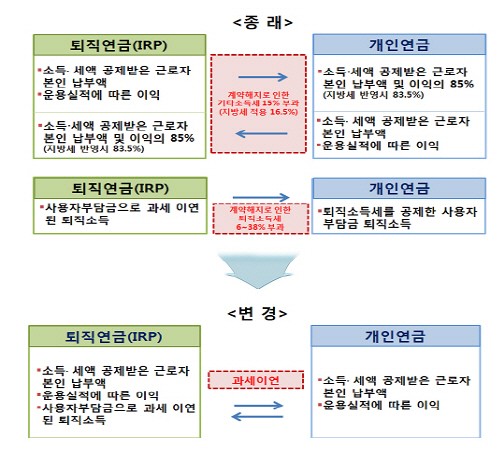
Mr. Park, a 50-year-old executive nearing retirement, often struggled with the desire to increase his equity allocation due to retirement pension regulations. Due to the system’s focus on protecting retirement assets, equity investments were strictly limited to 70% of the total accumulated funds. However, he learned that by strategically utilizing bond-mixed products, he could effectively increase his actual equity exposure beyond the risky asset limit. By leveraging the mandatory 30% safe asset allocation, it is possible to balance both stability and profitability in the overall portfolio.
Recently, regulatory improvements have allowed the purchase of 10-year and 20-year individual investor government bonds within IRP accounts, significantly broadening investment choices. For example, the 20-year government bonds issued in September this year are emerging as an excellent alternative for long-term investors, offering attractive coupon rates plus additional spreads. Safe assets like government bonds serve as a shield for the portfolio when the stock market is volatile, reducing overall fluctuation. Instead of pouring all retirement assets into risky stocks, mixing them with government bonds to aim for long-term compound interest is a wiser investment strategy.
While adhering to the 30% mandatory safe asset rule, you can maximize portfolio stability by utilizing government bonds or mixed products.
3. Proper Understanding of Early Withdrawal and Secured Loans
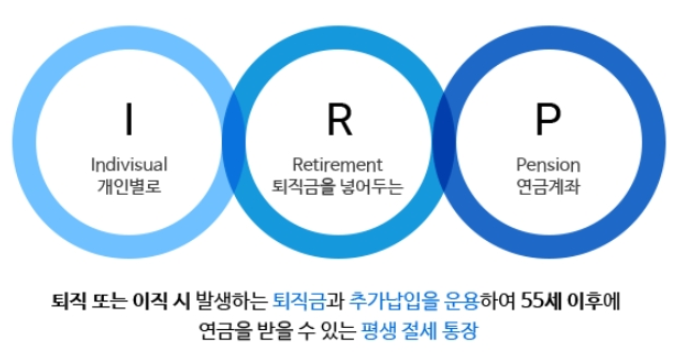
Mr. Lee, a department head, found himself in a serious dilemma when he suddenly needed a large sum of money, wondering if he should close his retirement pension account. He later learned that early withdrawal from an IRP account is strictly restricted, and unauthorized closure requires repaying all previously received tax benefits. Withdrawals are only exceptionally permitted under very strict legal grounds, such as purchasing a home, paying a deposit for a rental, bankruptcy declaration, or a non-homeowner purchasing a home in their own name. Therefore, it is wise to seek alternative funding sources rather than closing the account, as unauthorized closure can result in a significant tax penalty.
Fortunately, it is possible to secure a loan from a financial institution at a low interest rate by pledging up to 50% of the accumulated funds in the IRP account. This allows you to access immediate cash while keeping the pension assets intact, which is advantageous for maintaining tax benefits. Although there is the burden of loan interest, it is a much wiser choice than closing the account, losing the principal, and facing tax penalties. It is essential to develop the habit of strictly separating general savings accounts for emergencies from pension account funds.
Since unauthorized withdrawal from an IRP incurs significant tax penalties, you should prioritize secured loans unless the withdrawal meets legal requirements.
4. Timing of Pension Receipt and Low-Rate Tax Benefits
Mr. Choi, who recently reached mandatory retirement age, wanted to receive his severance pay as a lump sum to buy a new car immediately and sought advice from acquaintances. However, experts unanimously advised against this, stating that receiving a lump sum requires paying the full severance income tax incurred during the previous employment, resulting in a huge loss. By transferring the received severance pay to an IRP account and receiving it as a pension, you can save significantly on taxes. When received as pension income, you can receive a tax reduction of 30% to a maximum of 40% on the original severance income tax, providing an excellent tax-saving effect.
Moreover, if the pension receipt period exceeds 10 years, a low tax rate of only 3.3% to 5.5% is applied, virtually eliminating the tax burden. This creates a steady monthly cash flow during the income gap after retirement, significantly improving the quality of life in old age. Spending a large sum at once can quickly deplete funds, so receiving it in installments as a pension is far more beneficial for financial stability. By reducing taxes and extending the receipt period, you can secure a stable retirement income for life.
By depositing severance pay into an IRP and receiving it as a pension, you can benefit from low-rate taxation and dramatically reduce your tax burden.
5. Pension Portfolio Strategy Starting in Your 40s
Mr. Jeong, a 40-year-old employee who thought retirement was still far away, began to feel a sense of crisis about his lack of preparation. Experts advise that the most important step for those in their 40s is to actively combine personal pensions and IRPs and develop the habit of consistent annual contributions. The standard approach is to build assets aggressively with Exchange-Traded Funds (ETFs) while young and gradually increase the proportion of safe assets as retirement approaches. Setting up automatic monthly transfers allows you to consistently accumulate stocks at favorable prices without worrying about market fluctuations.
Retirement assets are not built overnight but are the result of long-term compound interest and consistent contributions. Trying to adjust equity allocations all at once in your 50s often means missing the optimal timing and being at the mercy of market conditions. You should immediately check your mobile banking app to see how much of your pension contribution limit remains and fill in the shortfall. Small actions today can completely change your quality of life after retirement, so starting now is the best time.
To ensure a comfortable retirement, you should systematically build your pension portfolio using automatic transfers and compound interest starting in your 40s.
6. Final Advice for a Successful Retirement
The IRP retirement pension is a precious asset that serves as the final safety net for our lives, going beyond a simple tax-saving product. There are few tools that can simultaneously offer tax benefits and stable investment opportunities as you face the wave of retirement. Imagine feeling proud of your year-end tax refund and receiving a steady pension monthly in your old age, similar to receiving rent. Based on what you have learned today, take the small step of selecting products that match your investment style and reviewing your account. By paying attention to government policy changes and trends in various financial products, anyone can secure a solid and enviable retirement. Start now by checking your IRP account status through a financial institution’s app and making a definitive investment for your future.
The IRP account is the most reliable shield for your retirement, so you should actively manage and utilize it starting now.
Frequently Asked Questions
=