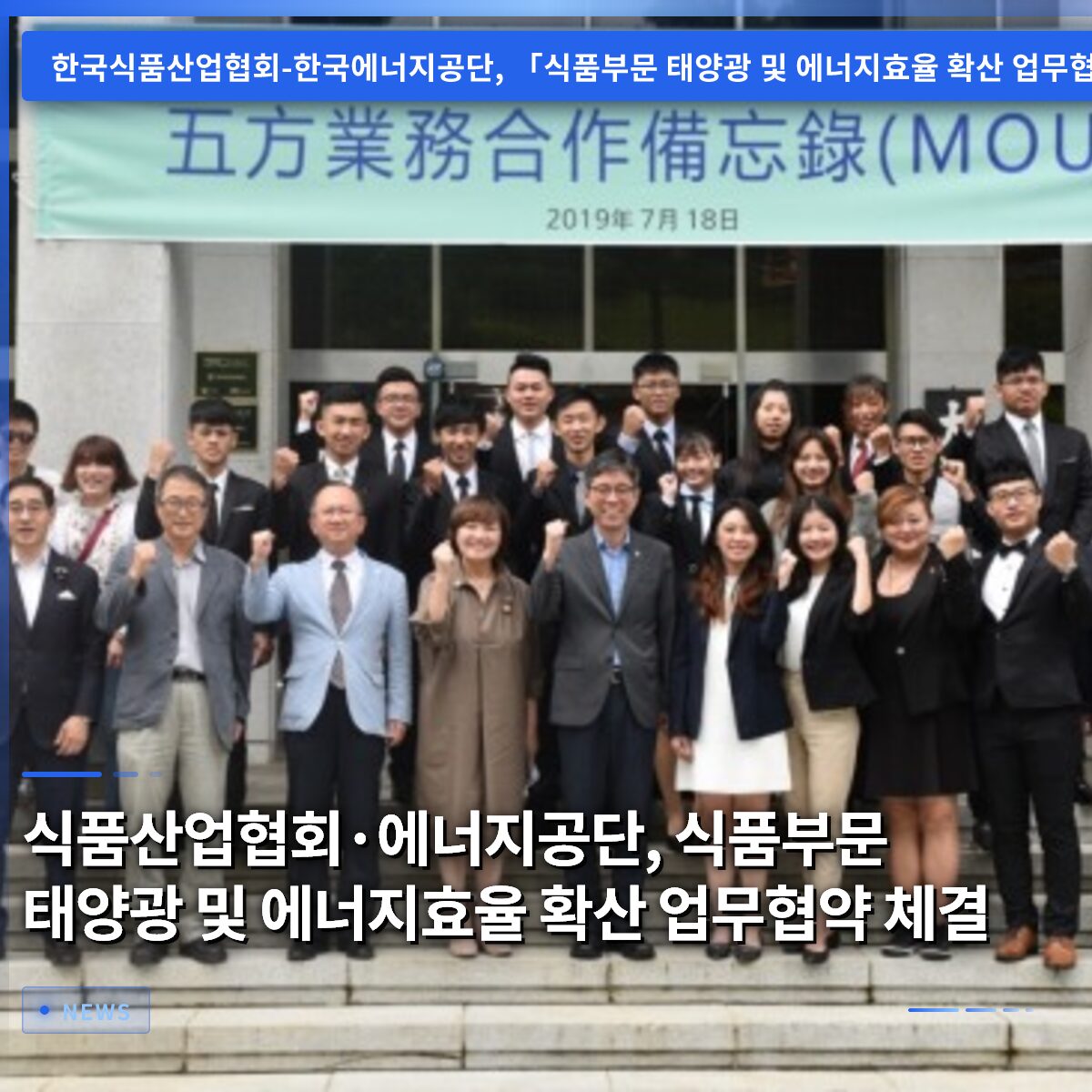
A solid foundation has been laid for domestic food companies to alleviate the burden of soaring energy costs and effectively respond to the era of carbon neutrality. On September 11, the Korea Food Industry Association signed a Memorandum of Understanding (MOU) with the Korea Energy Agency to promote solar power and energy efficiency in the food sector. This initiative launches practical support measures to resolve the difficulties companies face amid strengthening global environmental regulations and trade barriers. This collaboration goes beyond a mere declaration, focusing on enhancing tangible benefits for businesses through on-site tailored facility improvements and the sharing of policy information. Specifically, multifaceted solutions are planned to alleviate the concerns of food manufacturing plants, which are major electricity consumers. Let us examine the specific contents of the agreement and the expected effects to see how the domestic food industry will build eco-friendly competitiveness.
=
Korea Food Industry Association and Korea Energy Agency Sign MOU to Promote Solar Power and Energy Efficiency in the Food Sector
1. Background and Purpose of the Agreement
In recent years, global calls for environmental protection and climate change response have grown louder, increasing the burden on our companies. In particular, the food manufacturing and processing stages consume massive amounts of electricity and energy, making cost reduction and eco-friendly management an urgent task that can no longer be postponed. In this context, the Korea Food Industry Association and the Korea Energy Agency have joined forces to establish a dedicated support system for the food sector. This agreement aims to expand the adoption of solar power generation in frontline factories and maximize the efficiency of aging equipment.
By doing so, it helps individual companies more easily achieve greenhouse gas reduction targets that were previously too burdensome to handle alone. Consequently, this is expected to become a key driver for domestic food manufacturers to meet environmental standards on the global stage and enhance their export competitiveness. It is anticipated that many companies will be able to seek management stability once these meticulous support measures, reflecting on-site voices, are fully implemented.
The two institutions have joined hands to address global environmental regulations and alleviate energy costs.
2. Key Areas of Cooperation and Action Plan
Under the newly signed MOU, the two institutions plan to unfold effective support programs for food sector factories from multiple angles. The most notable aspect is comprehensive implementation support for expanding the adoption of solar power facilities and improving energy efficiency within factories.
Additionally, systematic guidance and promotion will be provided to ensure companies do not miss information on rapidly changing government policies and various support programs. To grasp the actual situation on the ground, they have agreed to thoroughly investigate and share data on energy usage and climate change response status in food factories. In this process, an organic cooperation system will be activated where the Association identifies specific needs among member companies and the Agency links them with specialized policies and systems.
Practical support programs, from solar adoption to efficiency improvements and status surveys, will be promoted organically.
3. Role Division Between the Association and the Agency
To ensure the successful execution of the project, the Korea Food Industry Association and the Korea Energy Agency have agreed to perform a close division of roles, leveraging their respective expertise. The Association will take on the central role of meticulously assessing the greenhouse gas reduction status and solar installation needs of member companies at the frontline.
Furthermore, the Association will actively guide member companies about useful support programs and identify companies that wish to participate. Meanwhile, the Agency will generously provide the Association with the latest policy and system information, as well as details on various support programs, based on its specialized knowledge. It is also a key duty of the Agency to collect grievances and opinions faced by food companies in the field and actively reflect them in the actual support policies and project execution processes.
A cooperative structure has been established where the Association identifies on-site needs and the Agency provides specialized policies and systems.
4. Expected Effects and Significance for the Food Industry
Park Jin-sun, President of the Korea Food Industry Association, emphasized that recent intense global environmental demands and soaring energy costs place a heavy burden on business management. He explained that this agreement will provide practical help to member companies, serving as an opportunity to more easily utilize solar power and efficiency improvement projects.
In fact, with many manufacturing plants suffering from the burden of electricity bills, this support measure is expected to play a role like rain in a drought. It lays the foundation for individual companies to improve their internal structure to keep pace with the massive trend of carbon neutrality. With solid, on-site-centric support backing them, the overall response capabilities of our companies are expected to become even more robust.
It can lower soaring energy costs and significantly enhance on-site carbon neutrality response capabilities.
5. Strengthening Export Competitiveness and Future Outlook
For the domestic food industry to demonstrate its strength in the global market, establishing eco-friendly production processes has become an essential requirement. This is because major export destination countries are rapidly introducing strict environmental standards and carbon emission regulations for imported goods. The cooperation system established this time will serve as a strong weapon for our companies to wisely overcome these trade barriers.
Reducing factory energy consumption and actively utilizing eco-friendly energy will significantly contribute to improving corporate profitability in the long run. As more manufacturing sites install solar facilities and high-efficiency systems become established, the foundation for sustainable growth will be laid. This change, created by the trinity of the government, the Association, and specialized public institutions, will further elevate the status of K-Food.
It breaks through strict global environmental regulations and lays the foundation for sustainable K-Food exports.
6. Recommendations for Readers on Future Response
If you are a manager or practitioner in food manufacturing or related industries, it is necessary to keep a close eye on the progress of this support program. It is important to check the energy usage status of your company’s factory and grasp the various support benefits provided by the government in advance.
It is required to frequently check announcements from the Association and actively apply if there is a need for facility improvements. This is a prime opportunity to catch two rabbits at once: reducing energy costs and building a good image as an eco-friendly company. Please pay attention to the upcoming specific support program announcements and actively participate to elevate your company’s competitiveness to the next level.
Corporate practitioners should monitor information on related support programs and actively formulate participation strategies.
Frequently Asked Questions
=