The Ministry of SMEs and Startups has announced that it is actively soliciting candidate projects for new Regulatory-Free Zones (RFZs) to be designated in 2027. This call includes Global Innovation RFZs and Metropolitan-Linked RFZs, targeting local governments. This open call is a crucial opportunity to inject vitality into regional economies and help local governments with innovative ideas launch groundbreaking projects. It is expected that various projects, which have previously been stalled by new regulations, will finally take off through this zone designation. For instance, unlike in the past when new technologies developed in small local research institutes were halted by regulatory barriers, they can now freely undergo demonstration processes within the zones. Attention is already focused on which regions and innovative projects will submit their applications and emerge from the fierce competition to be selected. In this article, we will carefully examine the specific scale of this candidate project solicitation, the characteristics of each type, and the key items local governments need to prepare.
=
Ministry of SMEs and Startups Launches Large-Scale Call for 11 Candidate Projects for 2027 Regulatory-Free Zones
1. Overview of the Candidate Project Solicitation for Regulatory-Free Zones
This candidate project solicitation for Regulatory-Free Zones, driven by the Ministry of SMEs and Startups, is a significant policy move aimed at driving innovative growth in every corner of South Korea. Local governments across the country can apply to this call by identifying new industries and technologies that perfectly match their regional characteristics. Because bold regulatory relaxation benefits, which were previously unimaginable, are provided, the enthusiasm for participation among local governments eager for regional economic revitalization is very high. The RFZ Policy Division, RFZ Operation Division, and RFZ Support Division of the Ministry of SMEs and Startups are collaborating to oversee this solicitation. Every year, numerous local governments challenge this grand stage to create jobs for local residents and discover future growth engines. The candidate projects selected this time will lay the foundation for final zone designation through rigorous verification by experts and on-site evaluations, going beyond simple document reviews. This creates an environment where hidden regional technologies can freely operate within the framework of laws and regulations. This solicitation aims to select approximately 11 high-value projects, requiring customized development strategies that highlight the unique characteristics of each region. It is a representative example of a cooperative model where regions lead and the government supports, moving away from uniform, central-government-led support. Local government officials are currently working day and night, collaborating with local enterprises to prepare perfect proposals. These efforts contribute significantly to achieving balanced development across South Korea and serving as a catalyst to disperse infrastructure concentrated in the metropolitan area to the regions.
The Ministry of SMEs and Startups has officially launched a solicitation for approximately 11 new Regulatory-Free Zone candidate projects to foster regional new industries.
2. Unprecedented Solicitation Scale of Approximately 11 Projects
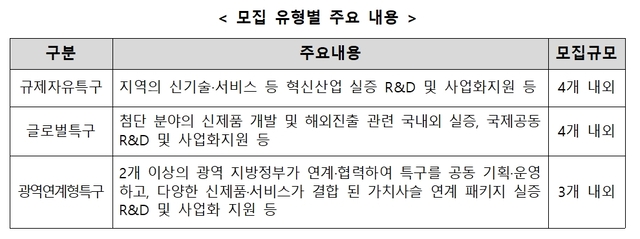
This new designation solicitation plans to select approximately 11 projects, categorized into General RFZs, Global Innovation RFZs, and Metropolitan-Linked RFZs. Specifically, approximately four slots are allocated for General RFZs and Global Innovation RFZs, respectively, while approximately three slots are configured for Metropolitan-Linked RFZs. General RFZs play the role of breaking through existing rigid regulations based on region-led new technologies and innovative services. Global Innovation RFZs focus on cultivating projects that possess innovative technological capabilities and global scalability, capable of competing not just in South Korea but on the world stage. Metropolitan-Linked RFZs are a wise and cooperative model where two or more local governments join hands to jointly promote projects, maximizing synergy effects. Since various customized tracks are prepared, the optimal choice is possible according to the scale and capacity of each region. For example, if two adjacent cities wish to jointly research advanced mobility technology, they can efficiently concentrate budget and personnel through the Metropolitan-Linked track. These diverse support methods greatly contribute to creating a healthy ecosystem where local governments compete with each other while also cooperating at times. Although fierce competition is expected given the solicitation scale of approximately 11 projects, the ripple effects and support benefits upon selection are beyond imagination. The government plans to provide not only regulatory exemptions but also substantial R&D funding and infrastructure construction costs necessary for demonstrations through this solicitation. The innovative energy sleeping in every corner of South Korea is ready to surge up like a massive tornado through these 11 slots.
Approximately 11 customized candidate projects, including 4 General, 4 Global, and 3 Metropolitan-Linked, will be selected through fierce competition.
3. Key Application Strategies Local Governments Should Note
For local governments challenging this solicitation, the most important task is to perfectly prove the specificity and feasibility of their regional industries. Rather than proposals packaged with merely impressive words, the outcome is determined by how organically local SMEs, universities, and research institutes can unite. Projects that are armchair theorizing and do not reflect voices from the field are structurally bound to be filtered out during the rigorous review process. Therefore, local government officials must directly meet with local business owners to identify exactly which regulations are the biggest obstacles and find solutions. For example, if a region specializes in the bio-industry, it must confidently request the relaxation of difficult licensing and permitting regulations encountered during the prototype production process. Additionally, since the sustainability of the project and future job creation effects are heavily evaluated in this solicitation, meticulous preliminary preparation is absolutely necessary. Experts repeatedly emphasize the strong will of local government heads and the expertise of the practical execution team for successful candidate project selection. One should not try to solve everything alone but actively embrace the sharp insights of private enterprises and the academic research outcomes of universities. Only proposals thoroughly armed in this way can capture the hearts of the reviewers and confidently make the list of 11 candidate projects. This is why numerous local governments across the country are currently holding all-night meetings to refine their own winning strategies.
Local governments must plan feasible and innovative projects with clear regulatory breakthrough effects, based on close collaboration with local enterprises and research institutes.
4. Changes in Regional Economies Brought by Regulatory-Free Zones
Being designated as a Regulatory-Free Zone means not just postponing a few regulations, but a massive transformation that completely changes the fundamental nature of the regional economy. It breaks the vicious cycle where talent and capital were concentrated only in the metropolitan area, creating the soil for world-class unicorn companies to be born in the regions as well. In fact, some regions selected in previous cohorts have achieved dazzling economic growth by attracting numerous innovative companies after their zone designation. A robust ecosystem is gradually being built where young people can pursue their dreams in their hometowns without having to leave for jobs. For example, a certain local city, after being designated as a hydrogen energy zone, is now brimming with vitality as numerous related companies have set up shop. The 11 candidate projects newly solicited this time are also undergoing rigorous preparation to become the protagonists writing the second and third success stories. Residents will enjoy the privilege of directly witnessing cutting-edge technology being demonstrated in their area and experiencing the future society before others. This synergy created by the combined efforts of local and central governments serves as a spark to rekindle the economic growth momentum of the entire nation. This is why we can all look forward to the dazzling progress of South Korean local cities that boldly break free from the old shackles of regulation and move forward.
Zone designation is a magical opportunity to resolve metropolitan concentration and attract innovative companies and youth jobs to the regions.
5. Upcoming Schedule and Thorough Preparation Process
In line with the schedule for this solicitation hosted by the Ministry of SMEs and Startups, local governments nationwide are making every effort to ensure no mistakes are made until the final submission deadline. Since the solicitation began, local governments have been carefully checking the detailed contents of the guidelines through close communication with relevant ministries and refining their documents. A long process of sharp verification and feedback from numerous experts awaits until the final candidate projects are confirmed through preliminary and main reviews. Local governments must quickly supplement any deficiencies pointed out during this process and maximize the completeness of their projects to taste the joy of final victory. Relevant ministries are also shining their eyes to identify truly high-value projects that can contribute to the national economy through fair and transparent reviews. Thorough preparation serves as a shield not only to increase the probability of selection but also to prevent potential trial-and-error issues that may arise when the zone is actually operated. As the document submission deadline approaches, the tension among local government staff reaches its peak, but so does the expectation for visible results. All citizens are cheering for all local governments participating in this solicitation to surpass their limits and set a new milestone for South Korea’s innovative growth. Full attention is focused on how the regional economic landscape of South Korea will be restructured in the coming years, depending on the final selection results to be announced.
Once final candidate projects are confirmed through thorough preliminary preparation and a fair review process, the clock for regional innovation will start ticking rapidly.
6. Recommendations and Outlook for Successful Zone Designation
_231107_2.jpg "6. Recommendations and Outlook for Successful Zone Designation")
The solicitation for candidate projects for Regulatory-Free Zones, Global Zones, and Metropolitan-Linked Zones is a very critical watershed for South Korea to leap to the next stage. To achieve successful results, the voices of private enterprises and local residents must be deeply reflected, going beyond one-way communication between local and central governments. We need real innovation that practically benefits people’s lives and eases the burden on enterprises, rather than showy projects just to secure budget. The government must continue to serve as a reliable fence, providing continuous monitoring and generous financial support to ensure that companies within the zones possess global competitiveness. Readers, if you pay attention to what innovative projects your local area is challenging in this solicitation, it will greatly contribute to regional economic development. Let us all offer our unconditional applause and warm encouragement toward the dynamic future and dazzling balanced regional development of South Korea that lies ahead.
Only when the public and private sectors unite to achieve substantial regulatory reform will South Korea’s regional economy truly possess global competitiveness.
Frequently Asked Questions
=