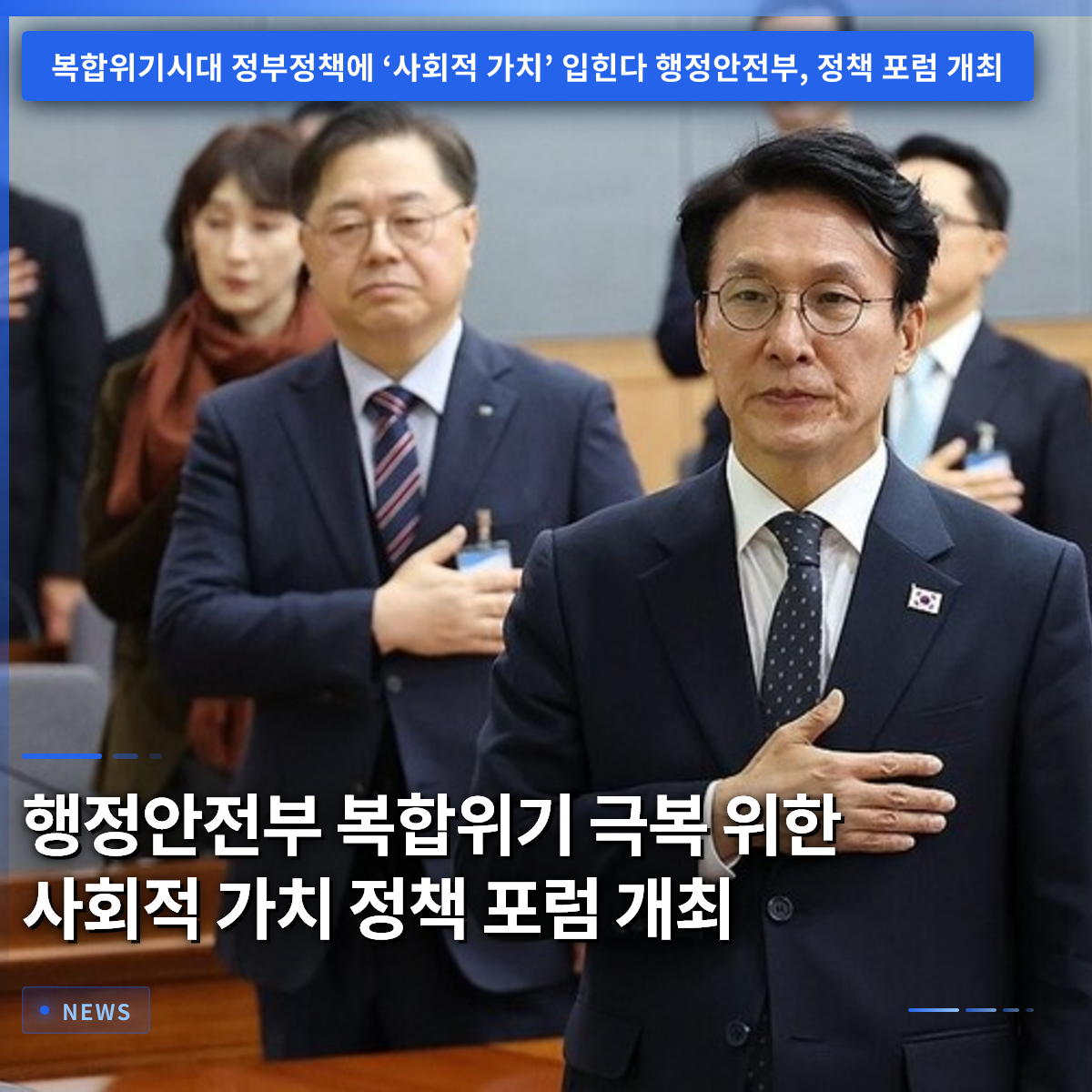
The Ministry of the Interior and Safety (MIS) held a policy forum to actively incorporate social values into government policies across the board, aiming to overcome the various national challenges and complex crises that have recently intensified. This event was organized with the purpose of firmly rooting public interest values—such as symbiosis with local communities, environmental protection, and respect for human rights—within the administrative framework, moving beyond the traditional approach that pursued only economic growth. The numerous disasters and social conflicts we experience in our daily lives have reached a level where they can no longer be resolved by piecemeal prescriptions, and consequently, the role of the government is being called for a fundamental change. For example, while administration in the past was dominated by physical achievements such as widening roads and building structures, we now need a multidimensional administration that carefully examines whether vulnerable groups are being marginalized and whether solidarity among neighbors is breaking down during these processes. Held against this backdrop, this forum holds great significance as administrative experts and field practitioners from across the country gathered to pool their wisdom and seek practical alternatives. We will carefully examine how these public values will be integrated into the various policies the government plans to pursue in the future, and how they will change our lives.
=
Ministry of the Interior and Safety Holds Policy Forum on Social Values to Overcome Complex Crises
1. The Arrival of the Era of Complex Crises and New Administrative Demands
The crises facing modern society are taking on a form entirely different from the past, violently shaking the foundations of our lives. Natural disasters caused by climate change have now far exceeded predictable ranges, and local communities are gradually losing their vitality due to low birth rates and an aging population. As economic uncertainty grows, it is the harsh reality of today that more people are struggling to maintain even a normal daily life. Attempting to solve these complex and massive challenges with outdated administrative criteria is a reckless endeavor.
In the past, efficiency-focused administration, where the state led the rapid execution of budgets and expansion of facilities, was the mainstream. However, now direction is more important than speed, and the metric of how many people were cared for has become more important than how much profit was made. Listening to voices from the field, residents are no longer impressed by cold numerical achievements; they strictly evaluate whether their quality of life has actually improved. If government policies fail to change in line with these demands of the times, trust with the public will inevitably collapse in an instant.
The forum hosted by the Ministry of the Interior and Safety started from this sense of urgency and continued deep discussions. It aimed to clearly identify where the compass of administration should point in times of crisis and to find the answer on the solid foundation of social values. We now stand at a critical crossroads where we must shake up the paradigm of national governance from the root and establish new standards.
In the era of complex crises, it is urgent to shift from the existing efficiency-focused administration to a paradigm that prioritizes the public’s quality of life and public interest.
2. What Are Social Values and Why Are They Needed in Government Policy?
The concept of social values may seem somewhat abstract at first glance, but it is a core pillar supporting every specific corner of our lives. It is a concept that encompasses all tangible and intangible values that realize the public interest and enhance the sustainability of the community. Specifically, this includes job creation, symbiotic cooperation, environmental conservation, safety assurance, and consideration for the socially vulnerable, which is like the oxygen that allows our society to breathe healthily.
If these values are absent from government policy, the state will merely move like a cold and insensitive giant machine. For example, when building a large-scale public facility in a certain area, if nearby residents suffer from noise and environmental pollution, or if specific groups are excluded in the process, it cannot be called a true success. Only when the values of public interest and symbiosis are fully permeated into every moment of policy formulation and execution can we truly move toward a welfare state.
At the recently held forum, in-depth discussions took place on how these values can be specifically reflected in government budget execution and legislation. Participants unanimously stated that social values should not remain merely idealistic slogans but must be used as direct indicators in the performance evaluation and measurement of actual civil servants. Only when efforts to change the essence of administration continue in this way will citizens begin to feel true protection and respect from the state.
Social values are a core pillar for realizing public interest and symbiosis, and they must now be established as essential indicators in the process of formulating and executing government policies.
3. Field-Centered Discussions and Sharp Diagnoses by Experts
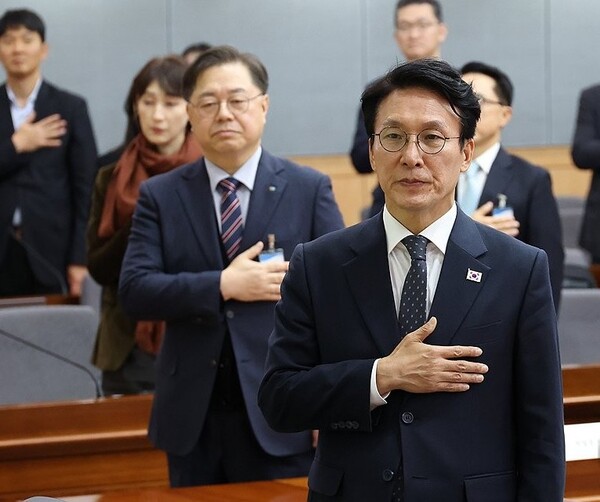
This policy forum did not end as a mere gathering of bureaucrats; field experts from across the country and representatives of civil society participated in large numbers, engaging in heated discussions. Experts from various fields coldly analyzed the various policies the government has pursued over the past few years, pouring out both the successes and the shortcomings without reservation. In particular, to reduce the gap between theory and the field, the difficulties felt by frontline civil servants and the inconveniences experienced by citizens were vividly shared.
One discussant pointed out the budget shortage problem local governments face in inducing voluntary participation from residents and urged for effective support measures. Another expressed concern that policies prioritizing environment and safety could inadvertently make administrative procedures overly complex and slow down progress. However, attendees agreed that these side effects can be sufficiently overcome through meticulous institutional design and organic communication between ministries.
Through these roundtable discussions, the Ministry of the Interior and Safety refined specific plans to permeate social values throughout the entire process, from policy formulation to execution and post-evaluation. The outcomes of these discussions, which fully reflect voices from the field, will serve as valuable nourishment for determining the future policy direction of the South Korean government. A sincere attitude aimed at bringing about substantive change, rather than a show for appearances, deeply permeated the entire forum venue.
This forum is highly significant as field experts and citizens participated in large numbers to narrow the gap between theory and practice and derive practical administrative improvement plans.
4. The Importance of Inter-Ministerial Collaboration and Public-Private Partnerships
To successfully establish social values in government policy, the efforts of a specific ministry alone are grossly insufficient; cooperation from multiple aspects is essential. Centered on the Ministry of the Interior and Safety, each central ministry and local government must form a web-like communication network and work closely together. Furthermore, a solid partnership involving private enterprises, civil organizations, and ordinary citizens must be built, moving away from one-way, government-led administration.
Looking around us, we often witness cases where the private sector identifies and solves local community problems faster than the government. For example, welfare projects caring for the elderly living alone or symbiosis projects revitalizing local street commerce have limits with administrative power alone; they only shine when the warm hands of local residents are added. The government must faithfully perform its role as a reliable fence ensuring that such voluntary private efforts are not blocked by regulations, and as a helper that connects necessary resources to the right places at the right time.
At this forum as well, specific success cases of how the government and the private sector can join forces to create synergy were shared, receiving a great response. Participants emphasized that in the path of pursuing public interest, there is no distinction between the government and the private sector; only shared responsibility through cooperation exists. Only when this organic collaboration system spreads nationwide can we wisely navigate the fierce waves of complex crises.
The realization of social values can only be completed through close collaboration between all government ministries and civil society, not by the strength of the Ministry of the Interior and Safety alone.
5. A Concrete Blueprint for Administrative Innovation That Citizens Can Feel

No matter how grandiose the policy or how noble its justification, if it does not improve the lives of the people, it is useless. Taking this forum as an opportunity, the Ministry of the Interior and Safety is gradually drawing a concrete blueprint for administrative innovation that citizens can feel with their whole bodies in their daily lives. Citizens will no longer be passive recipients waiting for policy benefits, but will firmly stand as subjects who participate in and evaluate policies from the planning stage.
For example, small things like neighborhood residents directly participating to make dangerous roads safe, or turning abandoned lots into beautiful gardens, are all practices of administration imbued with social values. The government has promised to lay the institutional foundation and provide generous support so that the power of this grassroots democracy can be firmly rooted in administration as a whole. When government policies, which once felt distant, approach us as stories of our neighbors and our neighborhoods, citizens will send true trust.
In the future, when this direction is issued as specific work guidelines for frontline administrative agencies, the degree of change felt by citizens will be much higher. The high threshold of complex and stiff government offices will be lowered, and warm public services that smell of humanity will fill our daily lives. This forum has become an important milestone declaring to the world that the wave of such change has become an unstoppable massive current.
This policy forum presented a blueprint for substantive administrative change that citizens can directly feel in their daily lives, rather than remaining at abstract slogans.
6. The Wisdom to Turn Crisis into Opportunity and Our Tasks

For South Korea to leap to a more mature society amidst the storm of complex crises, we must not stop our current efforts but continue them steadily. This policy forum led by the Ministry of the Interior and Safety is a precious first step in that great journey, and many more practices and tasks lie ahead of us. No matter how well institutions are designed, if the people who execute them do not have sincerity toward the public interest in their hearts, we cannot achieve what we desire.
We are all not bystanders to this massive change but subjects who should look around, ponder together, and lead the way. When we empathize with the pain of our neighbors, think about the environment, and exercise the wisdom to live together, government policies will also gain stronger power. We must envision a landscape of mature democracy where the government listens more to the voices of the people, and the people trust the government’s efforts and move forward in step.
Although the world to come will be unpredictable and countless difficulties may await us, if we proceed with social values as our compass, we have nothing to fear. I sincerely hope that every moment of administration is filled with a warm gaze toward people and the public interest. The small concerns and ponderings we throw out today will gather to make South Korea a safer, more livable, and happier community.
To overcome complex crises and create a sustainable future, the government’s policy efforts and the continuous interest and participation of the people must necessarily be in harmony.
Frequently Asked Questions
=